Welcome to the definitive guide to ecommerce SEO, designed specifically for local businesses on the Sunshine Coast, in Noosa, and across Brisbane ready to turn their online store into a growth engine. As an award-winning web design agency with deep SEO marketing skills, we know that a stunning website is a fantastic start, but true success comes when a steady stream of qualified customers finds you through search. That’s where powerful, targeted SEO comes in.
Building Your Foundation for Ecommerce SEO
An award-winning web design creates an incredible first impression, but ecommerce SEO is what actually fills your digital storefront with customers ready to buy.
Think of it like building a physical shop. You could have the most beautifully designed boutique in Noosa, but if it’s hidden down an unmarked alleyway, no one will ever find it. SEO is the art of putting up massive, clear signposts on the digital highway, guiding a constant flow of traffic from Brisbane to the Sunshine Coast directly to your products.
This guide is your actionable blueprint for growth. We’ll demystify how search engines like Google decide which online stores deserve the top spots and show you how to build a solid foundation. Without this base, any other marketing efforts can crumble under their own weight.
The Core of Online Visibility
For ecommerce businesses here in Australia, especially in competitive markets like Brisbane and the Sunshine Coast, SEO isn’t just a nice-to-have; it’s the engine that drives sustainable, organic traffic. Consider this: organic search is responsible for a whopping 53% of all website visits for small and medium businesses (SMBs)—and SMBs make up 97% of all enterprises in the country.
And the game is increasingly being played on mobile. With mobile commerce exploding—where an incredible 77% of site visits and 68% of orders now come from smartphones—optimising for mobile SEO has become completely non-negotiable for reaching your local customers.
The Three Pillars of a Strong Strategy
A truly successful ecommerce SEO strategy rests on three interconnected pillars. If you neglect one, the others will weaken, so it’s crucial to approach your efforts with a balanced perspective. As a web design-first agency, we know a great-looking site is a fantastic starting point, but weaving these elements into your ecommerce website design is what drives real, lasting revenue.
A common mistake is focusing purely on aesthetics or stuffing keywords everywhere. True ecommerce growth happens when technical health, relevant content, and trusted authority work together to create a seamless experience for both search engines and shoppers.
To get this right, you need to understand the three core components. We’ve broken them down in the table below to show you how each piece fits into the puzzle.
The Three Pillars of Ecommerce SEO
| SEO Pillar | Primary Focus | Impact on Your Store |
|---|---|---|
| Technical SEO | The ‘engine room’ of your site: speed, mobile-friendliness, security, and making sure search engines can easily crawl and understand your pages. | A technically sound site gets indexed faster and ranks higher. It provides a smooth, frustration-free experience that keeps shoppers on your site. |
| On-Page SEO | Everything on your product and category pages: keyword research, compelling product descriptions, optimised images, and clear page structure. | This is how you signal relevance to Google for specific searches. Great on-page SEO helps you show up for the exact terms your customers are using. |
| Off-Page SEO | Building your store’s authority and reputation across the web, primarily through earning high-quality backlinks from other reputable websites. | Backlinks act as “votes of confidence” from other sites. The more quality votes you have, the more Google trusts you and sees you as an authority. |
As you can see, each pillar plays a vital role. Technical SEO makes sure your store is accessible, on-page SEO tells Google what you’re about, and off-page SEO proves that others trust you. When all three work in harmony, you’ve got a recipe for serious organic growth.
Mastering Technical SEO for Your Online Store
If your award-winning web design is the stunning showroom of your business, then technical SEO is the high-performance engine that gets customers in the door. It’s all the behind-the-scenes work that makes sure your online store runs smoothly, loads quickly, and is dead simple for search engines like Google to understand.
Without a rock-solid technical foundation, even the most beautiful website will struggle to get found by shoppers in Brisbane, Noosa, or anywhere else on the Sunshine Coast.
Technical optimisation is all about making it easy for search engine crawlers to access, interpret, and index your website. Think of these crawlers as digital librarians; if they can’t easily read your books (your pages), they have no way of recommending them to people searching for them. This behind-the-scenes work is absolutely critical for your entire ecommerce SEO strategy.
Prioritising Site Speed and Mobile Experience
In today’s market, speed isn’t a feature—it’s everything. A slow-loading website is one of the quickest ways to lose a potential customer. It’s not an exaggeration either; pages that load in one second have a conversion rate 2.5x higher than pages that take five seconds.
For shoppers on the go across the Sunshine Coast, a clunky mobile experience is just as damaging. Your store has to be fully responsive, giving them a seamless browsing and checkout process on any device. Google now uses mobile-first indexing, which means it primarily looks at the mobile version of your site for ranking. A poor mobile site directly hurts your visibility.
Your site’s technical health is the first handshake you offer both Google and your customers. A fast, clean, and mobile-friendly experience builds immediate trust and encourages them to stick around.
To get a handle on your site’s performance, you can use tools like Google PageSpeed Insights. For WordPress users, plugins are often the key to unlocking better performance. As our detailed review explains, caching plugins like WP Rocket can dramatically reduce load times by serving static versions of your pages, giving users that lightning-fast experience they expect.
Structuring Your Store for Success
Just like a physical store needs logical aisles and clear signage, your online store requires a clean and intuitive structure. We call this site architecture. A core part of technical SEO is designing an optimized site architecture that makes it simple for both users and search engines to navigate your inventory.
A logical structure usually looks something like this:
- Homepage: The front door to your entire store.
- Category Pages: Broad groupings of your products (e.g., “Men’s Shoes,” “Women’s Dresses”).
- Sub-Category Pages: More specific collections (e.g., “Men’s Running Shoes,” “Women’s Summer Dresses”).
- Product Pages: The individual product listings themselves.
This clear hierarchy ensures that every page is just a few clicks from the homepage, which helps spread “link equity” or authority throughout your site. A well-organised site isn’t just good for SEO; it creates a much better shopping experience, guiding your customers effortlessly from discovery to checkout.
Optimising Product Pages That Actually Convert
Once your site’s technical engine is humming along nicely, it’s time to focus on your digital shopfront: your product and category pages. These pages are where window shoppers become actual buyers, and getting them right is a blend of art and science.
Effective on-page optimisation is what transforms a simple product listing into a powerful sales tool. It’s not just about pulling in more traffic; it’s about attracting the right kind of traffic—shoppers from the Sunshine Coast to Brisbane—and giving them every reason to click “add to cart.” This means digging into keyword research, writing copy that connects, and strategically using every element on the page to win over both search engines and shoppers.
Uncovering Customer Search Intent
Before you write a single word, you need to get inside your customer’s head. What are the exact phrases they’re typing into Google when they’re ready to buy? This is what keyword research is all about—using data, not guesswork, to find those high-intent keywords that signal a desire to make a purchase.
Your goldmine is often in long-tail keywords. These are longer, more specific phrases that tend to have less competition and much higher conversion rates. For example, instead of a broad term like “organic skincare,” a far more valuable keyword for a local business would be something like “organic anti-ageing serum Brisbane.” This level of detail attracts shoppers who are much further down the buying funnel.
Crafting Compelling Content
With your keywords in hand, the next step is to weave them naturally into your page content. This is a delicate dance. You need to satisfy the search engines without your copy sounding like it was written by a robot. Great copy has to be persuasive first and optimised second.
Your on-page content breaks down into a few key areas:
- Page Titles: This is the first thing a user sees in the search results. Make it count. It should be descriptive and include your main keyword and brand name.
- Meta Descriptions: Think of this as your 160-character sales pitch. While it’s not a direct ranking factor, a killer meta description can dramatically boost your click-through rates.
- Product Descriptions: Don’t just list the manufacturer’s specs. Tell a story, focus on the benefits, and use bullet points to make key features easy to scan.
- Image Alt Text: Write clear descriptions for your images. This is crucial for visually impaired users and gives search engines another clue about your page’s content. It’s also a great spot to include relevant keywords.
Think of your product page as your best salesperson. It needs to be knowledgeable, persuasive, and trustworthy, answering every question a customer might have before they even think to ask it.
To see what a huge difference small on-page tweaks can make, let’s look at a simple before-and-after comparison.
Product Page SEO Checklist
| Page Element | Unoptimised Example | Optimised Example |
|---|---|---|
| Page Title | The Wanderer Tent | The Wanderer: 2-Person Waterproof Hiking Tent |
| URL | /product-12345/ | /tents/2-person-waterproof-hiking-tent-wanderer/ |
| H1 Heading | Tent | The Wanderer 2-Person Waterproof Hiking Tent |
| Description | Green tent. Sleeps two. | Built for Aussie adventures, The Wanderer is a lightweight, fully waterproof 2-person tent. Its quick-pitch design and durable ripstop fabric make it perfect for weekend hiking trips. |
| Image Alt Text | tent.jpg | 2-person waterproof hiking tent set up in the bush |
As you can see, the optimised examples are far more descriptive and useful for both search engines and potential customers, directly targeting what people are searching for.
The Power of Social Proof and Visuals
High-quality product images are completely non-negotiable. Your customers can’t touch or feel your products online, so your photos and videos have to do all the heavy lifting. Show your products from multiple angles, in use, and with crystal-clear detail.
Just as important are your customer reviews. For any Australian eCommerce store, social proof is a massive conversion driver. While grabbing the top spot in local search results can net you 24.4% of all clicks, it’s the reviews that often seal the deal. A staggering 88% of Aussies trust online reviews as much as a personal recommendation, and actively managing them can boost your conversions by up to 32%.
Standing Out with Structured Data
Finally, to give your product pages a real competitive edge, you need to use structured data (also known as Schema markup). This is a small snippet of code that gives Google highly specific information about your product—things like its price, availability, and average review rating.
When you implement this, Google can show “rich snippets” right there in the search results. These are the eye-catching star ratings and price details that make a listing pop off the page. This simple addition can significantly increase how many people click through to your site, drawing in more qualified buyers. We’ve seen this work wonders, just like in our award-winning web design for Forest to Fork, where clear, detailed product presentation is the key to turning casual visitors into loyal customers.
Building Authority with Content and Link Building
A stunning website might get your foot in the door, but genuine authority is what makes customers stick around and trust you. In the crowded world of eCommerce SEO, authority is the signal that tells both Google and your shoppers that you’re a credible, expert voice in your field. This is built on two powerful pillars: high-value content and high-quality backlinks.
Think of it like this: your product and category pages are for talking to people who are already inside your shop. But creating great content—like blog posts, guides, and tutorials—is like hosting a popular community event. It pulls people in from all over Brisbane and the Sunshine Coast who are interested in what you do, even if they aren’t ready to buy at that exact moment.
This content builds a relationship and establishes your expertise long before a sale ever happens, allowing you to rank for much broader search terms and capture a far bigger audience.
Creating Content That Actually Connects
The goal here isn’t just to sell; it’s to solve real problems. Your customers have questions that go way beyond your specific product list. A furniture store in Noosa, for instance, could write a brilliant article on “How to Choose the Right Dining Table for a Small Space.” A Brisbane-based skincare brand might create a practical guide on “Building a Morning Skincare Routine for Humid Climates.”
These topics hit on genuine user needs. By answering them, you provide real value, and that builds immense trust.
Google’s entire mission is to give its users the best possible answer to their question. When you consistently create content that is helpful, in-depth, and solves a user’s problem, you’re aligning your business directly with Google’s goal. You will be rewarded for it.
Here are a few content ideas that are perfect for building authority:
- Buying Guides: In-depth guides that walk customers through choosing the right product for their needs (e.g., “The Ultimate Guide to Choosing Hiking Boots for Queensland Trails”).
- How-To Articles: Simple, step-by-step tutorials showing how to use or care for your products (e.g., “How to Properly Season Your New Cast Iron Pan”).
- Inspiration Posts: Content that showcases your products in real-world settings, sparking new ideas for your customers (e.g., “5 Ways to Style Your Balcony for Summer Entertaining”).
Earning Trust Through Link Building
If your content is what you say about yourself, backlinks are what other people say about you. A backlink is simply a link from another website pointing to yours. In Google’s eyes, every high-quality backlink acts as a vote of confidence—a signal that your store is a reputable and trustworthy resource.
But here’s the catch: not all links are created equal. A link from a popular Brisbane lifestyle blog or a respected industry publication carries far more weight than a random link from an unknown, irrelevant site. The goal is always quality over quantity.
For online retailers, diving into specialized link building strategies for ecommerce sites can give you a serious edge, driving both traffic and sales.
Effective link-building tactics for eCommerce stores often include:
- Digital PR: Creating compelling stories, data, or content that news outlets and bloggers genuinely want to feature and link back to.
- Influencer Collaborations: Partnering with local Sunshine Coast or Brisbane influencers who can review your products and link to your store from their platforms.
- Supplier and Partner Links: Simply asking your suppliers or other complementary businesses you work with to link to your website.
When you combine valuable, problem-solving content with a smart strategy to earn high-quality backlinks, you build a rock-solid foundation of authority. This doesn’t just drive referral traffic; it’s one of the most critical factors for achieving and holding onto those top search engine rankings for your eCommerce store.
Your 90-Day Ecommerce SEO Action Plan
Knowing what to do is one thing; actually getting it done is another beast entirely. All the theory in the world won’t move the needle on your rankings without a clear, manageable plan. As an award-winning web design and SEO agency, we’ve seen it time and again with our clients across the Sunshine Coast and Brisbane: a structured roadmap is what turns knowledge into real, measurable results.
This 90-day plan breaks down the often overwhelming world of ecommerce SEO into simple, weekly tasks. It’s all about building momentum, creating good habits, and delivering tangible progress you can actually see and track. Think of this as your practical guide from where you are now to where your business deserves to be.
Month 1: The Foundation Phase
The first 30 days are all about getting your house in order. We’re focused on knocking over the critical technical fixes and truly understanding what your customers are searching for. Nailing this stuff is non-negotiable for any long-term success.
- Weeks 1-2: Technical Audit & Cleanup: Your first job is to run a full technical audit using tools like Google Search Console. Hunt down and fix any crawl errors, broken links, and duplicate content issues. Make sure your site has a clean XML sitemap and a correctly configured
robots.txtfile. This is your essential clean-up phase. - Weeks 3-4: Keyword Research & Mapping: Now for the fun part. Dive deep into keyword research to uncover those high-intent, money-making keywords (like “buy handcrafted leather wallet Brisbane”) and the helpful informational ones (like “how to care for a leather wallet”). Once you have them, map these primary keywords to your most important product and category pages.
Month 2: On-Page Optimisation
With your technical foundations solid and a clear keyword strategy in hand, Month 2 is all about refining your on-page elements. This is where you start telling Google exactly what your pages are about, starting with your most valuable ones first.
The 80/20 rule almost always applies here: 80% of your sales will likely come from just 20% of your products. Kick off your optimisation efforts with that top-performing 20% to see the biggest impact, fast.
Action Steps for Month 2:
- Weeks 5-6: Optimise Top Category Pages: Rewrite the page titles, meta descriptions, and H1 headings for your most important category pages, weaving in your target keywords naturally. Add 150-300 words of unique, helpful introductory copy to each one.
- Weeks 7-8: Optimise Key Product Pages: Next up, your best-selling product pages. Craft compelling, benefit-driven product descriptions that sell the experience, not just the item. Optimise all your product images with descriptive alt text and ensure your URLs are clean and keyword-rich.
Month 3: Building Authority and Content
The final month of this initial push shifts the focus from your own site to building its reputation across the web. This means creating genuinely valuable content and starting the all-important process of earning backlinks to signal your authority to search engines.
The timeline below shows how consistent effort in content and link building really compounds over time to build your brand’s authority in the market.
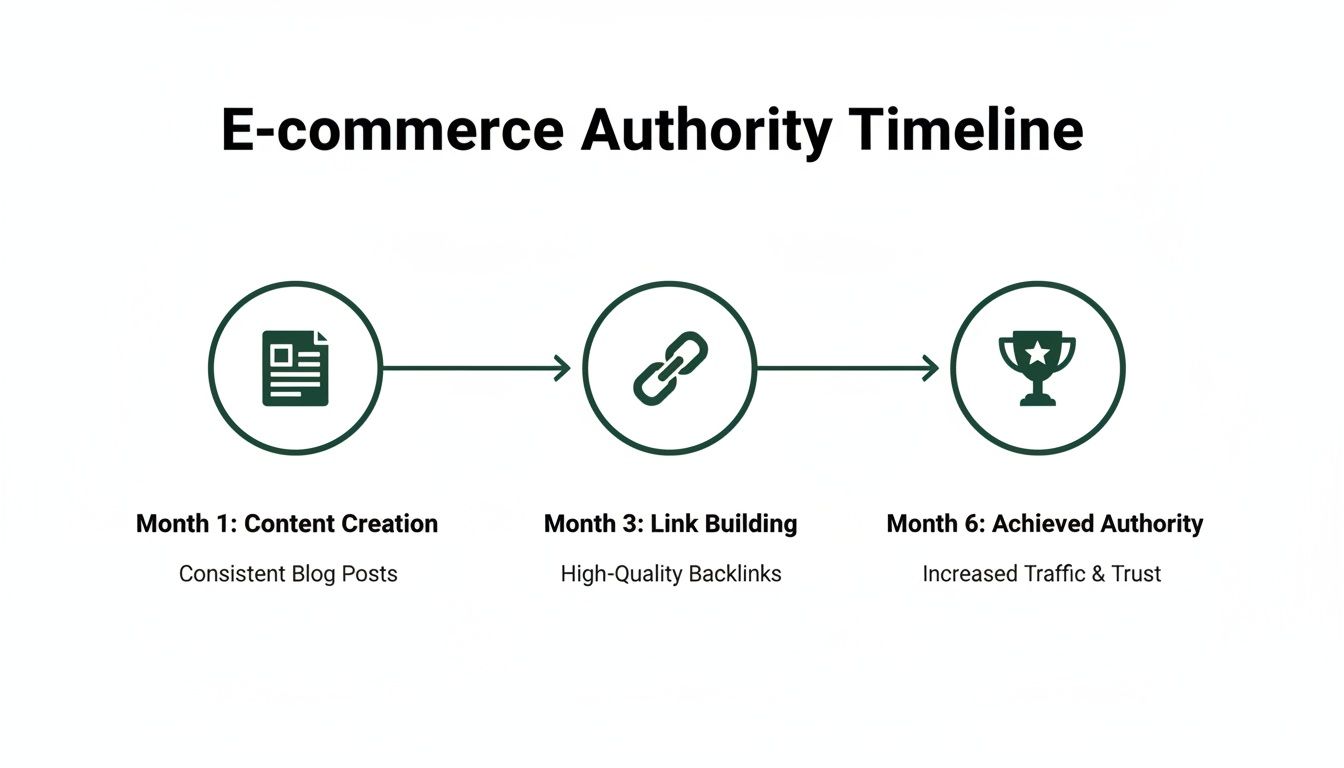
As you can see, authority isn’t built overnight. It’s the result of strategic, ongoing work—creating great content and earning trust signals like backlinks.
Action Steps for Month 3:
- Weeks 9-10: Content Creation: Write and publish your first two high-value blog posts based on the informational keywords you uncovered back in Month 1. These should solve a real problem for your customers, whether they’re in Noosa or anywhere else.
- Weeks 11-12: Link Building Kick-off: Time to start your outreach. Identify a handful of relevant local blogs, directories, or industry websites and begin building relationships. The goal here is simple: secure your first one or two high-quality backlinks.
Your Ecommerce SEO Questions Answered
Diving into ecommerce SEO always brings up a bunch of questions. As a web design and SEO agency that works with businesses across the Sunshine Coast, Noosa, and Brisbane, believe me, we’ve heard them all. So, let’s tackle some of the most common ones head-on.
Think of this as a quick, no-fluff chat. We’ll cut through the jargon and give you the straight answers you need to make the right moves for your online store.
How Long Does Ecommerce SEO Take to Show Results?
This is always the first question, and the honest answer is that ecommerce SEO is a marathon, not a 100-metre dash. While you might see some quick wins from technical fixes in just a few weeks, real, meaningful results typically start to show up around the four to six-month mark.
The first few months are all about building a rock-solid foundation. We’re talking technical audits, deep-dive keyword research, and methodically rolling out on-page optimisations across your site. You’ll likely see some positive little bumps in your rankings during this time.
True, sustainable growth comes from consistently building your site’s authority. This is a gradual process that involves creating genuinely helpful content and earning high-quality backlinks, which search engines reward over the long haul.
Businesses that stick with a smart, consistent plan often see a major lift in organic traffic and sales within a six to twelve-month timeframe. It’s a serious investment in the long-term health and visibility of your business, not an overnight trick.
Which Is the Best Ecommerce Platform for SEO?
Both Shopify and WooCommerce are brilliant platforms for building a high-performing online store, but they’re built for slightly different needs. There’s no single “best” choice; the right one comes down to what your business actually needs.
Here’s a quick breakdown:
- Shopify: This platform is incredibly user-friendly and takes care of a lot of the technical SEO grunt work for you. It’s a fantastic choice if you’re just starting out or want a super reliable, secure system that lets you get up and running fast.
- WooCommerce: As a plugin for WordPress, WooCommerce gives you almost unlimited flexibility and granular control over every tiny aspect of your SEO. That power comes with a steeper learning curve and means you’ve got to be more hands-on with the technical side of things.
For most businesses, it boils down to your technical comfort level, your goals for the future, and your budget. As a web design-first agency, we’ve built award-winning, high-ranking sites on both platforms by tailoring the solution to fit the client perfectly.
Can I Do Ecommerce SEO Myself or Should I Hire an Agency?
Doing your own ecommerce SEO is definitely possible, especially if you have a smaller store and you’re genuinely keen to learn the ropes. You can absolutely manage foundational tasks like on-page SEO, writing basic blog content, and setting up your local business listings.
But as your business grows, the complexity and the sheer time required for SEO ramp up dramatically. To stay competitive, you’ll need to get into the advanced stuff. We’re talking deep technical SEO audits, strategic link-building campaigns, and implementing sophisticated Schema markup to make your products pop in the search results. These tasks really need specialised expertise and access to professional-grade tools.
Hiring a dedicated web design and SEO agency lets you tap into a whole team of experts whose only job is to get you results. It frees you up to do what you do best—run your business—while leveraging professional know-how to get you growing faster and achieve a much better return on your investment.
Ready to stop guessing and start growing? As an award-winning web design and SEO agency, Digital Roo’s helps businesses across Brisbane, Noosa, and the Sunshine Coast build powerful online stores that get found. Let’s create a strategy that drives real, measurable results for your brand. Learn more about our services at Digital Roo’s.