
In Sydney’s cut-throat online market, a brilliant ecommerce website design isn’t just a nice-to-have—it’s your key to survival. A professionally designed site builds instant trust, makes your products look incredible, and turns casual window shoppers into loyal customers.
Think of it as your digital storefront on Pitt Street Mall. It has to make a killer first impression to drive sales.
Why Sydney Ecommerce Demands A Killer Design
Your website is your hardest-working employee. It’s on the clock 24/7, dealing with every single potential customer that walks through your digital door. In a city like Sydney, where shoppers are spoilt for choice, that first interaction has to be perfect.
A clunky, slow, or ugly website is like a rude salesperson. It sends people straight to your competitors, faster than you can say “add to cart.”
The Australian digital marketplace is incredibly crowded. As of 2024, there are roughly 97,000 online shopping websites all fighting for a piece of a market worth a staggering US$37.10 billion. The stats don’t lie: research consistently shows that 75% of users judge a website’s credibility purely on its design.
Even more telling, a massive 94% of first impressions are design-related. These numbers drive home why a thoughtful, professional ecommerce website design in Sydney is a critical investment, not just another expense. For a deeper look at what’s coming, you can check out this detailed 2025 report on Australian ecommerce trends.
The Foundation of Customer Trust
Trust is the currency of ecommerce. Simple as that. Before anyone is willing to type in their credit card details, they need to feel 100% confident in your business. A great design builds that trust by getting a few key things right.
- Professional Look and Feel: A clean, modern layout with high-quality photos signals that you’re a serious, reputable business.
- Navigation That Just Works: An intuitive site structure helps people find what they need without getting frustrated, reinforcing a sense of reliability.
- A Secure Checkout You Can See: Displaying security badges and offering a seamless payment process reassures customers that their personal info is safe.
This infographic breaks down how design, user experience, and security all come together to build that essential trust with Sydney shoppers.
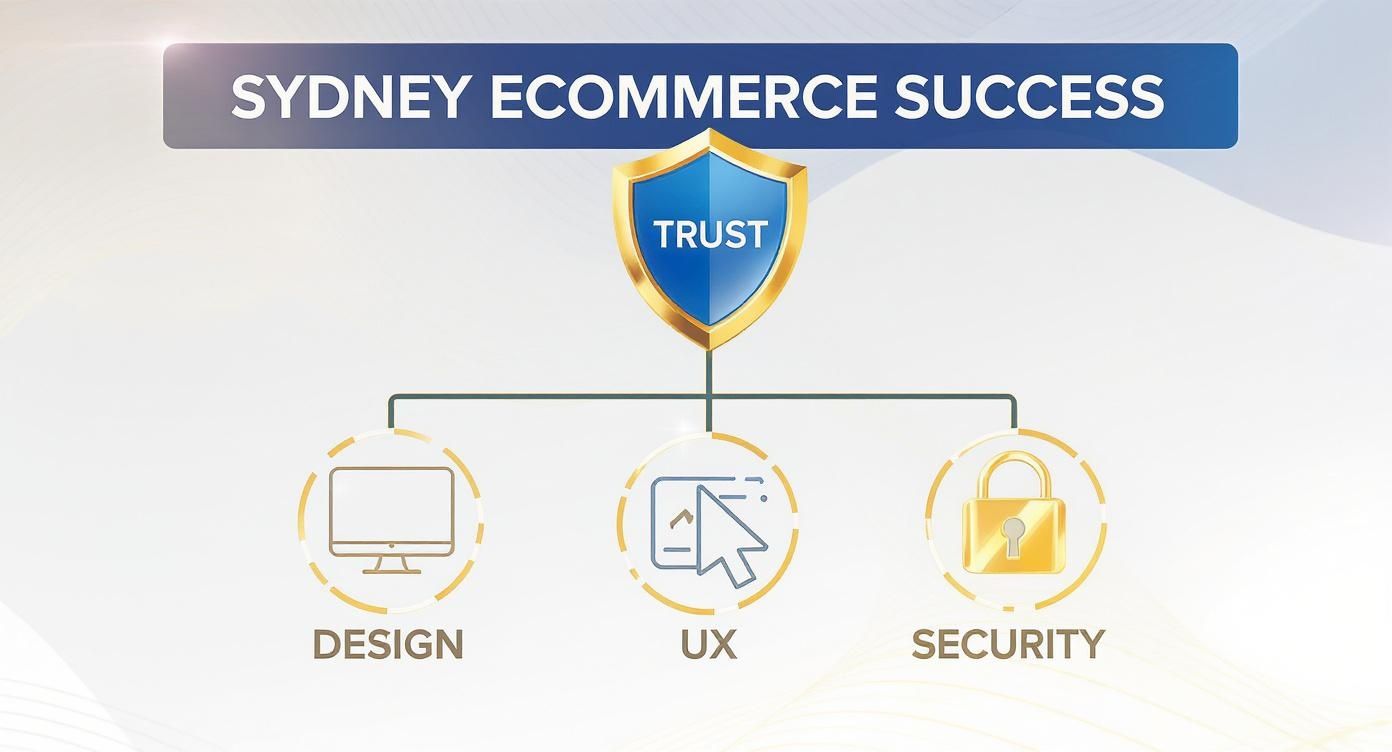
As you can see, trust is the end goal, built on the non-negotiable pillars of visual design, user experience, and security.
Meeting Modern Shopper Expectations
Today’s Sydney consumer is savvy and seriously impatient. They expect a shopping experience that is fast, mobile-friendly, and easy on the eyes. If your site takes more than a couple of seconds to load, or if it’s a pain to browse on a smartphone, you’ve already lost them.
An exceptional design does more than just look good; it anticipates the user’s needs and guides them effortlessly toward a purchase. It’s the silent architect of a positive customer journey, turning initial curiosity into lasting loyalty.
Ultimately, investing in a high-quality ecommerce website design in Sydney is about building a business that lasts. It’s how you stand out in a sea of competitors, build a brand people trust, and create a platform that doesn’t just attract visitors—it actually converts them.
To help you get started, we’ve broken down the foundational elements of a successful ecommerce site for the Sydney market.
Sydney Ecommerce Website Design Core Pillars
This table summarises the essential elements that form the foundation of a successful Sydney-based ecommerce website, highlighting their direct impact on your business goals.
| Pillar | Description | Impact on Your Sydney Business |
|---|---|---|
| User-Centric Design | A design that prioritises the needs and behaviours of your target audience, ensuring an intuitive and frustration-free experience. | Builds brand loyalty and reduces cart abandonment by making shopping easy and enjoyable for busy Sydneysiders. |
| Mobile-First Approach | Designing for the smallest screen first, ensuring your site looks and works perfectly on smartphones and tablets. | Captures the massive audience of on-the-go shoppers in Sydney, from commuters on the train to tourists at the beach. |
| Blazing-Fast Speed | Optimising every element of your site to load in under three seconds, from images to code. | Prevents high bounce rates and keeps impatient customers engaged, directly improving your conversion rates and SEO rankings. |
| Rock-Solid Security | Implementing clear security measures like SSL certificates and visible trust badges to protect customer data. | Builds the crucial trust needed for customers to feel comfortable entering their payment details and completing a purchase. |
Nailing these four pillars is non-negotiable. They are the bedrock of an online store that doesn’t just look good, but actually performs and drives real growth for your business in the competitive Sydney market.
Designing a High-Converting User Experience
A beautiful website that’s a nightmare to navigate won’t sell a thing. This is where user experience (UX) and user interface (UI) design become the absolute keys to your success.
Think of it like this: UI is the look of your car—the sleek paint colour, the stylish dashboard. UX is the feeling of driving it. A powerful ecommerce website design in Sydney masters both, creating a journey that’s as visually stunning as it is dead simple to use.

The whole point is to guide Sydney shoppers from their first click to the final purchase without any frustrating roadblocks. The stats don’t lie: a staggering 88% of online shoppers say they won’t return to a website after a bad experience. Getting UX right isn’t just good practice; it’s a matter of survival.
The Mobile-First Imperative in Sydney
In Australia, the smartphone is king. With well over half of all web traffic now coming from mobile devices, a “mobile-first” approach isn’t optional—it’s essential. This means you design the experience for the smallest screen first, then scale it up for tablets and desktops.
This strategy ensures the huge number of Sydneysiders shopping on their phones—whether on the train during their commute or from the couch at home—get a fast, clean, and fully functional experience. A slow or clunky mobile site is a direct path to lost sales.
Speed is a massive factor here. Even a one-second delay in page load time can cause a 7% reduction in conversions. To get a better handle on performance, our WP Rocket review explains how tools like caching plugins can make a huge difference to your site speed.
Crafting an Intuitive Customer Journey
A great customer journey just feels right. It anticipates what your shopper wants to do next and makes it completely obvious how to do it. This comes down to a few core elements working together perfectly.
- Crystal-Clear Navigation: Your main menu needs to be simple, using terms everyone understands. A shopper looking for “Men’s Shoes” shouldn’t have to play a guessing game to find them.
- High-Quality Product Imagery: People can’t touch your products online, so your photos have to do all the heavy lifting. Show items from multiple angles, in context, and let people zoom in on the details.
- Compelling Calls-to-Action (CTAs): Buttons like “Add to Cart” or “Buy Now” must stand out. Use a contrasting colour and clear, action-focused text that draws the eye and begs to be clicked.
A frictionless checkout process is the final, and most crucial, step in the user journey. Every unnecessary field, confusing instruction, or extra click increases the chance of cart abandonment. Keep it simple, secure, and fast.
For instance, offering a guest checkout option is a proven conversion booster. Forcing people to create an account is one of the biggest turn-offs for first-time buyers.
Building Trust Through Design
Ultimately, fantastic UX is all about building trust. Every little thing, from the professional photography and intuitive layout to the secure payment icons, sends a subconscious signal that your business is legitimate and reliable.
This psychological comfort is what convinces a visitor to become a paying customer. To dig deeper into the psychology of online selling, you might want to explore some insights on how to build a website that truly converts. By focusing on a clean interface and a logical flow, your ecommerce website design in Sydney can transform from a simple online catalogue into a powerful sales engine that builds loyalty and drives real growth.
Adopting Design Trends That Drive Engagement
To keep shoppers hooked, your website needs to feel fresh and alive. Let’s be honest, a stale, outdated design can make even the most incredible products feel a bit boring. Bringing in modern design trends isn’t about chasing fads; it’s about using smart visual tools to create a shopping experience that feels immersive and genuinely enjoyable, keeping customers on your site for longer.
An engaging design does more than just look pretty—it forges a real connection with your audience. For a local business, a thoughtful ecommerce website design in Sydney that nails these trends can be a massive differentiator, making your store feel premium, trustworthy, and current.
The Power of Minimalism and Clean Layouts
In modern eCommerce, less is almost always more. A minimalist approach uses clean layouts, plenty of white space, and a tight, focused colour palette to make your products the hero. Think of it like a high-end art gallery; the neutral walls and uncluttered space ensure the artwork—your products—is the undeniable star of the show.
This isn’t just about looking slick; it has huge practical benefits. By cutting out all the visual noise and distractions, you guide the customer’s eye directly to what matters most: your product photos, the key details, and that all-important “Add to Cart” button. It also helps your pages load faster, which is a massive win for keeping impatient Sydney shoppers from bouncing.
Creating a Premium Feel with Dark Mode
Dark mode has officially moved beyond being a simple user preference to become a strategic design choice. A well-executed dark theme can create an instant sense of luxury and sophistication, making it a perfect fit for brands in fashion, tech, or high-end goods. The high contrast makes visuals pop, allowing your vibrant product photography to really command attention.
A dark mode theme can also reduce eye strain for users browsing in low-light conditions, which massively improves the experience during those late-night shopping sessions. It’s a small touch that shows you care about your customer’s comfort, and that helps build real brand loyalty.
Immersive Shopping with Interactive Elements
Static, boring product pages are a thing of the past. The most engaging online stores today bring their products to life with interactive features that do their best to mimic the in-store experience. These elements turn passive browsing into an active, hands-on exploration.
Here are a few interactive trends that are making a huge impact right now:
- 3D Product Viewers: These allow customers to spin, zoom, and inspect products from every conceivable angle. This is incredibly powerful for things like furniture, electronics, or sneakers, where the little details and construction are key selling points.
- Product Customisers: Give shoppers the power to personalise products in real-time. Whether it’s changing the colours on a t-shirt or engraving a message on a piece of jewellery, this feature sends engagement through the roof and makes the final product feel uniquely theirs.
- Video Backgrounds: A dynamic, subtle video can instantly set a mood and grab attention. To keep up with modern design expectations and seriously boost user engagement, think about how you can integrate background videos into your website design. This can show your products in action or tell your brand’s story without a single word.
By thoughtfully weaving these trends into your store’s design, you create more than just a place to buy things. You build an engaging digital destination that captures attention, encourages people to stick around and explore, and ultimately drives more sales.
Using AI to Create Personalised Shopping Journeys
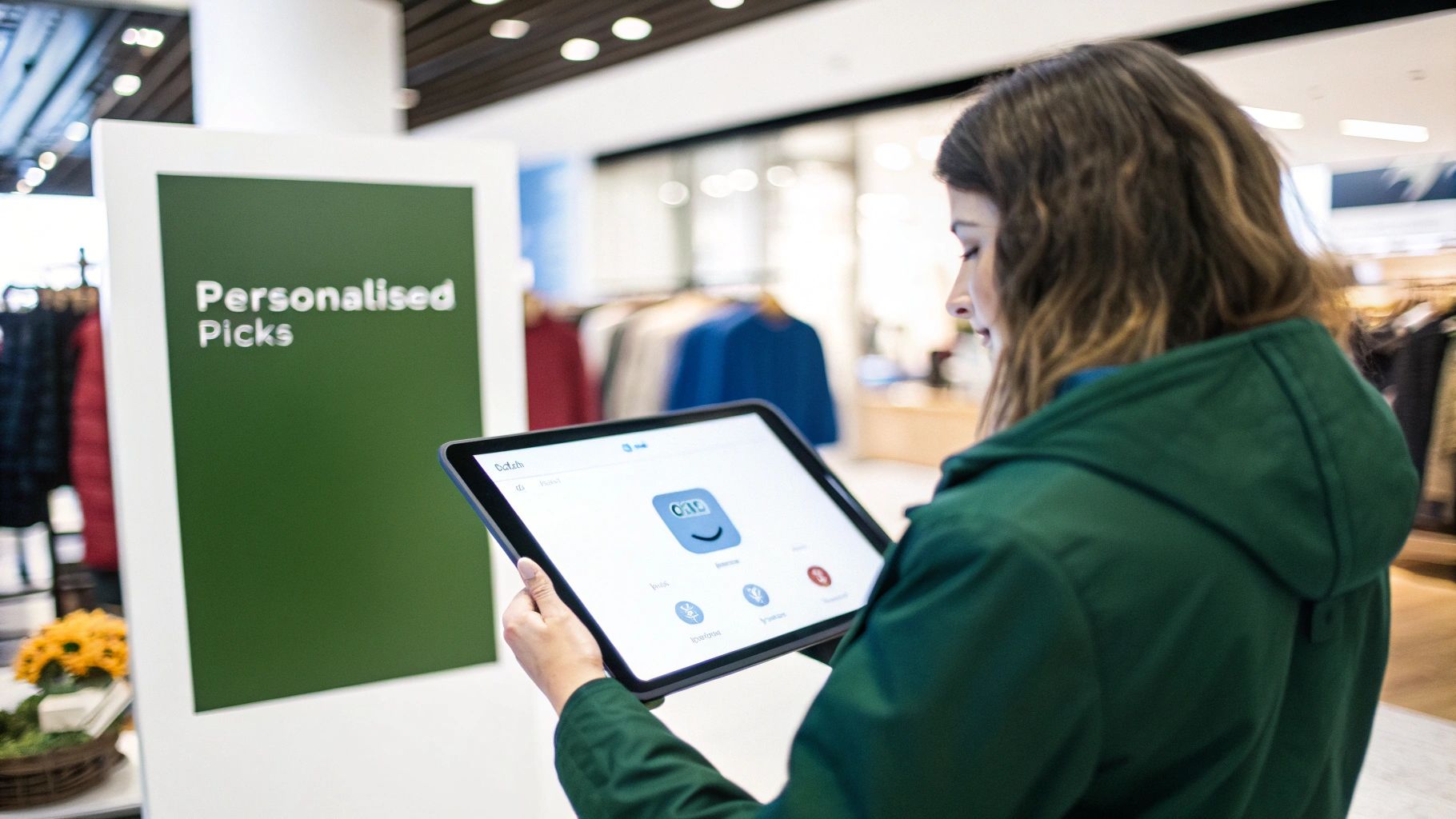
Artificial Intelligence (AI) isn’t just some far-off concept from a sci-fi movie anymore; it’s a real-world tool that’s changing how Sydney businesses sell their products online. Think of AI as the ultimate personal shopper, one for every single person who visits your website. It works quietly in the background, figuring out what customers want and making them feel like your store was built just for them.
For any ecommerce website design in Sydney, this is fast becoming a non-negotiable. It’s what separates a generic online store from one that builds a loyal following and seriously boosts the bottom line. You get to move beyond a ‘one-size-fits-all’ approach and start delivering genuinely unique experiences.
AI Powered Product Recommendations
The most common—and powerful—use of AI in ecommerce is the recommendation engine. You’ve seen it a thousand times: the “You Might Also Like” or “Frequently Bought Together” sections on your favourite retail sites. This isn’t just a lucky guess. It’s AI in action, analysing past purchases, browsing habits, and what similar customers have bought to make eerily accurate suggestions.
Imagine a customer in Manly adds a surfboard to their cart. The AI could instantly recommend high-quality wax, a leg rope, or a specific brand of rashie that’s popular with local surfers. It’s proactive, helpful, and a brilliant way to increase your average order value by showing shoppers things they actually need.
Intelligent Chatbots for 24/7 Support
Sydney shoppers don’t stick to a 9-to-5 schedule, and neither should your customer service. An AI-powered chatbot is your tireless support agent, ready to answer common questions at any hour of the day or night. These aren’t the clunky bots of a few years ago. Modern chatbots understand natural language, can check on an order status, explain your returns policy, and even guide someone to the right product category.
This frees up your human support crew to tackle the more complex issues, ensuring no customer is ever left waiting. Offering instant help at 3 am builds incredible trust and can be the single thing that turns a lost sale into a loyal customer.
Dynamic Pricing and Behavioural Insights
AI analytics can dig so much deeper than your standard website traffic report. It can sift through mountains of data to spot subtle shopping patterns, predict which products are about to trend, and even suggest the perfect time to run a promotion for maximum impact. This opens the door to dynamic pricing, where prices can be adjusted in real-time based on demand, what your competitors are doing, or your current stock levels.
By understanding not just what customers buy, but why they buy, AI provides the insights needed to refine marketing strategies, improve product offerings, and create a smarter, more responsive business.
Australian shoppers are starting to expect this level of service. A recent report flags AI adoption as a major trend for 2025, with 65% of Australian consumers now wanting these personalised journeys. Better yet, integrating features like AI-driven recommendations can lift your average order value by as much as 25%. You can get a deeper look into these findings on integrating AI into enterprise ecommerce sites.
Ethical Use and Australian Privacy Standards
With great power comes great responsibility. When you start using AI, being completely transparent with your customers about how their data is being used is critical. Any ecommerce website design in Sydney must stick to Australian privacy laws like glue, especially the Privacy Act 1988.
This means you need to be doing three key things:
- Obtaining clear consent before you collect and use any personal data for personalisation.
- Securing all customer data with robust security to protect against breaches.
- Providing customers with control over their data, including an easy way to opt out.
Using AI ethically is how you build trust, which is the most valuable currency any online store can have. When you integrate these smart tools thoughtfully and responsibly, you create a shopping journey that feels helpful, not creepy.
Building a Strong Technical SEO Foundation
A beautiful website is great, but it’s completely useless if your customers can’t find it. This is where technical Search Engine Optimisation (SEO) comes into play. Think of it as the plumbing and wiring inside the walls of your online store; if it’s not set up right, nothing else works properly, no matter how slick the design is.
For any business serious about its ecommerce website design in Sydney, getting the technical SEO right is the bedrock of your online visibility. It’s all the behind-the-scenes work that makes it dead simple for search engines like Google to find, crawl, and understand what your site is all about, giving you a fighting chance to rank for the products you sell.
Why Site Architecture Matters
Imagine walking into a massive, disorganised warehouse with no signs, aisles, or labels. Finding what you need would be a nightmare. Your website’s architecture is the blueprint that organises all your content, creating clear pathways for both shoppers and search engine crawlers.
A well-structured site groups your products into intuitive categories and subcategories. This doesn’t just make it easier for customers to browse; it helps Google understand the relationships between your pages, which is absolutely critical for ranking. A logical path like Home > Men's Clothing > T-shirts > V-Neck T-shirts is simple, clear, and effective.
The Non-Negotiable Need for Speed
In the fast-paced Sydney market, speed is currency. Page load time is a confirmed ranking factor for Google, and slow sites get pushed down the list. Even more importantly, slow speeds absolutely murder conversions. The stats are brutal: 88% of online shoppers say they won’t return to a site after a bad experience, and a slow-loading page is one of the biggest turn-offs.
Your web design agency should be obsessed with:
- Optimising Images: Compressing image files so they’re lightweight but still look sharp.
- Minifying Code: Stripping out all the unnecessary characters from your site’s HTML, CSS, and JavaScript.
- Using a Caching Plugin: Storing a ready-made version of your site to serve it to visitors much faster.
These technical tweaks make sure your pages load almost instantly, keeping impatient customers engaged and moving them towards the checkout.
Mobile Responsiveness and Clean Code
With well over half of all web traffic now coming from mobile phones, a responsive design isn’t a feature anymore—it’s a fundamental requirement. Your website has to look and work flawlessly on every screen, from a huge desktop monitor to the smallest smartphone. Google now uses mobile-first indexing, which means it primarily looks at the mobile version of your site to decide how to rank you.
A clean, well-written code base is the engine that powers your technical SEO. It ensures there are no broken links, crawl errors, or messy scripts that could confuse search engines and stop your pages from being properly indexed.
Ultimately, building a strong technical SEO foundation is all about making your website as easy as possible for Google to understand and for customers to use. It’s a vital, ongoing process that underpins every other marketing effort you make. To get a deeper understanding of how these elements fit into a broader strategy, you can explore more about our comprehensive SEO services, which are designed to build long-term visibility and drive sustainable growth for Sydney businesses.
How to Choose the Right Sydney Design Agency
Picking the right partner for your ecommerce website design in Sydney is one of the most important calls you’ll make for your business. This isn’t just about hiring someone to build a website; it’s about finding a strategic partner who genuinely gets your vision, your customers, and the quirks of the local market. A great agency becomes an extension of your team, as invested in your long-term growth as you are.
The right choice can be the difference between a site that just sits there and one that becomes a powerful engine for sales and brand building. With so many agencies out there, you need to look past the slick presentations and dig into what really matters for your business. That means evaluating their process, their portfolio, and their past results with a critical eye.
Evaluate Their Portfolio and Past Results
An agency’s portfolio is their resume—don’t just glance at the pretty pictures. Dive into their live client websites. Do they load in a snap? Are they a breeze to navigate on a mobile? Do they feel like they were built for the modern Aussie shopper?
Look for agencies that showcase a diverse range of projects, not just the same cookie-cutter style repeated over and over. A strong portfolio shows they’re versatile and can tackle unique business challenges. Most importantly, you need to see proof that their work actually delivers. For an idea of what detailed project breakdowns look like, you can explore our work with other businesses to see how smart design translates into tangible results.
Ask About Their Design and Development Process
A great agency has a process that’s clear, transparent, and collaborative. They should be able to walk you through every single step, from the initial discovery and strategy sessions right through to wireframing, design mockups, development, and post-launch support. If their process sounds vague or confusing, that’s a massive red flag.
Here are a few crucial questions to ask about how they work:
- Who will be my main point of contact? Consistent, clear communication is the key to a smooth project.
- How do you handle feedback and revisions? There needs to be a structured system for incorporating your input.
- What ecommerce platform do you specialise in? Make sure their expertise lines up with your needs, whether it’s Shopify, WooCommerce, or something else.
- How do you approach SEO and mobile design? These shouldn’t be afterthoughts; they need to be baked in from the very beginning.
To help you stay organised when you’re talking to different agencies, we’ve put together a handy checklist.
Agency Evaluation Checklist
| Evaluation Criteria | What to Look For | Why It Matters |
|---|---|---|
| Portfolio Quality | Do their past projects look professional, modern, and user-friendly? Are the sites live and functional? | This is direct proof of their design skill and technical ability. It shows you the quality of work you can expect. |
| Relevant Experience | Have they worked with businesses in your industry or of a similar size? Do they have ecommerce case studies? | An agency with relevant experience will understand your unique challenges and target audience from day one. |
| Client Testimonials & Reviews | What are past clients saying on Google, Clutch, or their own website? Can they provide references? | Honest feedback from previous clients tells you about their communication, reliability, and ability to deliver on promises. |
| Clear Process | Can they clearly explain their entire process, from discovery to launch and beyond? Is it collaborative? | A structured process prevents misunderstandings, keeps the project on track, and ensures you’re involved at key stages. |
| Technical Expertise | Do they specialise in the ecommerce platform you want to use? Do they have in-house developers? | The right technical skills are crucial for building a secure, scalable, and high-performing online store. |
| Local Market Knowledge | Do they understand the Sydney consumer? Can they speak to local market trends and competition? | Local insights can give you a competitive edge, ensuring your site resonates with Sydney shoppers. |
| Communication & Culture | Do you get a good vibe from the team? Are they easy to talk to and responsive? | You’ll be working closely with this team for months. A good cultural fit makes the entire process smoother and more enjoyable. |
Using a checklist like this ensures you’re comparing apples with apples, making it much easier to spot the agency that’s the perfect fit for your business.
Understand Their Local Market Knowledge
A Sydney-based agency should bring more to the table than just technical skills; they should offer genuine local insights. They need to understand the nuances of the Sydney consumer, from their expectations around delivery times to their design preferences. This local expertise can give you a massive edge in a crowded market.
Australia’s web design industry is a thriving sector, and it’s absolutely integral to the success of online retail. It hit a market value of $1.3 billion in 2022 after a 6.9% growth spurt, which shows just how seriously businesses are taking their online presence. This investment pays off, as data shows that professionally designed websites can boost conversion rates by up to 200% compared to poorly executed ones. If you’re interested, you can discover more insights about these web design statistics.
Choosing an agency isn’t about finding the cheapest quote. It’s about finding the best value—a partner who will deliver a high-performing asset that generates a powerful return on your investment for years to come.
Common Questions About Ecommerce Design in Sydney
Jumping into the world of ecommerce design can feel like you’re trying to assemble a puzzle with a thousand moving pieces. It’s completely normal to have questions. To help you get some clarity, we’ve put together answers to the most common queries we hear from Sydney business owners who are just starting their online store journey.
Think of this as your starting guide. We’ll cover the big topics like costs, timelines, and choosing the right tech, so you can make smart, confident decisions right from the get-go.
How Much Does an Ecommerce Website Cost in Sydney?
This is always the first question, and the honest answer is: there’s no one-size-fits-all price tag. The cost of an ecommerce website design in Sydney can swing from a few thousand dollars for a straightforward, template-based store to well over $50,000 for a complex, custom-built platform with all the bells and whistles.
The final figure really comes down to a few key ingredients:
- Platform Choice: Getting started with a template on a platform like Shopify is usually more budget-friendly than a completely custom build on WooCommerce.
- Design Complexity: A unique, bespoke design with custom graphics and user features will naturally cost more than a slick, pre-designed theme.
- Number of Products: A store with a handful of products is much simpler to set up than one with thousands of items and complex filtering.
- Custom Integrations: If you need to connect your store to specialised inventory systems, CRMs, or unique payment gateways, that will add to the development cost.
A good way to think about it is like building a house. A project home from a set plan has a very different budget than an architect-designed dream home built from scratch.
How Long Does It Take to Build an Online Store?
Just like the cost, the timeline can vary quite a bit. A simple Shopify store using a ready-made theme can be up and running in as little as 4-6 weeks. On the other hand, a more ambitious project with custom design and development work could take anywhere from 3 to 6 months, sometimes longer.
The biggest things that influence the timeline are the clarity of your vision, the complexity of the build, and how quickly you can provide feedback and content (like your product photos and descriptions). A clear brief and decisive communication can seriously speed things up.
The most successful ecommerce projects are true collaborations. When the client and agency work together with clear communication and shared goals, the timeline stays on track and the final product exceeds expectations.
Which Ecommerce Platform Is Best for My Business?
The “best” platform really depends on what you need, how comfortable you are with technology, and where you want your business to go. For most Sydney businesses, the choice usually comes down to two main players: Shopify and WooCommerce.
- Shopify is an all-in-one solution that’s incredibly user-friendly. It’s perfect for businesses that want to get selling quickly without having to worry about the technical side of hosting and security.
- WooCommerce is a powerhouse plugin for WordPress. It offers almost limitless customisation, but it does require a bit more hands-on technical management.
Nailing this decision is one of the most critical first steps you’ll take on your ecommerce journey.
Ready to build an online store that drives real growth for your Sydney business? At Digital Roo’s, we specialise in creating high-performing ecommerce websites that look incredible and convert visitors into loyal customers. Let’s build your success story together.