

Imagine having a finger on the pulse of the entire internet, seeing exactly what people are curious about in real-time. That's pretty much what Google Trends gives you. It's a free, and frankly, an incredibly powerful tool that tracks the popularity of search terms, offering a unique window into public interest.
How Google Trends Unlocks Market Secrets
Don't think of Google Trends as a crystal ball that predicts the future. It's more like a public barometer measuring curiosity. Instead of giving you raw search numbers—like telling you 10,000 people searched for "air fryer"—it gives you a simple, relative score from 0 to 100.
This number shows a topic's popularity in relation to all other searches on Google at that time. A score of 100 means "peak popularity," the highest point of interest a term hit in your chosen timeframe. A score of 50? It was half as popular then. This clever system lets you compare the buzz around "boba tea" versus "cold brew" on a level playing field, revealing subtle shifts in what people want without getting lost in huge, meaningless numbers.
Here’s the main interface where you can kick off your own exploration.
That simple trend line immediately shows you the rhythm of public interest, flagging everything from seasonal spikes and sudden fads to those slow-burning trends that creep up over time.
Why The Data Normalisation Matters
The real magic is how Google normalises the data. It analyses a sample of all searches to create that relative popularity score. For those of us in Australia, this gives us some seriously nuanced insights. Think about major sporting events like the T20 Cricket World Cup. We see massive spikes in searches for terms like "match scores," with interest sometimes jumping hundreds of percentage points in relative popularity almost overnight. To really get a handle on this, you can find out more about how Google processes this data.
This relative scoring is what makes the tool so useful for any business. It helps you see:
- Seasonality: You can map out exactly when interest in products like "sunscreen" or "winter coats" predictably rises and falls each year.
- Cultural Moments: It shows how real-world events, from movie releases to major news stories, drive sudden surges in public curiosity.
- Market Shifts: You can spot long-term changes in taste, like the steady, five-year rise of "plant-based recipes."
By looking at these patterns, you’re no longer guessing what your audience cares about—you’re seeing it directly through their search habits. This is a foundational step in building a responsive and effective marketing strategy.
This tool essentially decodes the internet's collective consciousness, giving you clues that can shape everything from your next blog post to your next product launch. For more ideas on using data-driven insights, check out our other tips for small businesses. By getting a handle on just a few basic features, you can turn this free resource into a powerhouse for making smarter business decisions.
Discovering Untapped Keyword Opportunities
Tired of the endless battle for the same old crowded keywords? Smart keyword research isn’t just about finding what's popular right now; it’s about seeing what’s going to be popular next. This is where Google Trends gives you a serious leg up, helping you uncover hidden gems before your competitors even know they exist.
Instead of just fighting for high-volume terms everyone is chasing, you can find emerging niches and long-tail queries that signal strong buyer intent. This approach lets you connect with a more motivated audience, and often with way less competition.
The process of finding these opportunities is pretty straightforward, as you can see in the infographic below.
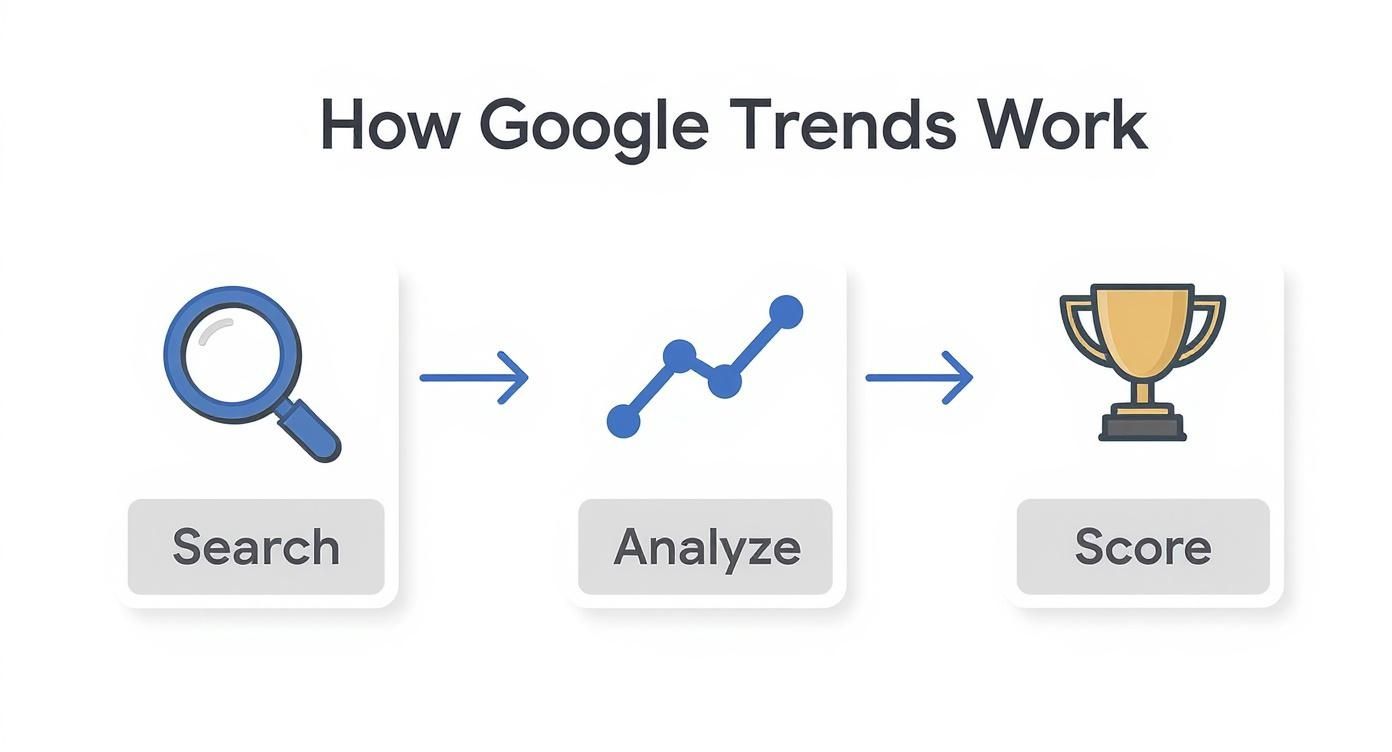
This simple flow of searching, analysing, and scoring helps you systematically figure out a keyword's real potential. By following these steps, you can move from a broad idea to a validated, high-potential keyword for your next campaign.
Mastering The Related Queries Feature
One of the most powerful features tucked away in Google Trends is the Related queries section. You'll find this little goldmine at the bottom of the results page, and it's brilliant for understanding the context and intent behind searches. It's split into two incredibly useful categories:
- Top: These are the most popular search queries related to your term. Think of them as the established, consistent performers.
- Rising: This is where the magic happens. These are queries that have had the most significant growth in search frequency recently.
A query marked "Breakout" in the Rising section means it's seen growth of more than 5000%. Spotting one of these early is like finding a trending topic before it goes viral. For a small business, this is a massive opportunity to become an early authority on a topic.
From Fleeting Fad to Sustainable Niche
The real trick is using the trend graph to tell the difference between a short-lived fad and a genuine, sustainable niche. A viral meme might show a massive, sharp spike that disappears just as quickly. A real business trend, on the other hand, often shows a more gradual but steady upward climb over several months or years.
Let's imagine a local Aussie cafe owner. They might see a sudden spike for "cronuts" and think about adding them to the menu. But a quick look at the five-year trend might show its popularity has well and truly faded.
Analysing the long-term trend line helps you avoid investing in temporary fads. Instead, it guides you toward sustainable opportunities with lasting customer interest, ensuring your efforts deliver long-term value.
However, if they research "boba tea," they might see a consistent, year-on-year growth pattern. This points to a sustained market shift, not just a passing craze. Armed with this data, they could confidently invest in boba tea equipment and marketing, capturing a growing customer base their competitors might have missed. This is the core of a strong SEO strategy: making data-informed decisions that lead to growth. If you want to dive deeper into this topic, learn more about how to build a powerful SEO strategy for your business.
Finding Valuable Long-Tail Keywords
The Related queries feature is also perfect for digging up valuable long-tail keywords. These are longer, more specific search phrases that tend to convert better because they reflect a very specific user need.
For example, a search for the broad term "skincare" might show rising related queries like:
- "niacinamide serum for sensitive skin"
- "best vegan moisturiser Australia"
- "how to use retinol for beginners"
These aren't just keywords; they are direct questions and problems from your potential customers. Creating content or product pages that specifically answer these queries lets you attract a highly qualified audience that is much further along in their buying journey. By digging into what people are actually asking, you move beyond guesswork and start creating content that truly serves your audience's needs.
Crafting Content Your Audience Craves
Guesswork is the enemy of a great content strategy. Instead of throwing ideas at the wall and seeing what sticks, you can use Google Trends to build a content calendar that actually hits the mark. It’s all about creating the articles, videos, and social posts that your audience is actively looking for, right when they need them most.
This shifts your entire approach. You move from making content you think your audience wants, to making content you know they’re searching for. It’s a data-driven move that saves time, cuts down on wasted effort, and seriously improves your chances of connecting with customers.
Planning Around Predictable Seasonal Peaks
One of the simplest yet most powerful ways to use Google Trends is to plan for seasonal content. Just about every industry has predictable peaks and troughs in interest throughout the year, and you can map these out with stunning precision.
Take a financial advisor in Australia, for example. By looking up "tax tips," they'll see a clear, repeatable spike that kicks off in May and peaks just before the October 31st tax deadline. Instead of scrambling to publish something in July, they can plan a whole series of posts, videos, and articles to go live just as that search interest starts its upward climb.
This same logic applies everywhere:
- eCommerce: A swimwear brand can see the exact moment searches for "bikinis" start to rise in spring, letting them time their new collection launch perfectly.
- Services: A gym owner can get ahead of the New Year's resolution rush by preparing "gym membership deals" content in December.
- Hospitality: A hotel in Cairns can track interest for "Great Barrier Reef tours" to plan promotions around peak holiday seasons.
By building your content calendar around these reliable cycles, you guarantee your message lands when your audience is most receptive. That means maximum attention and more traffic.
Capitalising on Sudden Spikes in Interest
While seasonal trends are predictable, Google Trends also helps you react to those sudden, unexpected surges in public curiosity. These "trending searches" are golden opportunities to create timely, relevant content that can capture a huge amount of immediate attention. It’s about being agile enough to join the conversation that the world is having right now.
Think of it as newsjacking for your niche. When a new technology drops or a cultural moment goes viral, you can quickly produce content that connects that event to your industry. This move positions your brand as a timely and relevant authority.
The key is to act fast. A trending topic today might be old news by next week. Setting up alerts for keywords related to your industry can give you a crucial head start, allowing you to be one of the first voices in the conversation.
Understanding what your audience is hungry for is the first step. By exploring effective content creation strategies, you can learn how to turn those insights into high-impact content. Combining timely topics with solid execution is how you turn a passing trend into a valuable marketing win.
Creating Location-Specific Content
Finally, Google Trends is an exceptional tool for making your marketing more personal and effective through localisation. You can filter trend data right down to the state or even city level, revealing unique interests and priorities in different regions. This lets you stop using a one-size-fits-all approach and start speaking directly to local customers.
In 2023, the data showed just how much Australian search behaviour reflects both local and global events. While national news like the Optus outage drove searches everywhere, Western Australia showed particularly strong interest in entertainment topics like the Barbie versus Oppenheimer box office battle and local sports teams. It shows that even within one country, interests can vary significantly, highlighting the importance of tailoring your message.
A national retailer, for instance, might discover that searches for "air conditioners" are spiking in Brisbane due to a heatwave, while "electric blankets" are trending in Hobart. Armed with this insight, they can run targeted digital ads and create location-specific content that speaks to the immediate needs of customers in each city. It makes their marketing far more relevant and resource-efficient.
Forecasting Demand And Spotting Market Shifts

What if you could see what your customers wanted before they even knew they wanted it? Using Google Trends for forecasting helps you stop reacting to the market and start preparing for it. It's about turning raw search data into a genuine business planning tool.
By digging into historical search patterns, you can uncover the predictable cycles in what people want. This kind of insight lets you make smarter calls on everything from ordering stock to hiring seasonal staff, giving your business a massive operational edge.
Identifying Cyclical Patterns With Multi-Year Data
The real forecasting magic of Google Trends unlocks when you set the date range to five years or more. This long-range view cuts through the short-term noise and reveals the consistent, cyclical patterns that really drive your industry. A single year might show a random spike, but a five-year view proves it's a reliable annual thing.
Imagine you run an online store selling outdoor gear. A quick search for "hiking boots" shows a crystal-clear pattern: interest starts climbing in spring, peaks over summer, and drops off as autumn ends. This isn't just a fun fact; it's actionable intelligence.
With that knowledge, you can plan your operations with precision:
- Inventory: Place your big orders for hiking boots in late winter, making sure you’re fully stocked just as demand starts to take off.
- Marketing: Fire up your ad campaigns in early spring to catch customers right at the start of their buying journey.
- Staffing: Bring on extra customer support staff during the peak summer months to handle the flood of enquiries and orders.
This approach flips your business from being reactive to being predictive, helping you manage cash flow and resources far more effectively.
To illustrate this, here's a look at some common seasonal search trends we see right here in Australia. These patterns show how planning around search interest can give you a huge advantage.
Seasonal Search Trend Examples In Australia
| Product Or Service | Typical Peak Search Interest Period | Potential Business Action |
|---|---|---|
| "Air conditioner" | November – February | Launch marketing campaigns in spring; ensure stock levels are high. |
| "Tax return" | July – September | Increase ad spend for accounting services; create helpful content. |
| "Gym membership" | January | Run "New Year, New You" promotions and special offers. |
| "Winter coats" | May – July | Begin showcasing winter collections in April; run sales in late winter. |
| "Wedding venues" | December – January (post-engagement season) | Promote venue packages and open days for newly engaged couples. |
As you can see, these aren't just guesses—they're predictable rhythms in consumer behaviour that you can build your entire business calendar around.
Spotting Emerging Macro Trends Early
Beyond the predictable seasons, Google Trends is brilliant for flagging bigger market shifts. These are the slow-burning changes in what people want that can redefine a whole industry. Spotting them early gives you a massive head start on slower competitors.
For example, a five-year search for "oat milk" compared to "soy milk" tells a dramatic story of changing tastes in dairy alternatives. A café owner who saw this trend taking off early could have become the local go-to for oat milk lattes, capturing a whole new customer base.
By regularly monitoring the upward or downward trajectories of key terms in your industry, you can position your business to meet future demand, not just current needs. This foresight is what separates market leaders from followers.
The key is to look for steady, sustained growth over several years. A sudden, sharp spike might just be a passing fad, but a consistent upward climb signals a genuine shift in the market you can confidently get behind.
Using Regional Data For Strategic Advantage
Drilling down into regional data adds another powerful layer to your forecasting. What's trending nationally might not be the reality in your city or state. Local insights allow for super-targeted and efficient planning.
A national clothing brand might see a general rise in searches for "winter coats," but the data could show that interest in Perth is for lightweight jackets while Melbourne is searching for heavy-duty parkas.
Here in Australia, where Google has a massive 94.7% search engine market share, these trends are a near-perfect mirror of what consumers are thinking. During the pre-Christmas shopping season, searches for "best gift ideas" can jump by over 200%, while fitness queries go through the roof every January. Understanding these national and local rhythms is crucial for getting your timing right.
While Google Trends offers incredible insights, exploring other market intelligence tools can flesh out your strategic planning even further. Combining data sources gives you a more complete picture of the market, reducing risk and making your business decisions that much sharper.
Beyond just digging for keywords and content ideas, Google Trends can be your own private business intelligence dashboard. It gives you a live, unfiltered look at how your brand is perceived in the public eye and—just as importantly—how you're stacking up against the competition.
Think of it as a constant, free focus group. By simply tracking the search interest for your own brand name, you can get a real sense of your brand’s health and public awareness. This data is a clear, unbiased measure of whether your marketing efforts are actually turning into genuine curiosity from potential customers.

Benchmarking Against Your Rivals
The real magic happens when you start comparing. Google Trends lets you plot the search interest for up to five terms at once, meaning you can directly benchmark your brand’s popularity against your key competitors. This gives you a crystal-clear picture of your position in the market.
For example, two local gyms in Sydney could plug in their brand names to see who's generating more online buzz. A steady lead for one might point to stronger brand recognition or more effective local marketing. This isn't just a vanity metric; it’s a vital health check for your brand's visibility.
You can use this comparison to:
- Measure Brand Awareness: See how your search interest stacks up against the established players in your industry.
- Track Campaign Impact: Did that recent ad campaign or PR push cause a noticeable spike in searches for your brand?
- Spot Competitor Wins: A sudden surge for a rival could signal a successful campaign you need to break down and learn from.
By regularly checking these trend lines, you move from guessing your market position to actually measuring it. This data gives you the context you need to know if your marketing is moving the needle or if a competitor is quietly gaining ground.
Turning Data into Actionable Insights
Looking at the trend lines is one thing; knowing what they mean is another. Every dip and spike in that graph tells a story that can inform your business strategy. A competitor's rising trend line isn't a reason to panic—it's an opportunity to learn. It could be tied to a new product launch, a viral social media campaign, or a big influencer collaboration.
On the flip side, a sudden dip in a competitor's search interest could signal an opening for you. Maybe they copped some negative press or released a poorly received product update. This could be the perfect moment to launch a targeted campaign to capture disillusioned customers and grab some market share.
Finding Regional Weaknesses and Opportunities
Don't forget to dig into the geographic data. The "Interest by subregion" map can reveal where your competitors are strong and, more importantly, where they're weak. This is an absolute goldmine for strategic expansion and targeted marketing.
Imagine you run an eCommerce business selling coffee beans. You might discover your biggest rival dominates search interest in Victoria and New South Wales but has almost no presence in Queensland. This insight lets you focus your ad budget with surgical precision.
You could launch a targeted digital ad campaign aimed specifically at coffee lovers in Brisbane and the Gold Coast, speaking directly to a market they're ignoring. This geo-targeting helps you avoid costly head-to-head battles in saturated regions and instead pour your resources where you have the best chance of winning new customers. It's just a smarter, more efficient way to grow.
Going Beyond The Basics: Advanced Strategies And Common Mistakes
Nailing the fundamentals of Google Trends is a great start, but using it to get a real strategic edge means digging a little deeper. Moving past simple keyword comparisons involves mixing its data with other tools you already use and, crucially, understanding its limits. This is how you turn interesting trend graphs into genuine business intelligence you can act on.
One of the most powerful moves you can make is to pair Google Trends data with what you see in your Google Analytics. Think about it this way: Trends shows you what the public is curious about, while Analytics tells you what your specific audience is actually doing on your website. Seeing a keyword trend upwards is exciting, but confirming that same trend is driving real traffic and conversions to your site? That’s where the magic happens.
This simple two-step process validates your content ideas and helps you fine-tune your marketing budget. It ensures you’re not just chasing popular topics, but focusing on the ones that attract both broad interest and customers who are ready to buy.
Pro Tips For A More Accurate Analysis
To pull genuinely useful insights from Google Trends, you need to be deliberate with your searches. A few small tweaks to your parameters can make a massive difference in the quality of your data and stop you from jumping to the wrong conclusions.
- Use Category Filters: A search for "Rocket" could be about space travel, a movie, or even a type of lettuce. Applying a category filter is non-negotiable. It ensures you're only looking at data relevant to your industry, not just a popular search term.
- Analyse 5+ Year Timeframes: Looking at data over five years or more helps you spot real, long-term cultural shifts and separate them from short-lived fads. This long-range view is essential for building a strategy that lasts.
- Compare Locations: Never assume a national trend applies everywhere. Use the regional comparison feature to pinpoint local hotspots or even find underserved areas where you might have a massive competitive advantage.
Critical Mistakes You Must Avoid
Google Trends is powerful, but it can be seriously misleading if you’re not careful. Too many businesses make simple errors that lead them to build flawed strategies. Knowing the common pitfalls is the key to making smart, data-informed decisions.
Probably the single biggest mistake is confusing relative popularity with absolute search volume.
A score of 100 doesn’t mean a term gets millions of searches. It simply marks the peak popularity for that term within the selected timeframe and location. A super-niche term can easily hit 100 with just a few thousand searches if that's its highest point of interest.
Another classic blunder is mistaking a short-term viral spike for a genuine business trend. A meme, a news story, or a TikTok challenge can cause a massive, temporary surge that has zero connection to lasting consumer demand. For your website's performance, steady, consistent growth is always better. To learn more about improving your site’s speed and reliability, check out our detailed WP Rocket review. Always zoom out and look at the long-term graph to make sure you’re investing in a sustainable shift, not just a fleeting moment of internet chatter.
Your Google Trends Questions, Answered
Jumping into a new tool always brings up a few questions. To help you get the most out of Google Trends, let's clear up some of the most common queries we hear from business owners and marketers.
How Does Google Trends Data Differ From Paid SEO Tools?
This is a great question, and the difference is crucial. Think of it this way: paid SEO tools like Ahrefs or SEMrush give you absolute search volumes. They estimate roughly how many times a keyword gets searched each month, which is brilliant for gauging the total potential traffic for a term.
Google Trends, on the other hand, shows relative popularity. It doesn't tell you how many people are searching, but rather how popular a topic is right now compared to its all-time peak, on a simple scale of 0 to 100. It's less about raw numbers and more about measuring the "buzz" or momentum around an idea. This makes it perfect for spotting what's hot and what's not.
Just How Accurate Is The Data?
The data is incredibly reliable because it’s not a poll or a survey—it's a massive, anonymised sample of real Google searches. You're getting a direct look at what people are genuinely curious about.
However, its accuracy really depends on what you're looking for. For very niche, low-volume keywords, the data can be a bit sparse or even unavailable. It shines brightest when you're analysing broader topics that have a decent level of public interest. Always remember to use the location and category filters to make sure the trends you're seeing are actually relevant to your audience.
The tool’s real strength isn't in providing exact search counts. It’s in revealing the bigger picture—the direction, timing, and comparative interest of search behaviour. It shows you what the public finds interesting, and when.
How Often Should I Be Checking Google Trends?
There’s no single right answer here; it all comes down to your industry and your goals. But building a simple routine can make a huge difference in keeping your marketing sharp and relevant.
Here’s a practical schedule we often recommend:
- A Weekly Check-in: A quick 15-minute look once a week is perfect. It's just enough time to spot any short-term rising queries and find timely content ideas in your niche before your competitors do.
- A Monthly Analysis: Set aside a bit more time each month to dig deeper. This is your chance to review broader trends, see what your competitors are up to, and track how your own brand’s search interest is performing.
- Quarterly or Annual Planning: Use long-term data (think 5+ years) to inform your big-picture strategy. This is gold for planning major seasonal campaigns, new product launches, and making smarter business decisions.
This balanced approach keeps you agile enough to jump on sudden spikes while also building a solid, forward-looking strategy based on long-term patterns.
Ready to turn these insights into measurable growth for your business? The team at Digital Roo's specialises in building high-performance websites and executing data-driven SEO strategies that get results. Let's build a stronger business together.