

Ever wondered what your customers are really thinking?
Google Trends is a free tool from Google that acts like a window into the public consciousness. It tracks how often people search for specific topics, showing you what’s popular, where it’s popular, and when. In short, it’s an absolute goldmine for any local business serious about market research and SEO.
Why Google Trends Is a Secret Weapon for Local SEO

Running a business in Brisbane, Noosa, or anywhere on the Sunshine Coast means you're up against some fierce competition. Having a great service is one thing, but truly standing out means getting inside the heads of your local customers—often before they even realise they need you.
This is where a powerful, and completely free, tool like Google Trends comes into play. Most businesses sleep on it, but the savvy ones use it to carve out a serious competitive advantage. As an award-winning web design and SEO agency based right here in Queensland, we use these exact techniques every day to get real results for businesses just like yours.
Tapping Into the Local Pulse
Forget generic, one-size-fits-all advice. The real magic of Google Trends happens at the local level. It lets you ditch the guesswork and make sharp, data-driven decisions that actually connect with a South East Queensland audience.
Think of it like this: Google Trends gives you a direct line to what your community is thinking about, right now. By analysing what they’re searching for, you can spot the subtle shifts in what people want, what’s in season, and what’s just around the corner.
It’s about finding the "why" behind what your customers are looking for.
From Keywords to Customer Intent
Mastering Google Trends is a fundamental part of building a strong digital presence. It’s the perfect partner to traditional SEO work, adding a layer of timely, regional intelligence that your competitors are probably missing.
Of course, you still need to nail the basic principles of SEO to build your website's authority. But once you have that foundation, Google Trends helps you aim that authority at what's actually relevant today.
This isn’t just theory. We’re going to walk you through practical, real-world scenarios designed to help you outsmart the competition and connect with your customers in a much more meaningful way.
Before you can start pulling winning strategies out of Google Trends, you need to get your head around what the numbers on the screen are actually telling you. The single biggest mistake people make is thinking it shows raw search volume. It doesn't.
What it gives you is something far more useful: relative popularity.
Think of it as a popularity contest. Google takes all the search data for a topic within a specific timeframe and location, finds the moment of peak interest, and calls that 100. Every other point on the graph is then scored relative to that peak. A score of 50 simply means the term was half as popular at that time.
This is your secret weapon for understanding whether a topic is heating up or cooling down, and it’s especially powerful for local businesses in Brisbane and the Sunshine Coast. For example, a massive spike for "air conditioning repair Brisbane" during a summer heatwave might hit 100 in Brisbane's local data. But zoom out to a national view, and that same spike looks like a tiny blip. Grasping this context is the key to making smart, localised decisions.
Understanding the Normalised Index
The real magic of Google Trends is its normalised index. It's a method used all the time by researchers and journalists in Australia to fairly compare interest in a topic over time or between different places.
Google basically takes a sample of all its web searches and scales the data so the highest point for your chosen search is always 100. This means the graph line represents how popular your term is compared to everything else people are searching for.
This is a critical distinction. A downward trend doesn't automatically mean fewer people are searching for your term in absolute numbers. It just means its share of voice or relative interest is shrinking. It’s a subtle but crucial point, especially for tracking public interest, as you'll often see Australian media outlets do during major events. For a deeper dive, you can explore the methodology behind this data on their official training resource.
Real-Time vs. Historical Data
Google Trends splits its data into two very different views, and it’s vital you don’t get them mixed up.
- Real-time data: This gives you a look at search interest over the last seven days. It's perfect for jumping on sudden trending topics or reacting to news as it breaks.
- Historical data: This sample goes all the way back to 2004. It’s your go-to for spotting long-term market shifts and predictable seasonal patterns.
Google makes it clear these are two separate data sets. Trying to compare a short-term, real-time spike with a long-term historical trend is like comparing a movie trailer to the full film—both are useful, but they tell very different stories.
Turning Numbers into Actionable Insights
So, how do you translate these squiggly lines and scores into something you can actually use for your business? It’s all about looking for the patterns, not just the individual numbers.
A rising trend line, even if the score is still low, can be the first whisper of an emerging opportunity. It’s your chance to get in early and position your business as the go-to authority before your competitors even know what's happening.
To help you make sense of what you're seeing, here’s a quick rundown of how to read the data and what it means for your local business.
Interpreting Google Trends Data: A Quick Guide
This table summarises key concepts from Google Trends to help you quickly understand what the data represents for your local market analysis.
| Data Point | What It Means | Local Business Application |
|---|---|---|
| Peak Interest (100) | The moment of highest relative popularity for your search term. | Dig into what caused the peak. Was it a news story, a seasonal event, or a local festival? Use that knowledge to plan future campaigns. |
| Rising Trend | The topic is gaining momentum and becoming more popular over time. | This is a growth area. Get busy creating content or services around this rising trend to attract new customers. |
| Falling Trend | The topic is losing its share of interest compared to other searches. | You need to figure out if it's a temporary dip or a long-term decline. It might be time to pivot to more relevant topics. |
| Seasonal Spikes | Predictable peaks and troughs that pop up at the same time each year. | Plan your entire marketing calendar around these spikes. A resort in Noosa, for instance, should ramp up ads for "holiday accommodation" just before school holidays hit. |
By focusing on these patterns, you move beyond just looking at data and start spotting real, actionable opportunities that can give you a serious edge.
Finding Your Niche with Local Market Research
Alright, let's get our hands dirty and turn Google Trends into your secret weapon for local market domination. This is where the real magic happens. The tool’s power isn’t just in showing broad trends; it’s in revealing what your specific community wants and needs, letting you sharpen your services and marketing with surgical precision.
By comparing search interest for different services right in your backyard, you can stop guessing and start listening. You’re tapping into what potential customers in Brisbane, Noosa, and the Sunshine Coast are actively looking for, helping you find that profitable sweet spot.
Pinpointing Local Demand
Imagine you’re a local business owner deciding where to put your marketing dollars. With Google Trends, you can compare search interest for related services in your specific region. As a web design agency ourselves, we could pit ‘web design Noosa’ against ‘SEO Sunshine Coast’.
This simple comparison instantly shows which service has more people looking for it, helping you make smarter decisions. If ‘SEO Sunshine Coast’ consistently gets more search love, that’s a strong signal of a hotter market. It tells you to push those services harder on your website and in your local ad campaigns.
The image below shows a real-world example, comparing two service-based keywords filtered just for Queensland over the last 12 months.
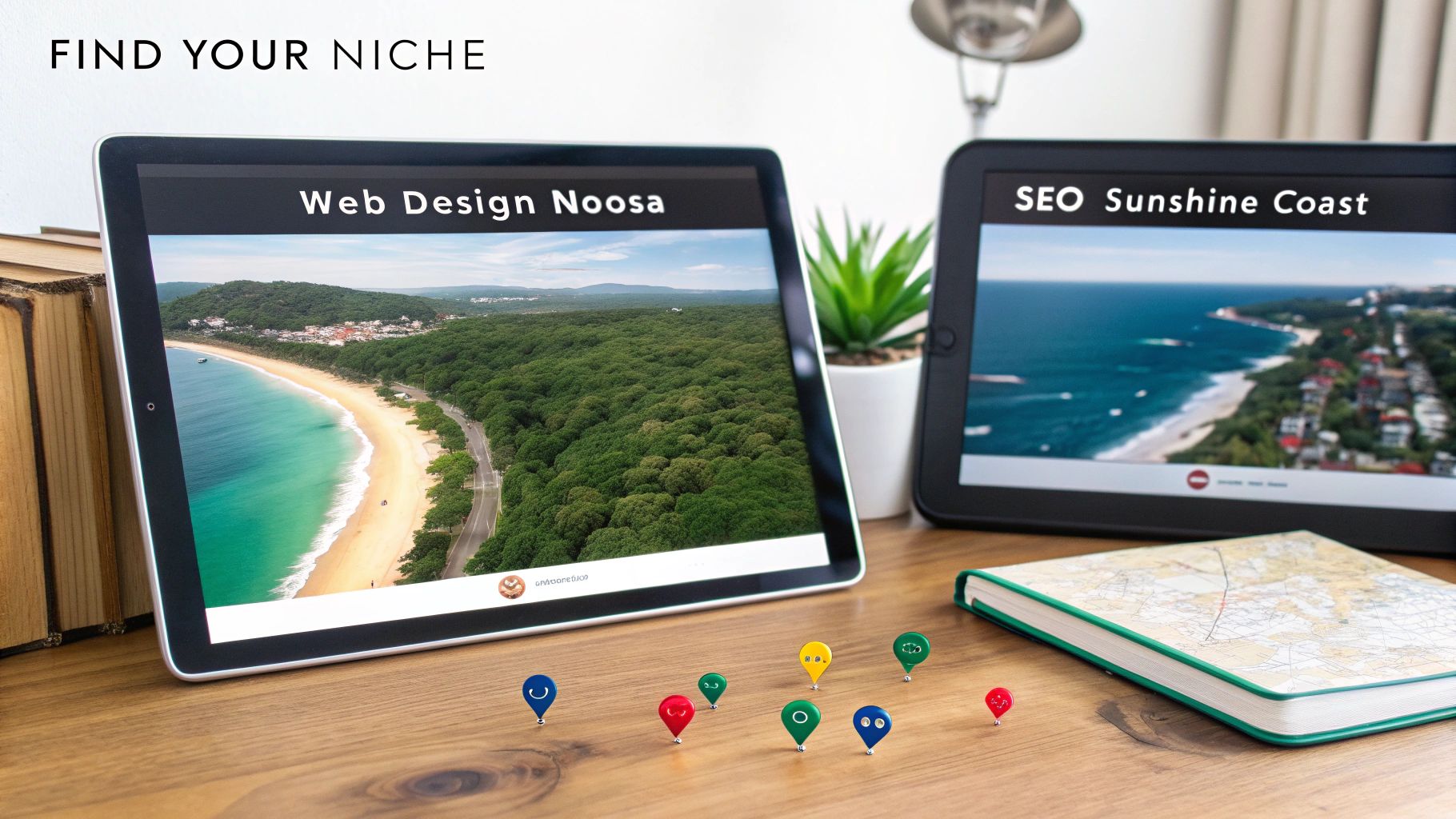
This kind of visual data tells a clear story about local demand, giving a business the confidence to pivot towards services with proven, consistent interest.
Discovering Untapped Opportunities
Beyond comparing services you already offer, Google Trends is brilliant for digging up fresh opportunities. The "Related Queries" and "Related Topics" sections are absolute goldmines here. They show you what else people are searching for around your main keywords, often flagged as "Rising" or "Breakout" queries.
- Rising Queries: These are search terms that have grown significantly in popularity. They point to emerging interests you can jump on before everyone else does.
- Breakout Queries: A "Breakout" query has seen explosive growth, usually because the topic is new. Getting in early on these can make you the go-to expert in the local market.
Let’s say you’re a Brisbane-based builder and you spot "eco-friendly home builders Brisbane" as a rising query. That’s not just a keyword; it’s a direct signal of a growing local demand for sustainable building. This insight lets you build specific landing pages, write blog posts, and run ad campaigns that speak directly to this highly motivated audience—capturing leads your competitors are completely missing.
By paying close attention to these rising trends, you're not just finding keywords; you're understanding the local mindset. You're learning that customers aren't just looking for a "builder," they're looking for a specific type of builder who aligns with their values.
Validating Your Business Ideas
Google Trends is also your best friend for stress-testing a new business idea before you sink a heap of time and money into it. Are you a Sunshine Coast cafe thinking about launching a dedicated vegan menu? Before you start sourcing ingredients, you can check the search trend for "vegan cafe Sunshine Coast" or "plant-based food Noosa."
A steady upward trend over the past couple of years is solid proof that a sustainable market is there. On the flip side, if interest is flat or falling, you might want to rethink your plan. This data-first approach minimises risk and ensures your big moves are backed by real-world demand, not just a gut feeling.
For local businesses, getting your focus right is everything. To see how these insights are put into practice, check out our guide on SEO services for the Sunshine Coast and Noosa.
Building a Winning Content Strategy with Search Insights
Great content isn’t about just filling a page with words. It’s about answering the exact questions your ideal customers are already typing into Google. When you plug Google Trends data into your content plan, you ditch the old "publish and pray" mindset for a sharp, data-backed strategy that actually hits home with your local market.
This is how you stop guessing. It’s how you start creating content that doesn't just rank, but genuinely helps and converts customers, whether they're on the Sunshine Coast, in Noosa, or across Brisbane.
Spotting Seasonal Rhythms and Capitalising on Timeliness
One of the most powerful things Google Trends can do for a local business is show you seasonal patterns with absolute clarity. For any Queensland business, timing is everything. Trying to push a service when nobody is looking for it is just burning through your marketing budget.
Let's say you run a landscaping company in Brisbane. A quick search for "outdoor living," filtered specifically to Queensland, reveals a predictable surge in interest every single year. It kicks off around September and peaks right before summer hits. That's not just a data point; it's your content calendar, gift-wrapped.
This insight is your signal to get a series of timely blog posts, social media updates, and special offers ready to go live just as that search interest starts its climb. You're meeting your customers exactly where they are, right when they need you.
By getting ahead of these seasonal waves, your content becomes hyper-relevant, grabbing the attention of motivated buyers at the perfect moment.
Building Topic Authority with Related Queries
If you want to truly own your niche, you have to be seen as the go-to expert. Google Trends is your secret weapon here, uncovering the subtopics and related questions your audience is asking. The ‘Related Queries’ feature is a genuine goldmine for building out topic clusters—smartly interlinked groups of content that cover a subject from every angle.
This is a cornerstone SEO strategy that proves to Google your website has deep, real-world expertise in a specific field.
For instance, a search for "landscaping Queensland" might show you rising related queries like:
- "low maintenance garden ideas Brisbane"
- "native plants Sunshine Coast"
- "best turf for Queensland climate"
Every one of those is a blog post or a guide just waiting to be written. By creating detailed articles for each and linking them all back to a main "Ultimate Guide to Queensland Landscaping" page, you weave a powerful web of authority that search engines absolutely love.
Using Google Trends for Content Validation
Before you sink hours into writing that huge, comprehensive guide, Google Trends can tell you if it's even worth the effort. By comparing a few potential blog topics, you can see which one has more sustained interest or a stronger upward trend in your specific local area.
This simple check stops you from creating content nobody is looking for. It ensures your resources are always aimed at topics with the highest possible impact, saving you a massive amount of time in the long run.
Understanding how Aussies search is vital here. Recent data shows a huge chunk of local searches happen on mobile, and many queries are answered without a click. While research reveals Australians frequently search for information (74.3%) and how-tos (68%), a lot of these end up as "no-click" searches.
A high interest score on Google Trends means people want to know, but it doesn’t guarantee a click unless your content is compelling and deep enough that Google can’t just summarise it on the results page. You can dig into more Australian search statistics on Red Search.
This makes it even more critical to use Google Trends to pinpoint those deeper, more complex questions that demand a full blog post to answer properly, driving that valuable traffic to your award-winning website. When you create truly comprehensive resources around trending topics, you give people a powerful reason to click through and connect with your brand.
Ready to move beyond the basics? Once you're comfortable with finding your niche and sketching out a content plan, it's time to get a real competitive edge. This is about using Google Trends to do more than just understand your audience—it’s about understanding exactly where your competitors fit into the market. It’s how you turn raw data into a strategic advantage that puts you miles ahead.
As an award-winning web design and SEO agency, we know success isn't just about what you do well. It's about knowing what everyone else is doing, too. By comparing brand interest, digging into local performance, and analysing different search platforms, you can start to anticipate market shifts and position your Sunshine Coast or Brisbane business to win.
Monitoring Brand Awareness and Share of Voice
One of the most powerful, and often overlooked, features in Google Trends is its ability to directly compare search interest for different brands. Think of it as a raw, unfiltered look at your share of voice in the local market. How many people are actually searching for your brand by name versus your biggest rival?
Imagine you run a popular café in Noosa, and a slick new competitor just opened up down the road. You can plug both your brand names into the comparison tool and, crucially, filter the location down to "Sunshine Coast."
Just like that, you have a visual timeline of brand awareness. You can see if their big launch campaign created a genuine spike in interest and track whether your own brand's search popularity is holding steady or taking a hit. This isn't just abstract data; it's a real-time report card on how relevant your brand is in the local community.
By checking this regularly, you can see how effective your marketing campaigns really are. If you run a massive promotion but see zero lift in brand searches while your competitor's interest is climbing, that's a crystal-clear signal that your message just isn't cutting through.
Uncovering Geographic Strengths and Weaknesses
Filtering by broad regions like "Queensland" is a good start, but drilling down to specific cities is where the real gold is. The "Interest by sub-region" feature is basically a treasure map, showing you exactly where your brand is strong and, more importantly, where your competitors have a solid foothold.
Let’s say you run a building company that services both Brisbane and the Sunshine Coast. By comparing your brand against a key competitor and setting the location to "Queensland," you might uncover something fascinating:
- You might be absolutely dominating searches across Brisbane’s suburbs.
- But your competitor could be the go-to choice in hotspots like Noosa and Maroochydore.
This kind of insight is invaluable. It tells you precisely where you need to double down on your local SEO efforts or run highly targeted ad campaigns to build awareness. It stops you from wasting your budget marketing to areas you already own and helps you go on the attack in regions where you’re falling behind.
Of course, this is just one piece of the puzzle. For a complete guide on how to approach this, it’s worth learning how to do a competitive analysis from top to bottom.
Analysing Interest Across Different Google Properties
Most people never change the default "Web Search" filter in Google Trends, and they're missing out on a huge part of the story. Your customers aren't just typing into the standard search bar; they’re hunting for information on YouTube, Google Images, and Google Shopping.
Switching between these different properties can reveal entirely different layers of what your customers are thinking.
-
Image Search: A high search interest here for a competitor’s product suggests they've nailed their visual branding, and people are actively looking for it. For a Sunshine Coast builder, this could mean potential clients are searching for images of their finished projects.
-
YouTube Search: A rising trend here is a massive clue that there's a demand for video content. If your competitor has a popular YouTube channel packed with project showcases or DIY tips, that's your cue to get a video strategy in place to compete.
-
Google Shopping: For any e-commerce business, this filter is non-negotiable. It shows you which specific products are trending and which brands are grabbing the attention of people who are ready to pull out their wallets.
By taking the time to explore these different search types, you get a much richer, more complete picture of your competitor's digital footprint. It lets you spot the gaps in their strategy—and your own—so you can make smarter calls on where to invest your marketing budget for the biggest possible impact.
Turning Google Trends Insights Into Real-World Action
All the data in the world is useless if you don't do anything with it. This final part is all about creating a clear roadmap to weave Google Trends into your regular marketing routine, turning those cool graphs into consistent, measurable growth. Success always comes down to having a solid process.
As an award-winning web design and SEO agency, we've seen firsthand that systematically applying these insights is what separates thriving businesses from the rest. The goal is to move beyond just dipping in and out of Google Trends and instead build a structured approach. This makes data-informed decisions a core part of your strategy, ensuring your efforts are always in sync with what customers across Brisbane, Noosa, and the Sunshine Coast are actually searching for.
This simple process flow shows exactly how to tackle competitive analysis using trend data.
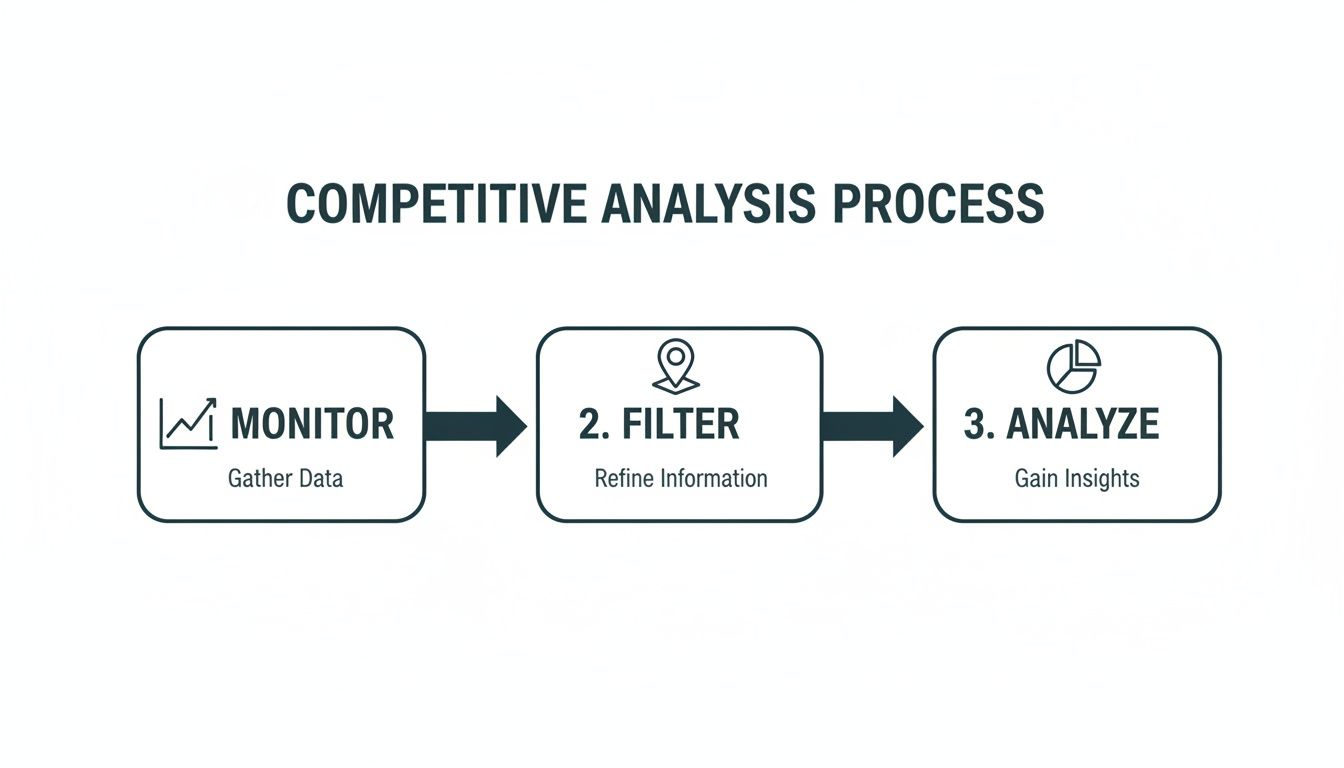
This workflow boils it down to three essential steps: Monitor, Filter, and Analyse. It’s a straightforward way to transform raw data into smart strategic actions that give you a genuine competitive edge.
To see how we apply these same principles to get real results for local businesses, feel free to explore some of our award-winning projects in our work portfolio. By sticking to a clear plan like this, you can turn Google Trends into a powerful tool for growing your visibility and bringing in more customers.
Got Questions About Google Trends?
We get a lot of questions from Brisbane, Noosa, and Sunshine Coast businesses about how to really put Google Trends to work for their local marketing. Here are the answers to the most common ones.
How Is Google Trends Different from Paid SEO Tools?
Think of Google Trends and paid tools like Ahrefs or SEMrush as partners, not rivals. They answer different questions.
Google Trends is your go-to for understanding the relative popularity and seasonal rhythm of a topic. It tells you what people are interested in and when they’re most interested.
Paid SEO tools, on the other hand, give you the hard numbers: estimated search volumes, keyword difficulty, and deep competitor data. They tell you how many people are searching for something and how hard it will be to rank for it.
A smart strategy uses both. We start with Google Trends to spot a rising local trend, then jump into a paid tool to find the exact, high-value keywords to target within that trend.
Is the Data Reliable for a Small Area Like Noosa?
Yes, but you have to be clever about it. For super niche search terms in a smaller town, you might hit a "not enough data to show here" message. Don't let that stop you.
You can still pull out powerful local insights by widening your scope slightly to the "Sunshine Coast" region. Even better, use the comparison feature. Pitting "plumber Noosa" against "blocked drain Noosa" will still clearly show you which service term has higher relative interest, telling you which pages to prioritise on your website.
How Often Should I Check Google Trends for My Business?
There’s no need to live on the platform, but a consistent routine makes all the difference. We recommend a simple two-part approach for our clients.
- For your core services and brand name: A quick check-in once a month or even quarterly is perfect. This gives you a clear view of long-term patterns and your brand's share of voice in the local market.
- For content planning and seasonal topics: A weekly check-in can be a game-changer. It helps you spot emerging interests and get timely content out before your competitors even notice the shift.
Here's a pro tip: set up Google Alerts for your most important local keywords. That way, you get an email the moment there’s a big spike in search interest, allowing you to react fast.
Ready to turn these insights into measurable growth for your Sunshine Coast or Brisbane business? At Digital Roo's, our award-winning team leads with expert web design and backs it up with data-driven SEO to build digital experiences that deliver real results. Let's build a stronger website and an even stronger business, together. https://digitalroos.com