
Local directories are a non-negotiable for any business that wants to be found by customers in their neighbourhood. At their simplest, they’re online platforms listing businesses by what they do and where they are. Think of giants like Google Business Profile and TrueLocal—they’re essential engines for driving local traffic, calls, and ultimately, sales for businesses across the Sunshine Coast, Noosa, and Brisbane.
Why Local Directories Are a Growth Engine
There’s a common myth floating around that local directories are old news, completely overshadowed by social media. Nothing could be further from the truth. For businesses in competitive markets like the Sunshine Coast, Noosa, and Brisbane, they’re more critical than ever. As an award-winning web design first agency with expert SEO marketing skills, we’ve seen it time and time again: a smart, strategic presence on these platforms is a massive trust signal for both customers and search engines.
Put yourself in the customer’s shoes. Every time someone searches “cafe near me” in Noosa or “plumber Brisbane,” Google glances across these directories to figure out which businesses are legitimate, active, and relevant. A listing on a high-authority site is like a digital thumbs-up that boosts your credibility.
The Bedrock of Local SEO: NAP Consistency
The absolute heart of any successful local directory strategy is NAP consistency. This is the non-negotiable acronym for your business Name, Address, and Phone number.
When this core information is identical across every single online listing—and I mean identical—it sends a crystal-clear signal to search engines that your business data is accurate and trustworthy.
Even tiny inconsistencies can throw a spanner in the works. Using “St” on one directory and “Street” on another, or having an old phone number floating around, creates confusion. That confusion chips away at Google’s trust, hurting your local search rankings and making it that much harder for customers on the Sunshine Coast or in Brisbane to find you.
A consistent NAP across the web is the single most critical factor for local SEO. It’s the foundation upon which all other local marketing efforts are built, confirming your business’s physical location and legitimacy to Google.
Amplifying Your Digital Footprint
Beyond just giving your search ranking a nudge, a solid directory presence massively expands your online visibility. You’re no longer relying solely on your own website. Each optimised listing becomes another digital doorway for a customer to discover your business. To see the bigger picture, it’s helpful to view directories as one part of your broader local marketing strategies.
A strong network of listings works in harmony to:
- Increase touchpoints: Customers can find you on Google Maps, Yelp, TrueLocal, and industry-specific sites, multiplying the chances they’ll connect with you.
- Build authority: Every high-quality citation acts like a vote of confidence in your business, contributing to your overall digital authority.
- Drive direct actions: A well-optimised listing doesn’t just sit there; it translates directly into phone calls, website clicks, and foot traffic to your Sunshine Coast or Brisbane location.
At the end of the day, local directories are a key piece of a much larger puzzle. They are a fundamental part of a multi-faceted approach to search engine optimisation. To see how this fits into a complete strategy, you can learn more about our comprehensive SEO services.
Find and Claim Your Online Presence
Chances are, your business already has a digital footprint scattered across various local directories—whether you put it there or not. Platforms often scrape public data to automatically generate profiles, which can be a messy mix of accurate, outdated, or just plain wrong information. The first, most critical step is to take control of that narrative.
Think of it like tidying up your shopfronts across the city. You wouldn’t let one of your physical locations in Brisbane or Noosa have the wrong opening hours taped to the door, and the same rule applies online. This whole process is about auditing your presence, hunting down every single listing, and officially claiming ownership.
Uncovering Your Digital Footprint
Before you can fix anything, you need a complete picture of where your business is listed online. So many business owners are shocked to find listings they never knew existed, often with old phone numbers or previous addresses that are actively confusing potential customers on the Sunshine Coast.
A simple but highly effective starting point is to run a few specific searches for your business. Be sure to use different variations to catch everything:
- Business Name + City: “Your Cafe Name Brisbane”
- Business Name + Postcode: “Your Clinic Name 4567”
- Phone Number: “07 5555 1234”
- Old Business Names or Addresses: If you’ve moved or rebranded, definitely search for those, too.
Document every single listing you find in a spreadsheet. This audit becomes your roadmap for the cleanup ahead and helps you track your progress methodically.
As an award-winning web design agency, we see this all the time. A client in Brisbane or Noosa thinks they only have a Google profile, but a quick audit reveals a dozen other listings on sites like TrueLocal and Yelp, many with conflicting details. Taking control of these is non-negotiable for building trust with Google.
The Claiming and Verification Process
Once you’ve found a listing, the next job is to claim it. This is how you prove to the directory platform that you are the legitimate business owner. While each platform has its own little quirks, the general process is pretty consistent. You’ll typically look for a link that says something like “Claim this business” or “Is this your business?”
From there, you’ll need to complete a verification step. This is a crucial security measure that confirms your connection to the business. The most common methods include:
- Phone Call or SMS: The directory sends an automated call or text with a PIN to your listed business number.
- Email Verification: A confirmation link is sent to an official business email address (like one with your domain name).
- Postcard by Mail: Google, in particular, still uses this method often. They will mail a postcard with a unique code to your physical business address to verify your exact location.
Just be prepared for this process to take a few days, especially if you’re waiting on a postcard. It’s a small investment of time that pays off massively by giving you full control over your business information and proving to search engines that your data is rock-solid and reliable.
Turn Your Listings into Customer Magnets
Just getting your business profile claimed on a few local directories is only the first step. The real magic—the part that helps you pull ahead of your competition in Brisbane and across the Sunshine Coast—is in the optimisation.
This is where our expertise as an award-winning web design first agency really shines. It’s about turning a basic, bare-bones listing into a powerful tool that actively draws in new customers.
This is much more than just dropping in your business name and address. You’re crafting a story that connects directly with what local people are searching for. Think about it: a potential customer isn’t just typing “electrician” into Google. They’re searching for “emergency electrician in Noosa” or “best cafe near South Bank.” Your listing needs to be the answer to those specific queries.
Craft Compelling Business Descriptions
Your business description is prime real estate. It’s your one shot to tell both customers and search engines exactly who you are, what you do, and why you’re the best choice in the area.
Don’t just rattle off a list of services. Instead, weave your crucial local keywords into a natural, compelling narrative. A well-written description is a powerful signal that connects your business to the specific problems people are trying to solve. For a Sunshine Coast plumber, that means talking about servicing suburbs from Caloundra to Maroochydore and mentioning specific jobs like “hot water system repairs.”
Of course, before you can optimise, you have to get control of your listings. The process always follows three core stages: finding your existing profiles, claiming ownership, and then verifying your connection to the business.
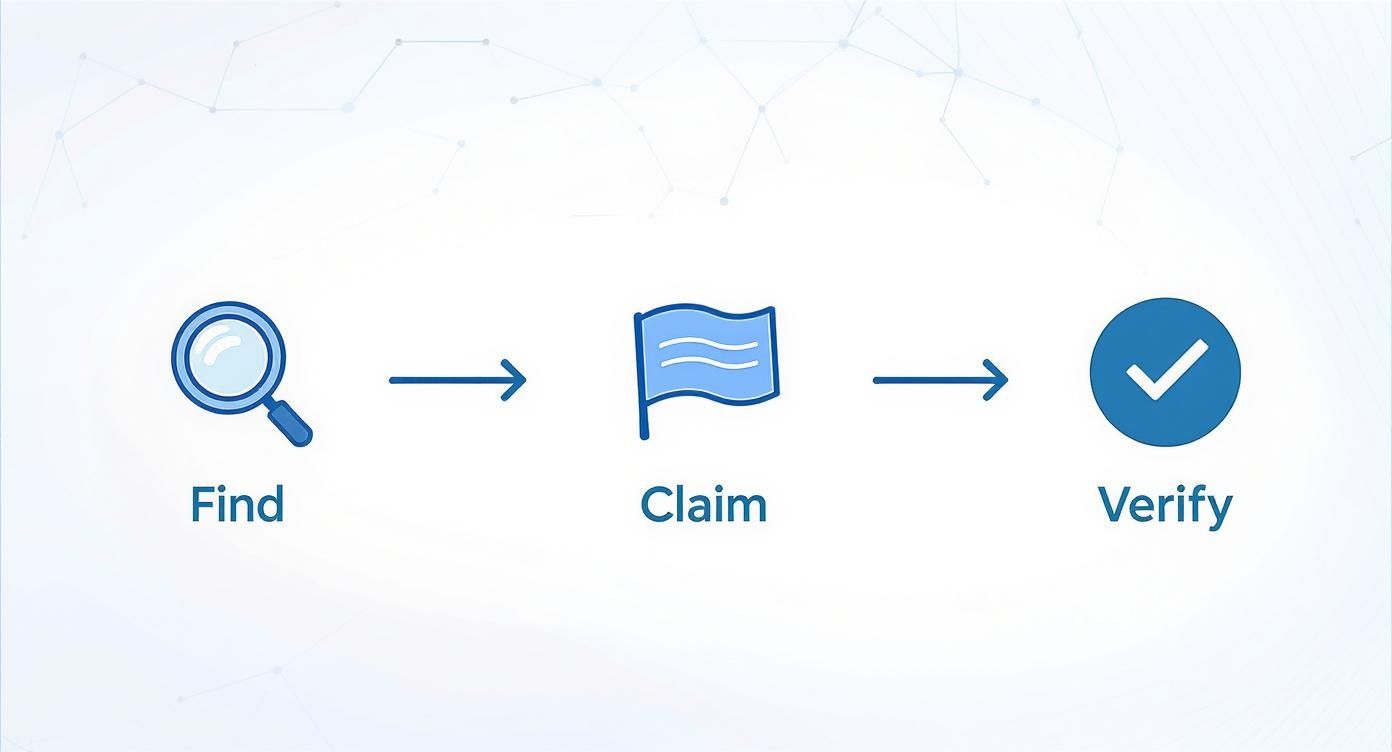
Nailing this simple workflow is the foundation. It’s how you take control of your online presence before you can start the critical work of making it shine.
Bring Your Business to Life with Rich Media
A listing with just text is completely forgettable. High-quality photos and videos are what make a user stop scrolling and actually engage. They offer a real, tangible glimpse into what you do, building trust long before a customer ever steps through your door.
Make sure you upload a variety of images:
- Your exterior: Show people what your storefront looks like so they can easily find you.
- Your interior: Give them a feel for the atmosphere. A Brisbane cafe should show off its cosy seating, while a Noosa retail shop should highlight its unique product displays.
- Your team: Putting a friendly face to the business name makes you instantly more approachable and trustworthy.
- Your work: Showcase your best products or the finished results of your services.
Pro Tip: Before you upload any photos, make sure you geotag them. This embeds location data directly into the image file, giving search engines another strong local signal that your business is genuinely tied to that specific area.
This strategic approach isn’t just guesswork; it’s backed by solid Australian data. Businesses that keep their profiles rich and active across multiple directories don’t just see an average 23% increase in local search visibility—they also have a 34% higher survival rate in their first three years. These figures highlight just how vital this strategy is for long-term success.
Finally, remember that all your hard work on local directories can be undone if your website is slow. A customer clicking through from your listing only to find a site that takes forever to load will simply leave. Your website’s performance is deeply connected to your local SEO success. You can explore our insights in this WP Rocket review to get a better handle on how crucial site speed is for user experience and turning visitors into customers.
Mastering Your Online Reputation with Reviews

For any local business today, reviews are the lifeblood of your reputation. They’re the digital version of a classic word-of-mouth referral, whether you run a bustling Sunshine Coast café or a trade business in Brisbane.
Think about it. Reviews are often the final piece of social proof a potential customer needs before they decide to pick up the phone or walk through your door. It’s not enough to just hope for the best; you need a proactive strategy to generate and manage them.
Encouraging Genuine Customer Feedback
The best time to ask for a review is right after a great experience. That’s when a customer’s satisfaction is at its peak and they’re most likely to share their positive thoughts.
But you have to make it dead simple for them. No one is going to hunt down your profile.
Instead, you should:
- Provide direct links: Send a follow-up email or SMS with a direct link to your Google Business Profile or TrueLocal listing.
- Use QR codes: Pop a small sign with a QR code at your point-of-sale or on an invoice. This makes it incredibly easy for customers to leave feedback on the spot.
Just by removing that little bit of friction, you’ll see a huge increase in the number of reviews you get.
A thoughtful response to a negative review can be more powerful than a dozen positive ones. It demonstrates accountability, showcases your commitment to customer service, and proves to everyone watching that you value your clients, turning a potential negative into a public display of trust.
Responding to Every Single Review
Responding to reviews is completely non-negotiable, and it’s where so many businesses drop the ball. Every response shows that you’re engaged and that you genuinely value what your customers have to say—good, bad, or somewhere in between.
With positive reviews, a simple, personalised “thank you” goes a long way. Try to mention a specific detail from their review to show you actually read it.
For negative reviews, your approach is critical. Respond quickly and publicly. Acknowledge their concern without getting defensive, and then offer to take the conversation offline to sort it out properly. This shows everyone reading that you’re professional and committed to getting it right.
This whole feedback loop is vital because Australian local directories still command a massive amount of user trust. Platforms like TrueLocal and Yelp Australia, for example, pull in around 1.1 million and 1.5 million monthly visits respectively. And directories with local customer service teams see 40% higher trust ratings.
Ultimately, managing your online reputation isn’t just about damage control. It’s about finding ways to constantly enhance the customer experience, which is what fuels real business growth. You can explore more strategies to improve customer satisfaction to build on this foundation.
Scaling Your Strategy for Multiple Locations
Managing local directories gets a lot more complex once your business grows beyond a single storefront. For brands with a presence across Brisbane, Noosa, and the Sunshine Coast, a cookie-cutter approach just won’t cut it. Each location needs its own distinct online identity to connect with its local community and send clear, powerful signals to search engines.
The goal here is to treat each branch as its own separate local business. This means you need to create individual, fully optimised listings for every single location. It’s a common mistake to just copy and paste the same information across the board, but a generic description doesn’t help a customer in Noosa who needs to know if your store there offers a specific service that your Brisbane branch might not.
Giving Each Location Its Own Voice
To make each of your listings really shine, you have to infuse them with local flavour. This goes way beyond just changing the address; it’s about customising the content to reflect that specific area and the people who live there.
- Location-Specific Keywords: Instead of using broad terms, get specific. Target phrases like “award-winning web design Fortitude Valley” for your Brisbane office and “expert SEO services Noosa Heads” for your Sunshine Coast branch.
- Unique Photos: Post high-quality images of each storefront’s exterior, interior, and, most importantly, the local team. Nothing builds trust and confirms a physical location better than seeing the actual place and the people who work there.
- Localised Reviews: Actively encourage customers to leave reviews for the specific branch they visited. A review that raves about a great experience in your Sunshine Coast office is an incredibly powerful local signal for that particular listing.
On top of all this, maintaining perfect NAP (Name, Address, Phone Number) consistency across every single listing for each location is completely non-negotiable. This is where so many multi-location businesses fall down, but getting it right is absolutely crucial for building authority for your entire brand.
The rewards for getting your multi-location strategy right are enormous. Australian data shows that multi-location businesses drive an astounding 557% more traffic on average than single-location businesses, a testament to their expanded digital footprint.
That massive difference really highlights the value of scaling your local SEO efforts the right way. Our experience providing SEO services on the Sunshine Coast and in Noosa has shown us time and again that a dedicated strategy for each location builds a much stronger, more visible brand.
In fact, research shows that multi-location businesses average around 80,022 sessions, completely dwarfing the 12,186 sessions seen by their single-location counterparts. You can explore more of these Australian local SEO statistics to really understand the full impact.
Common Questions About Local Directories
Diving into the world of local directories always stirs up a few questions. As an award-winning web design first agency with strong SEO marketing skills, we’ve helped businesses right across Brisbane, Noosa, and the Sunshine Coast, and we’ve pretty much heard it all. Here are the clear, no-fluff answers to the queries that land in our inbox most often.
Think of this as your cheat sheet to managing your local SEO with confidence. Let’s get straight into what business owners like you are asking.
Which Directories Should My Business Focus On?
For any business trading in the Sunshine Coast, Noosa, or Brisbane, your Google Business Profile is non-negotiable. It’s your most powerful digital storefront, period. Once you’ve got that looking perfect, turn your attention to the high-authority Australian directories like TrueLocal, Yellow Pages, and Yelp Australia.
After you’ve nailed the big ones, it’s time to think about your specific industry.
- A restaurant in Noosa absolutely has to be on Zomato.
- A Brisbane-based sparky or plumber needs a solid profile on HiPages.
- A tourism operator anywhere on the Sunshine Coast must be visible on TripAdvisor.
A word of advice from the trenches: quality always, always beats quantity. A handful of fully optimised listings on relevant platforms will do more for your local SEO than fifty half-finished profiles on sites nobody’s ever heard of.
How Do I Handle a Negative Review?
First off, don’t panic. A negative review isn’t a disaster—it’s actually a golden opportunity to show everyone how professional you are. The cardinal rule is to respond publicly and respond quickly, ideally within 24 hours.
Acknowledge their experience without getting defensive. A bit of empathy goes a long way. Then, immediately offer to take the conversation offline to fix the problem. Something as simple as, “We’re very sorry to hear this. Please call our manager on… so we can make this right” shows potential customers that you take feedback seriously. Never, ever get into an argument online.
And if a review is obviously fake or breaks the platform’s rules? Use the reporting tool to flag it for removal.
How Often Should I Update My Listings?
You should be checking your key listings, especially your Google Business Profile, at least once a month. This is your chance to reply to new reviews and answer any questions that have popped up. But the real results come from active, ongoing management.
Try to add new photos every quarter to keep things looking fresh. It’s also a great habit to use features like Google Posts weekly to announce a special offer, share an update, or highlight a new service.
But here’s the most important part: if any of your core business details change—your hours, phone number, or address—you must update every single one of your local directory listings immediately. This is non-negotiable for maintaining that critical NAP consistency that search engines demand.
Can I Manage Directories Myself or Should I Hire an Agency?
You absolutely can manage your own listings. For a new business with a single location, it’s a fantastic way to get your hands dirty and take control of your online presence. Getting the basics right yourself is an empowering first step.
The reality, though, is that doing it properly takes a serious amount of time. As your business grows, or if you’re juggling multiple locations across Brisbane and the Sunshine Coast, working with an award-winning agency that is web design first with strong SEO marketing skills becomes a huge strategic advantage. We can guarantee perfect consistency at scale, roll out more advanced optimisation tactics, and free you up to do what you do best—run your business.
Ready to turn your local directory presence from a chore into a powerful customer acquisition channel? At Digital Roo’s, we combine award-winning web design with expert SEO to help businesses across the Sunshine Coast, Noosa, and Brisbane dominate their local market. Let’s build a stronger online presence for your business together. Learn more about our services at Digital Roo’s.