

Think of SEO keywords as the bridge connecting what your customers are searching for online and the solutions you provide on your website. They aren't just technical jargon; they are the exact words and phrases your audience uses every day, making them the absolute foundation of any solid digital strategy.
What Are SEO Keywords and Why They Matter

Let's imagine your business is a library packed with valuable information, products, and services. Your SEO keywords are the signs on the end of each aisle and the catalogue system that guides people straight to the exact shelf they need. Without those clear signs, potential customers would just wander around aimlessly and probably leave—even if you had precisely what they were looking for.
In the digital world, that "catalogue system" is run by search engines like Google. When someone types a question into the search bar, Google's algorithm zips through billions of pages to find the most relevant, helpful answers. It relies heavily on the keywords it finds on your pages to figure out what your content is all about.
The Bridge Between You and Your Customer
At its heart, keyword research is just good old-fashioned market research. It’s about getting inside your ideal customer's head to understand their needs, their questions, and what's keeping them up at night. When you start speaking their language on your website, you build a powerful connection.
This process tackles two massive business challenges head-on:
- Understanding Your Audience: It forces you to stop guessing what people want and start using real data to see what they're actively looking for.
- Getting Found: It helps you structure your website and content so that search engines can easily see it as the perfect answer to your audience's questions.
Getting this alignment right is what turns a website from a static online brochure into a dynamic, traffic-generating machine. By targeting the right SEO keywords, you make sure your business shows up at the exact moment a potential customer is searching for a solution you offer.
A classic mistake is creating content that you want to write, instead of content your audience genuinely needs to read. Good keyword research closes that gap, ensuring your efforts line up with real customer demand.
It's About More Than Just Traffic
While getting more website visitors is a huge plus, the real impact of a smart keyword strategy goes much deeper. It directly affects your ability to attract qualified leads—people who are much further along in their buying journey and far more likely to become customers.
Think about it. Someone searching for "best running shoes for flat feet in Melbourne" is a much hotter lead than someone just browsing for "shoes."
Ultimately, mastering keywords is all about relevance. The more relevant your content is to what someone is searching for, the higher Google will rank it. That higher visibility leads to more clicks, which in turn creates more opportunities for engagement, leads, and sales. It’s the foundational first step to building a sustainable online presence that drives real business growth.
Understanding the Different Types of Keywords
Thinking every keyword is the same is a bit like believing every tool in a toolbox is a hammer. You can’t build a solid business strategy with just one approach, and you certainly can’t build a great SEO strategy that way either. To get real, measurable results, you need to understand the different kinds of SEO keywords and how they slot into your customer’s journey.
Getting this right empowers you to pick keywords that line up perfectly with what you’re trying to achieve—whether that’s building brand awareness, educating potential customers, or driving sales right now. Let's break down the main categories you'll be working with.
Short-Tail Versus Long-Tail Keywords
The first and most fundamental split is between broad and super-specific search terms.
-
Short-tail keywords are the big, broad searches, usually just one to three words long. Think "shoes," "cafe," or "marketing agency." They pull in massive search volume but are fiercely competitive and incredibly vague. Someone searching for "shoes" could be looking for anything from baby booties to a local shoe repair shop.
-
Long-tail keywords are much longer, more descriptive phrases, typically four words or more. For example, "women's waterproof hiking boots size 8" or "best dog-friendly cafe in Fitzroy." While their individual search volume is way lower, the competition is a walk in the park by comparison, and they reveal a crystal-clear user intent.
Long-tail keywords are the secret weapon for small businesses. They attract highly qualified traffic from people who are often much closer to making a purchase, which naturally leads to higher conversion rates. A person searching a specific phrase knows exactly what they want.
To help you get your head around these concepts and how to apply them, here’s a quick comparison of the main keyword types.
Keyword Types and Their Strategic Use
This table breaks down the main keyword categories, showing you where they fit into a smart SEO plan.
| Keyword Type | Example | Typical Volume & Competition | Best Use Case |
|---|---|---|---|
| Short-Tail | "running shoes" | High Volume, High Competition | Building top-of-funnel brand awareness through blog content and guides. |
| Long-Tail | "best trail running shoes for wide feet" | Low Volume, Low Competition | Targeting high-intent buyers with specific product pages or detailed review articles. |
| Informational | "how to choose running shoes" | Varies (often high) | Attracting new audiences and building authority with how-to guides and educational blog posts. |
| Commercial | "Asics vs Brooks running shoes review" | Medium Volume, Medium-High Competition | Capturing users in the research phase with comparison articles, "best of" lists, and in-depth reviews. |
| Transactional | "buy Nike Pegasus 40 online" | Low Volume, High Competition | Driving immediate sales through optimised product pages, service pages, and special offer landers. |
| Local | "running shoe store Melbourne CBD" | Varies (often low) | Drawing foot traffic and local online orders for brick-and-mortar businesses or service area providers. |
Understanding these distinctions is what separates a scattergun approach from a laser-focused strategy that actually drives growth.
Keywords Categorised by User Intent
Beyond just length, the most critical factor is understanding why someone is searching in the first place. This is called user intent, and it generally falls into four distinct buckets. Each one demands a completely different type of content to give the user what they’re looking for.
-
Informational Intent: The user is hunting for information. They have a question or want to learn something, like "how to start a business" or "what is SEO." Your best bet here are blog posts, in-depth guides, and helpful tutorials.
-
Navigational Intent: The user is simply trying to get to a specific website or brand they already know. Searches like "Digital Roo's login" or "Facebook" fit this bill. Their goal is just to get from A to B.
-
Commercial Intent: The user is in the research phase, weighing up their options before they commit to a purchase. They’re looking for the best solution, and their searches often include words like "best," "review," "top," or "comparison," such as "best WordPress hosting Australia."
-
Transactional Intent: The user has their wallet out and is ready to buy. These keywords show strong purchase intent and often include terms like "buy," "discount," "price," or specific product names like "buy iPhone 15 Pro." Product pages and service pages need to be optimised for these terms.
Branded, Non-Branded, and Local Keywords
Finally, we can group keywords based on their connection to specific brands and places.
-
Branded keywords include a company or brand name, like "Nike running shoes." These searches are almost always made by people who already know and trust the brand.
-
Non-branded keywords are the generic terms that don’t mention a specific brand, such as "running shoes." These are absolutely vital for attracting new customers who haven't heard of your business yet.
Local keywords are searches tied to a specific geographic area, like "plumber in Ballarat" or "cafe near me." For any Australian business with a physical shopfront or a defined service area, these are pure gold. Local SEO is a massive part of business strategy here, with a staggering 28% of total search traffic in Australia coming from local searches.
Even more importantly, 76% of location-based mobile searches lead to a physical store visit within 24 hours. This stat alone shows how critical local keyword targeting is for driving real, immediate sales. You can dive deeper into these trends and learn more about local SEO for Australian businesses on Netstripes.com.
Your Step-by-Step Keyword Research Process
Alright, now that you’ve got a handle on the different types of SEO keywords, it’s time to roll up your sleeves and find them. Don't think of keyword research as some dry, technical chore. It's actually a form of digital market research—your playbook for figuring out exactly what your customers need and how you can be the best answer to their questions.
This process isn’t about guesswork. It’s about following a repeatable method to build a powerful list of terms that will bring the right kind of traffic to your site.
Begin with Brainstorming and Seed Keywords
Before you even think about touching any fancy software, start with a pen and paper (or a blank doc). The goal here is simple: get inside your customer's head. What are their problems? What questions do they ask? What words do they use to describe what they’re looking for?
These initial ideas are what we call seed keywords. They’re the broad, foundational topics related to your business that will kickstart your deeper research.
- List Your Products or Services: Start with the obvious. If you sell hiking boots, your seed keywords are "hiking boots," "trail shoes," and "outdoor footwear."
- Think Like Your Customer: How would they search for you if they didn't know your brand name? They might type in "best waterproof hiking boots for men" or "how to choose hiking boots."
- Consider Problems You Solve: People often search for solutions, not products. A customer might not search for your brand, but for an answer to their problem, like "sore feet after hiking" or "ankle support boots."
This first list doesn't have to be perfect. It’s just about creating a solid starting point before you dive into the data.
Leverage Powerful Keyword Research Tools
Once you have your seed list, it’s time to expand on it with some powerful software. These tools give you real-world data on what people are actually searching for, helping you shift from assumptions to informed decisions.
While there are plenty of options out there, most work on similar principles. Popular choices for Australian businesses include:
- Google Keyword Planner: This is a free tool from Google that gives you search volume estimates and new ideas straight from the source. It’s fantastic for initial research and getting a feel for search trends.
- Ahrefs and SEMrush: These are the big guns—premium, all-in-one SEO platforms. They provide incredibly detailed data on keywords, what your competitors are doing, and how hard it will be to rank, making them a worthy investment for serious growth.
These tools will take your handful of seed keywords and turn them into hundreds or even thousands of related terms, along with the crucial metrics you need to prioritise them. You can find many more valuable insights and practical guides in our collection of tips for small businesses.
Analyse Your Competitors for Hidden Gems
One of the smartest shortcuts to finding high-value keywords is to see what’s already working for your competition. This isn't about blindly copying them. It’s about spotting opportunities they might have missed or identifying areas where you can provide a much better answer.
You can use tools like Ahrefs to plug in a competitor's website and see the exact SEO keywords they’re ranking for. Keep an eye out for "keyword gaps"—these are terms they rank for that you don’t. This can uncover entire topic areas you hadn't even thought of, giving you a serious competitive edge.
By analysing the keywords that drive traffic to your competitors, you get a direct look into what your shared target audience is searching for. It’s like getting a free roadmap to customer intent.
This infographic gives a great visual of how to think about the user’s journey, from their initial research right through to making a purchase.
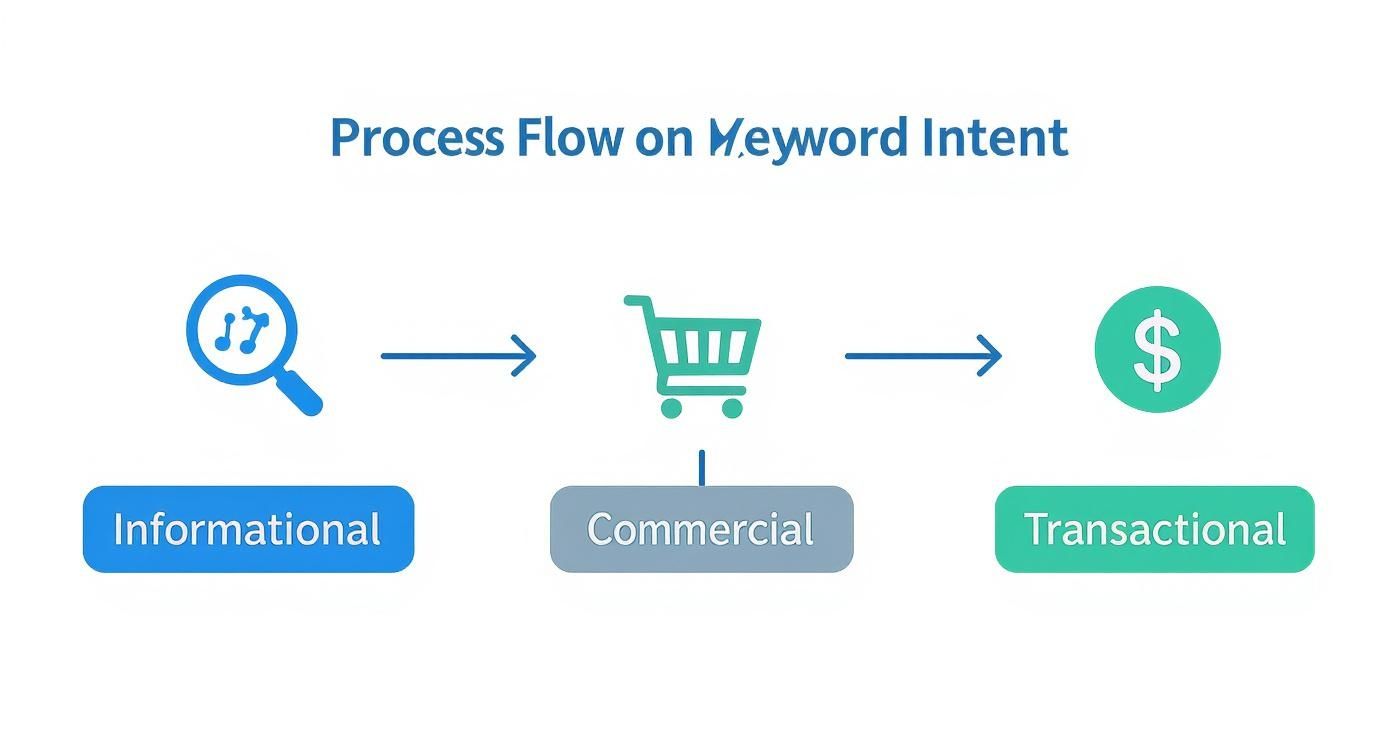
You can see the flow from informational to transactional intent, showing how a user’s search behaviour gets more specific as they move closer to buying.
Prioritise Keywords Using Key Metrics
Your research will probably leave you with a massive list of potential keywords. The final step is to bring some order to the chaos and prioritise this list based on data. Three core metrics should guide your decisions:
- Search Volume: This is the average number of times a keyword gets searched each month. Higher volume can mean more potential traffic, but it almost always means more competition, too.
- Keyword Difficulty (KD): This metric (scored differently by each tool, usually out of 100) estimates how hard it will be to crack the first page of Google for a specific term. As a small business, targeting keywords with lower difficulty scores is a smart way to get some early wins.
- Search Intent: As we've covered, this is the ‘why’ behind the search. Is the user trying to learn something, compare options, or buy right now? You need to match your keywords to content that serves their specific intent.
Australian businesses are projected to invest $1.5 billion in SEO services in 2025, a clear sign of its growing importance as a core marketing channel. A major driver for this is that 70% of all Australian searches now use long-tail keywords, which shows users are getting much more specific with their queries. You can discover more insights about the Australian SEO market on Redsearch.com.au.
By following this repeatable process, you can build a strategic keyword list that becomes the foundation of a truly successful content and SEO plan.
How to Map Keywords to Your Content Strategy

A well-researched list of SEO keywords is a great start, but on its own, it’s just raw data. The real magic happens when you turn that list into a structured, powerful content plan. This process, called keyword mapping, is all about assigning specific keywords to dedicated pages on your site.
It ensures every single piece of content you create has a clear, strategic purpose.
Think of your website like a well-organised retail shop. You wouldn’t just dump all your products in a big pile near the front door, would you? Of course not. You’d create specific aisles and shelves for each category. Keyword mapping does the exact same thing for your digital storefront, creating a logical structure that helps both users and search engines find what they need, fast.
This deliberate approach also prevents a common SEO issue known as "keyword cannibalisation." This is where multiple pages on your own site accidentally compete for the same keyword, confusing search engines and watering down your authority. A clear map ensures each page is targeting its own unique set of terms.
Aligning Keywords with Content Types
The first step in mapping is to match your keywords to the right kind of page, which is all dictated by user intent. Getting this alignment right is critical for meeting your audience's expectations and guiding them towards the right actions.
Here’s a simple framework many Australian businesses follow:
- Transactional Keywords for Product/Service Pages: Terms with strong buying intent like "buy R.M. Williams boots online" or "emergency plumber Sydney" belong on your product or service pages where a transaction can actually happen.
- Informational Keywords for Blog Posts and Guides: Queries like "how to clean suede boots" or "what to do when a pipe bursts" are perfect for blog content. These pages attract people at the beginning of their journey, building trust and positioning your brand as a helpful expert.
- Commercial Keywords for Comparison Pages: Searches such as "best hiking boots Australia" or "Blundstone vs R.M. Williams review" signal that a user is weighing up their options. These are ideal for in-depth reviews or comparison articles that help guide them to a decision.
- Navigational & Branded Keywords for Your Homepage: Terms like "[Your Brand Name]" or "[Your Brand] contact" should lead straight to your homepage or other core pages, making it easy for existing customers to find you.
Keyword mapping transforms your content strategy from reactive to proactive. Instead of guessing what to write next, you build a content calendar based on a clear blueprint of what your customers actually need. Every article and page serves a specific, strategic purpose.
For businesses on the Sunshine Coast, tying local SEO into this strategy is a must. Mapping local terms like "SEO services Noosa" to a dedicated service page can dramatically improve your visibility in geographically-targeted searches. You can see how this works by exploring professional SEO services on the Sunshine Coast and in Noosa.
Building Authority with Topic Clusters
A modern and incredibly effective approach to keyword mapping is the topic cluster model. This strategy involves creating a central, comprehensive "pillar page" on a broad topic and then linking out to several in-depth "cluster pages" that cover specific subtopics in more detail.
This model organises your content in a way that proves deep expertise to search engines. For an online shop selling outdoor gear, the structure might look something like this:
- Pillar Page: "The Ultimate Guide to Hiking in Australia" (targeting a broad, high-volume keyword).
- Cluster Pages: "Best Hiking Trails in NSW," "What to Pack for an Overnight Hike," and "Choosing Waterproof Hiking Boots" (each targeting a more specific, long-tail keyword).
The internal links flowing between the pillar page and the cluster pages signal to Google that there's a strong semantic relationship between them, which boosts your authority on the entire topic.
Measuring Keyword Performance and SEO Success
Choosing the right SEO keywords and mapping them to your content is a huge step forward, but it’s only half the battle. How do you actually know if any of it is working? This is where measuring keyword performance comes in, turning hopeful guesses into a data-backed strategy. It’s how you prove your return on investment and make smarter decisions down the track.
This isn’t about getting lost in a sea of complicated analytics. It’s about zeroing in on a few key performance indicators (KPIs) that tell you the real story. Tools like Google Search Console are invaluable here, giving you a direct look at how your site is performing in search results, without costing a cent.
Key Metrics to Track in Google Search Console
Think of Google Search Console (GSC) as your direct line of communication with Google. Once you’ve got it set up, it becomes a goldmine of data on the keywords driving people to your site. Forget the vanity metrics and focus on these four core indicators.
- Impressions: This is how many times your website popped up in search results for a specific keyword. High impressions are a great sign—it means Google sees your content as relevant, even if people aren't clicking just yet.
- Clicks: This one’s simple: how many people actually clicked on your link after seeing it. This is your raw organic traffic number and a primary sign of success.
- Average Click-Through Rate (CTR): Calculated by dividing clicks by impressions, your CTR shows the percentage of people who saw your link and decided to click. A low CTR could mean your page title or meta description isn’t compelling enough to grab their attention.
- Average Position: This is your average ranking in Google's search results for a keyword. Watching this number helps you see if your optimisation efforts are pushing you up the rankings over time.
Keeping a regular eye on these metrics will quickly show you which keywords are genuine business drivers, which ones are gaining momentum, and which pages might need a content refresh to perform better.
From Traffic to Tangible Business Results
While traffic and rankings are important, the ultimate measure of success is how your SEO efforts contribute to your bottom line. This means tracking conversions—the specific actions you want people to take on your website.
A conversion could be anything from a product purchase to filling out a contact form or making a phone call. By setting up goals in Google Analytics, you can connect your organic traffic directly to these valuable outcomes. This allows you to answer the most important question of all: which SEO keywords are actually generating leads and sales?
When you can tie a specific keyword to a dollar value, you've unlocked the true power of SEO. You're no longer just chasing traffic; you're building a predictable engine for business growth.
This data gives you the power to double down on what works and refine what doesn’t. You can spot underperforming content that needs an update and discover new opportunities based on the keywords that are already converting well for your business.
Tools for Tracking and Reporting
Beyond Google's free tools, several platforms can help you monitor your performance more efficiently and get a more complete picture.
- Google Search Console: Absolutely essential. It’s your non-negotiable tool for monitoring clicks, impressions, and positions for your target keywords.
- Google Analytics: Crucial for tracking what users do after they land on your site. This is where you monitor traffic growth and conversions from organic search.
- Rank Tracking Software (e.g., Ahrefs, SEMrush): These paid tools let you monitor your ranking positions for a specific list of keywords over time, providing daily updates and handy competitor comparisons.
A crucial part of performance is site speed, as slow pages can seriously hurt your rankings and kill conversions. For those using WordPress, optimising your site's loading time is essential. A well-configured caching plugin can make a world of difference, and you can learn more by reading a comprehensive WP Rocket review and setup guide. By regularly checking these metrics, you can confidently steer your SEO strategy with data, ensuring every action is a calculated step towards greater success.
Common SEO Keyword Mistakes to Avoid
Success with SEO keywords isn't about finding one secret, magic phrase. It’s much more about avoiding the common traps that trip up so many businesses. If you can sidestep these pitfalls, you'll build a smart, sustainable strategy that saves you a heap of time and money down the track.
Think of it like building a house. Using the wrong materials or skipping foundational steps will cause serious problems later on, no matter how great the design looks on paper. The same goes for keywords; a few simple mistakes can completely undermine all your hard work.
Let’s walk through the most frequent errors Australian businesses make and, more importantly, how you can sidestep them to build a stronger keyword plan from day one.
Mistake 1 Overstuffing Your Content with Keywords
One of the oldest and most damaging mistakes in the book is keyword stuffing. This is the old-school, outdated tactic of jamming your target keyword into a page as many times as possible, hoping you can trick search engines into ranking it higher.
Years ago, this might have had some effect. But today's search algorithms are far more sophisticated. They’re designed to reward high-quality, readable content that gives people a great experience. When you stuff keywords, your writing becomes clunky and robotic, which drives readers away and sends all the wrong signals to Google.
- The Fix: Simple. Write for humans first, search engines second. Use your main keyword naturally in a few key spots like your title, intro, and maybe a subheading. Then, focus on using synonyms and related ideas to build topical authority without sounding like a broken record.
Mistake 2 Only Chasing High-Volume Keywords
It’s incredibly tempting to go after those massive, high-volume keywords like "running shoes" because they promise a tidal wave of traffic. The problem is, these terms are almost always fiercely competitive, completely dominated by huge national brands with eye-watering marketing budgets.
For a small or local business, trying to rank for these keywords is like trying to win a shouting match against a packed stadium. You’ll pour a massive amount of effort in for very, very little return.
Chasing only the most competitive keywords is a fast track to frustration. A smarter approach is to find the less crowded conversations where your business can be the loudest, most authoritative voice in the room.
Mistake 3 Ignoring User Intent
As we’ve already touched on, understanding why someone is searching is everything. A classic blunder is trying to rank a product page for an informational keyword. For instance, optimising your "Buy Running Shoes Online" page for the keyword "how to choose running shoes" creates a total mismatch.
Someone searching for "how to choose" wants a helpful guide, not a hard sales pitch. When they land on a product page and don’t find the info they were looking for, they'll hit the back button immediately. This pushes your bounce rate up and tells Google your page is a poor match for that search query.
- The Fix: Meticulously map your keywords to the right kind of content. Informational keywords belong on blog posts or guides. Transactional keywords belong on your product or service pages. Always, always align what you create with what the user actually needs in that moment.
Got Questions About SEO Keywords? You’re Not Alone.
Even with a solid game plan, you're bound to have questions about the finer points of SEO keywords. It’s completely normal. Think of this section as your quick-reference guide for those nagging uncertainties, giving you the confidence to push forward.
Here are a few straight-up answers to the most common questions we hear from Australian business owners just like you.
How Many Keywords Should I Target Per Page?
While there’s no single magic number, a great rule of thumb is to focus on one primary keyword for each page. This is your hero term. It should be the absolute core topic of the page and pop up naturally in your page title, URL, and main headings.
From there, you’ll want to weave in about three to five secondary keywords. These are your supporting cast—closely related long-tail variations or synonyms that add depth and context. This helps your page show up for a wider range of searches without ever sounding robotic or stuffed with keywords.
How Long Does It Take to Rank for a Keyword?
Let’s be honest: ranking on Google is a marathon, not a sprint. For a brand new website, it can easily take anywhere from six to twelve months to start seeing real traction for competitive keywords.
Now, if you've got an older, more established website with a bit of authority, you might see results faster—often within a few months. It all comes down to a mix of factors like your site's reputation, how tough the keyword is to rank for, and the sheer quality of your content.
The real key is consistency. SEO is a long-term investment that builds on itself. The content you create and optimise today becomes the foundation for your authority and rankings tomorrow, so patience is absolutely crucial for success.
Should I Refresh My Keyword Research?
Absolutely. SEO is never a "set it and forget it" task. The market shifts, new competitors pop up out of nowhere, and the language your customers use is always evolving.
We strongly recommend doing a major keyword research audit once a year. On top of that, it's smart to do smaller, project-based research whenever you’re launching a new product, service, or a big content campaign. This ensures you’re always targeting the terms that will bring you the most value right now.
At Digital Roo's, we transform keyword strategies into real, measurable business growth. If you're ready to build a powerful online presence that attracts the right customers, explore our SEO and web design services. See how we can help your business thrive at https://digitalroo.com.