
For a small business owner on the Sunshine Coast or in Brisbane, marketing often feels like a constant battle for attention. You’re up against established names, working with a tight budget, and just trying to get noticed online. It’s tempting to throw money at paid ads for a quick hit of visibility, but that’s like renting a house—the moment you stop paying, your presence disappears.
This is where small business SEO completely changes the game. Think of it as building your own home. Every piece of content you write, every local backlink you earn, and every technical tweak you make adds real, lasting value to your digital property. It’s an investment that grows over time, creating a reliable source of leads that works for you 24/7.
Why SEO Is Your Greatest Digital Asset
So, what exactly is small business SEO? It's the whole process of fine-tuning your website and online presence to show up higher in search results, especially for keywords your local customers are using. This isn't about finding quick tricks; it’s about building a long-term digital asset that brings in a steady stream of high-quality traffic, without having to pay for every single click.
Shifting From Rented to Owned Traffic
Paid advertising certainly has its place, but it's transactional. Your visibility is directly tied to how much you're willing to spend each day. SEO, on the other hand, builds equity. As an award-winning web design and SEO marketing agency, we've seen it time and time again: a well-optimised website becomes a genuine lead-generation machine.
A Brisbane café that ranks for "best coffee Fortitude Valley" or a Noosa plumber showing up for "emergency plumber Noosa" isn't just getting a click. They're connecting with a customer who has a specific, immediate need.
This diagram perfectly illustrates the journey from costly, short-term ads to the sustainable, long-term growth that SEO delivers.
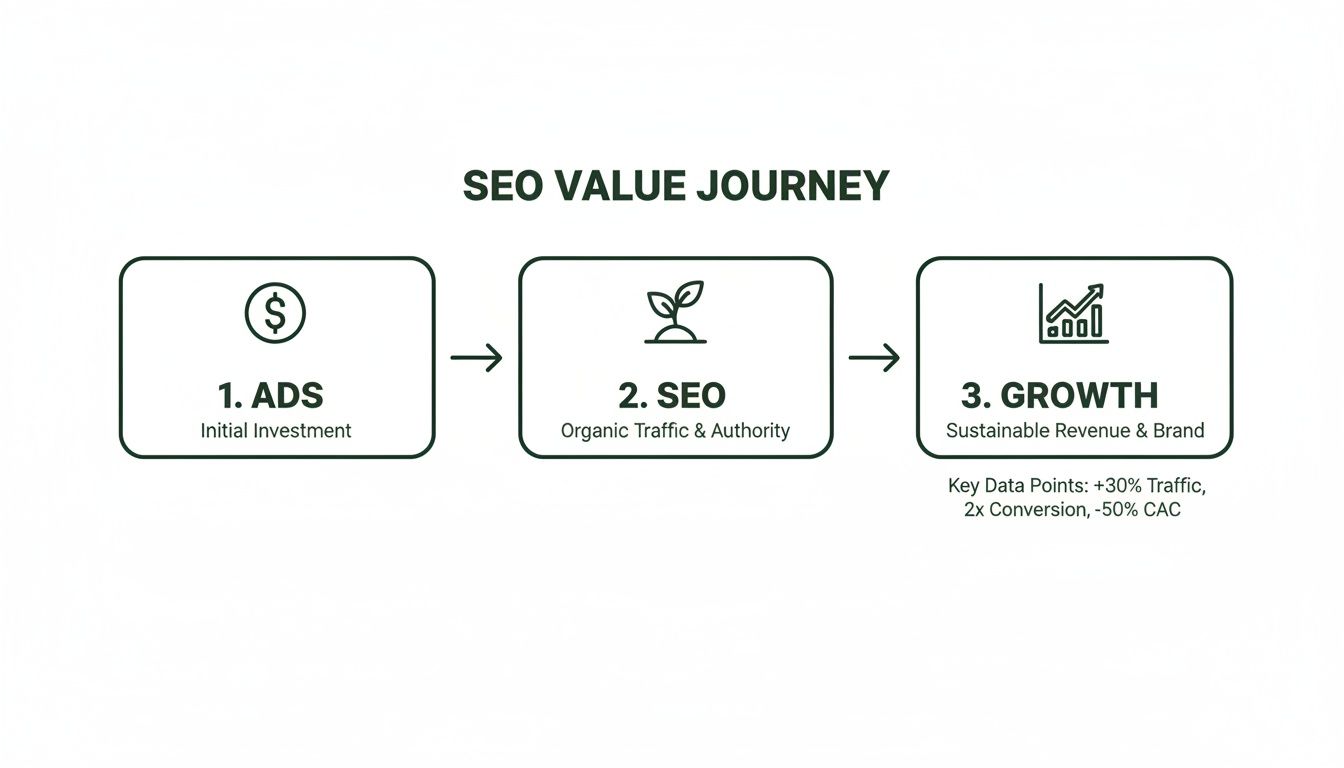
The key takeaway here is the move from "renting" traffic via ads to "owning" it through organic search. That shift is what builds a more resilient and profitable business in the long run.
The Long-Term Value Proposition
While ads can give you instant results, the cost to acquire a customer can be steep. SEO plays a different financial game. Sure, the initial effort can be intensive, but once you start ranking for those valuable keywords, the cost to keep those positions is far lower than constantly feeding an ad campaign.
SEO is the only marketing channel that, when done right, continues to pay dividends long after the initial work is completed. It’s about creating a powerful, self-sustaining engine for business growth.
Let's break down the core benefits:
- Enhanced Credibility and Trust: Showing up organically in search results builds far more trust than a paid ad. People tend to see organic listings as more authentic and authoritative.
- Cost-Effectiveness: Over the long haul, the return on investment from organic search traffic blows most paid channels out of the water. Your cost per lead drops dramatically as your rankings become more established.
- Competitive Advantage: Many of your local competitors are probably still stuck in the paid ad cycle or are ignoring SEO completely. By investing in a solid strategy, you can leapfrog them and grab valuable market share.
To get a better handle on the foundational elements and tactics for local search, it's worth exploring a detailed resource on Local SEO strategies. Building this knowledge is the first step in turning your website from an online brochure into your most valuable business asset.
Setting Up Your SEO Toolkit for Local Success
Before you can start climbing the rankings, you need a clear picture of where you’re standing right now. Think of it like a business dashboard; you wouldn't make financial decisions without looking at the numbers, and the same goes for your online presence. Getting the right tools set up is the non-negotiable first step in any decent small business SEO strategy.
The good news? The most powerful, foundational tools are completely free. They form the bedrock of your campaign, giving you the data you need to make smart, informed decisions instead of just guessing. Let's get them plugged in.
Your Essential Data Hubs: Google and Bing
First things first, you need to connect your website to the platforms that actually rank it. This gives you a direct line of communication with search engines, offering priceless insights into your site's health and performance that you simply can't get anywhere else.
There are three key accounts you need to set up straight away:
- Google Analytics 4 (GA4): This is your window into visitor behaviour. GA4 shows you how people from Brisbane, the Sunshine Coast, and beyond find your site, which pages they visit, and how long they stick around. It’s absolutely crucial for understanding what content is actually resonating with your audience.
- Google Search Console (GSC): If GA4 is about visitors, GSC is all about your performance in search. It tells you which keywords are driving traffic, flags technical issues that could be hurting your rankings, and lets you monitor your site's overall health through Google's eyes.
- Bing Webmaster Tools: Look, Google is the undisputed giant, but ignoring Bing means leaving potential customers on the table. Setting this up gives you access to a different slice of the search market and provides extra data points to work with.
Getting these configured properly from day one is essential. For local businesses, this means paying close attention to the location-based reports to make sure you're tracking the metrics that actually matter for your community.
Choosing the Right Tools for the Job
While the "big three" are non-negotiable, your toolkit will grow as your needs get more specific. You'll eventually need tools for digging into keyword research, tracking your rankings, and seeing what the competition is up to. When curating your SEO toolkit, it's crucial to evaluate various options to find the most effective solutions; discover the best ChatGPT rank tracker tools to help you monitor your ranking progress.
Making data-driven decisions is what separates thriving businesses from those that just tread water. It’s shocking, but while organic search drives 68% of online experiences in Australia, a staggering 90% of web pages get zero organic traffic from Google. This often comes down to a simple failure to use data to guide strategy. With the right tools, you can avoid becoming a statistic and build an online presence that lasts.
The goal isn't just to collect data; it's to turn that data into actionable insights. Your SEO toolkit is what makes this transformation possible, allowing you to measure your true impact and prove a return on investment.
To help you get started, here’s a quick checklist of the essential free tools that every local business should have set up from the get-go.
Essential Free SEO Tools Checklist
| Tool Name | Primary Purpose | Key Setup Tip for Local Businesses |
|---|---|---|
| Google Analytics 4 (GA4) | To understand user behaviour—how visitors find you, what they do on your site, and where they are from. | Make sure to set up conversion tracking for key actions like form fills or phone calls to measure what matters. |
| Google Search Console (GSC) | To monitor your site's performance in Google search, track keywords, and identify technical issues. | Submit your sitemap right away to help Google find and index all your important local service pages. |
| Bing Webmaster Tools | To manage your site's presence in Bing search and access its keyword and backlink research tools. | Use the 'Import from GSC' feature for a quick and easy setup. No need to start from scratch. |
| Google Business Profile | To manage how your business appears on Google Maps and in local search results. | Fill out every single section completely—services, photos, hours, and attributes. Detail is everything. |
Getting these foundational tools right is the first major step towards claiming your spot in local search results.
Once your analytics and search consoles are live, you can start digging into your site's performance. One of the first things you'll want to check is your site speed, as it’s a massive ranking factor. If you find your website is lagging, you can explore our detailed WP Rocket review to see how caching plugins can make a huge difference.
Mastering Local Keyword Research to Find Customers
Powerful SEO starts with one simple thing: understanding what your local customers are actually typing into Google. It's about getting laser-focused on the exact phrases people use when they're ready to buy, book, or visit. This is the absolute core of effective small business SEO.
As a web design first agency with SEO marketing skills, we've seen it time and again. The right keywords can turn a website from a static online brochure into your hardest-working lead generator. This isn't about guesswork; it's about learning the digital language of your local community.
For a business in Brisbane, that means knowing the huge difference between a vague term like "coffee" and a high-intent local keyword like "best flat white New Farm." The first gets you lost in a sea of global noise; the second puts you right in front of a customer who’s probably around the corner, ready to spend.
Thinking Like a Local Customer
First things first, you need to get inside your customer's head. Ditch the industry jargon for a minute and think about the real-world problems you solve. What would someone in a hurry, with a specific need, actually search for?
Brainstorming these "seed" keywords is the perfect starting point. Just list out your main services and products, then sprinkle in the location-specific words a real person would use.
- Instead of "plumbing services," think "emergency plumber Noosa Heads."
- Instead of "website design," consider "small business web design Sunshine Coast."
- Instead of "marketing agency," try "local SEO Brisbane."
This simple shift in perspective is what separates generic SEO from a strategy that drives real foot traffic and phone calls. You're lining your business up with the actual words coming from your target market.
Uncovering Buyer Intent Keywords
Once you've got your starting list, it's time to dig deeper for "buyer intent" keywords. These are the golden phrases that signal someone is close to pulling the trigger and making a purchase. They often include words that scream urgency, quality, or a desire to transact.
Keep an eye out for keywords with modifiers like:
- Urgency: "emergency," "24/7," "same-day"
- Quality: "best," "top-rated," "reviews"
- Cost: "affordable," "quote," "prices"
- Action: "buy," "near me," "for hire"
A café owner in Fortitude Valley could target "best brunch Fortitude Valley," while a mechanic in Maroochydore might focus on "affordable car service Maroochydore." These phrases attract customers who are well past the research phase and are actively looking to spend money.
By focusing on high-intent local keywords, you stop competing with the entire internet and start winning in your own neighbourhood. You attract fewer, but far more qualified, leads who are ready to become customers.
And the data backs this up, big time. A massive 46% of all Google searches in Australia carry local intent, making it a goldmine for small businesses. Even better, 76% of location-based mobile searches lead to a store visit within 24 hours. Optimising for these specific local terms isn’t optional anymore—it’s essential. You can see just how critical this is by diving into the latest local SEO statistics for Australian businesses.
Using Free Tools to Find Keyword Gold
You don't need a wallet full of expensive software to get started. Google itself gives you some of the best tools for uncovering valuable local keywords, and they won't cost you a cent.
Here are a few practical tricks you can use right now:
- Google Autocomplete: Simply start typing one of your seed keywords into the Google search bar. The suggestions that pop up are based on real, popular searches people are making every day.
- "People Also Ask" Section: Search for one of your main services. That "People Also Ask" box is a treasure trove, showing you the exact questions your potential customers need answers to. Perfect for blog posts and FAQ pages.
- Related Searches: Scroll right to the bottom of the search results page. The "Related searches" list will give you a heap of long-tail keyword variations you might never have thought of on your own.
By combining these simple methods, you can build a solid list of keywords that genuinely reflect what your customers across the Sunshine Coast, Noosa, and Brisbane are looking for. This research becomes the bedrock of your entire SEO strategy, ensuring every piece of content you create has a clear purpose: to drive business growth.
Your Blueprint for On-Page SEO and Content
Alright, you've got your local keywords locked in. Now it's time to put them to work and turn that raw data into an on-page SEO strategy that tells Google exactly who you are and where you operate. As a web design first agency that builds SEO into every site from the ground up, we know first-hand that a well-structured page is the absolute foundation for high rankings.
On-page SEO is the art of optimising individual pages on your website. It’s all about structuring your content, titles, and internal links so they’re crystal clear for search engines and, more importantly, for your potential customers here in Brisbane and on the Sunshine Coast.
Crafting Titles and Descriptions That Actually Get Clicks
Your title tag and meta description are your digital storefront window in Google's search results. They’re the clickable headline and the short snippet of text underneath it, and they play a massive role in convincing someone to choose your site over a competitor’s.
Think of the title tag as the headline of an ad. It needs to be compelling, include your main keyword, and ideally, mention your location to grab the attention of local searchers.
For example, a title like "Plumbing Services" is just dead in the water. A much stronger, locally-optimised title would be something like this:
Emergency Plumber Noosa Heads | 24/7 Service & Free Quotes
This title is powerful because it nails the user's intent ("Emergency Plumber"), specifies the location ("Noosa Heads"), and throws in compelling reasons to click ("24/7 Service & Free Quotes"). It speaks directly to someone with a burst pipe at 2 AM.
The meta description is your chance to expand on that promise. While it doesn't directly influence your rankings, a good one can seriously boost your click-through rate.
- Be concise: Keep it under 160 characters so it doesn’t get awkwardly cut off.
- Include a call to action: Simple phrases like "Call now for a free quote" or "Explore our recent projects" work wonders.
- Reinforce the keyword: Weave your main keyword in naturally.
This is the frontline of your small business SEO efforts. Get this right, and you're not just visible; you're inviting.
Structuring Your Content with Clear Headings
Once someone clicks through, the page itself needs to be easy to digest. This is where a logical heading structure (H1, H2, H3, etc.) is non-negotiable. Headings break your content into bite-sized, scannable sections, guiding the reader through the information.
- The H1 Tag: This is the main title of the page itself. There should only be one H1 per page, and it must clearly state the page's topic, usually by including your primary keyword.
- H2 Tags: Use these for the main subtopics. For a service page, these could be sections like "Our Plumbing Services," "Why Choose Us," and "Frequently Asked Questions."
- H3 Tags: These break down your H2 sections even further. Under "Our Plumbing Services," you might have H3s for "Blocked Drains," "Hot Water Systems," and "Leaking Taps."
This structure isn't just for people. It creates a clear hierarchy that helps Google understand the main themes of your content, which is crucial for ranking for all those related search terms.
The Underestimated Power of Internal Linking
Internal links are simply links from one page on your website to another. They are incredibly powerful for SEO for two key reasons: they help search engines discover every page on your site, and they pass authority (or "link juice") between your pages.
A smart internal linking strategy guides both users and Google to your most important content. For instance, a blog post about "5 Signs You Need a New Hot Water System" should absolutely link back to your main "Hot Water System Installation" service page.
A strong internal linking structure acts like a roadmap for your website. It ensures your most valuable pages are easy to find, boosting their authority and helping users navigate your services seamlessly.
This is a simple tactic that's so often overlooked, yet it strengthens your entire site's SEO performance. Building these connections is a fundamental part of good web design. For more on how structure and design impact your online presence, you can explore our approach to building high-performing websites.
Creating Content That Resonates with Locals
Beyond the technical bits, the content itself has to be genuinely valuable. For a local business, this means creating pages that speak directly to the needs, problems, and questions of your Sunshine Coast or Brisbane audience.
Here are a few content ideas that work wonders for local SEO:
- Hyper-Local Service Pages: Don't just have one generic "Services" page. Create dedicated pages for your key services in specific suburbs. A page titled "Web Design Noosa" is going to perform far better for that specific search than a broad "Web Design" page ever will.
- Case Study or Project Pages: Show off your local work. A portfolio entry titled "New Cafe Website for a Fortitude Valley Business" not only demonstrates your skill but also acts as a powerful local signal to Google.
- Community-Focused Blog Posts: Write content that answers local questions. A Mooloolaba real estate agent could write a blog post on "The Best Dog-Friendly Parks in Mooloolaba." This builds topical authority and attracts a relevant local audience, positioning you as a true community expert.
When you combine sharp on-page optimisation with content that genuinely serves your local community, you create a powerful formula for attracting the right kind of traffic—customers who are nearby and ready to do business.
Dominating the Map with Your Google Business Profile
If you run a local business in Brisbane, Noosa, or anywhere on the Sunshine Coast, your Google Business Profile (GBP) is your single most powerful local SEO weapon. Full stop. It's not just a listing; it’s your digital shopfront, your interactive business card, and a direct line to customers searching for you on Google Maps.
As an award-winning web design agency with SEO marketing skills, we’ve seen countless businesses treat their GBP as a "set and forget" task. Honestly, it’s a massive mistake. A fully optimised, active profile is what wedges you into the coveted "map pack"—that all-important box of three local businesses sitting pretty at the top of the search results.
Laying the Groundwork for GBP Success
Before you can even think about dominating, you need to get the foundations absolutely perfect. That starts with claiming and verifying your profile, a simple but non-negotiable first step. Once you’re in control, the real work begins: filling out every single section with rich, accurate, and genuinely helpful information.
Accuracy here is everything. Your Name, Address, and Phone number (NAP) must be perfectly identical across your GBP, your website, and any other online directory you’re listed on. Even a tiny difference—like using "St" on your profile but "Street" on your site—can confuse Google and dilute your local ranking authority.
Next up, your business categories. You get one primary category and several secondary ones. Be ruthlessly specific with your primary choice. If you're a plumber, your category should be "Plumber," not something vague like "Home Services." This is one of the biggest signals you can send to Google about what you actually do.
Bringing Your Profile to Life with Rich Content
A bare-bones profile is a boring profile, and boring doesn't win clicks. To really stand out, you need to use all the visual and interactive features Google gives you. This is your chance to show off the quality of your work and the personality behind your brand.
- Photos and Videos: Get high-quality, recent photos of your work, your team, and your premises up there. If you run a Brisbane café, this means mouth-watering shots of your coffee and smashed avo. For a Sunshine Coast builder, it’s crisp images of your finished projects.
- Products and Services: Don't just list what you do—detail it. Add descriptions and even prices if it makes sense for your business. This helps Google understand the full scope of your offerings and match you to more specific, long-tail searches from customers who are ready to buy.
- Google Posts: Think of this as a mini-blog right on your GBP. Use it to share updates, special offers, new products, or recent jobs. These posts show up directly in your search listing and signal to potential customers that your business is active and engaged.
Your Google Business Profile is a living, breathing part of your online presence. Consistently adding fresh content like photos and posts tells Google you're relevant, active, and deserving of a top spot in the local search results.
The Crucial Role of Customer Interaction
The final piece of the puzzle is engagement. Google watches how customers interact with your profile, and two features are absolutely critical: the Q&A section and your customer reviews.
The Q&A feature allows anyone to ask a question about your business, which is then displayed publicly on your profile. The best way to handle this is to get in there first. Populate it yourself by asking your own frequently asked questions and providing clear, helpful answers. This pre-empts customer queries and lets you control the narrative.
Finally, reviews are the lifeblood of your local SEO. A steady stream of positive, genuine reviews builds immense trust and social proof. Make it a habit to actively encourage your happy customers to leave feedback.
Just as importantly, you need to respond—professionally and promptly—to all of them, good and bad. A thoughtful, calm response to a negative review can often win over more future customers than a dozen five-star ratings. It shows you care, which is a powerful signal to both people and search engines.
To help you gauge where your GBP currently stands, here's a simple breakdown of the different levels of optimisation.
Google Business Profile Optimisation Levels
| Optimisation Level | Key Actions | Expected Impact |
|---|---|---|
| Basic (The Foundation) | Claim & verify profile. Fill out NAP, hours & primary category accurately. Add a logo & cover photo. | Gets you on the map, but you'll struggle to rank for competitive terms. Low visibility. |
| Intermediate (Active & Engaging) | Add multiple photos/videos. Detail all products/services. Create regular Google Posts (weekly). Actively ask for reviews. | Improved visibility in the map pack. Increased clicks, calls, and website visits. Higher trust signals. |
| Advanced (Dominating) | Populate and monitor the Q&A section. Respond to all reviews within 24 hours. Enable messaging and respond quickly. Use analytics to track performance. | Top rankings in the map pack for key terms. High engagement rates. Becomes a primary lead generation channel. |
Use this table to figure out where you are and what your next steps should be. Moving from 'Basic' to 'Intermediate' is where you'll see the most significant initial jump in performance.
Earning Trust with Links and Measuring the Wins
Okay, so you’ve dialled in your on-page SEO and your Google Business Profile is looking sharp. What’s next? Now it's time to convince Google that you're a legitimate authority in your field. This is where link building comes in, and I promise it’s not as technical or intimidating as it sounds.
For a small business seo strategy, this isn’t about chasing thousands of dodgy links. It’s about quality over quantity. Think of a backlink as a vote of confidence from another website. When a respected site links to yours, it’s a powerful signal to Google that you’re a trustworthy source. This process, combined with smart reporting, is how you build real authority and prove your efforts are actually paying off.
Practical Link Building for Local Businesses
You don’t need a massive budget to earn links that move the needle. For businesses on the Sunshine Coast or in Brisbane, the most powerful links often come from right here in your own community. It’s all about being an active, visible part of the local online conversation.
Here are a few low-budget strategies that genuinely work:
- Get into Quality Local Directories: Go beyond the generic, spammy directories. Focus on getting listed on industry-specific sites or respected local hubs like your local Chamber of Commerce. A single listing on a well-regarded local site is worth more than a dozen generic ones.
- Sponsor a Community Group: Sponsoring a local sporting team in Noosa or a community event in Brisbane is a brilliant move. It almost always comes with a link from their website back to yours. It’s a fantastic way to support your community while earning a highly relevant, authoritative backlink.
- Team Up with Your Neighbours: Partner with a non-competing local business. A Sunshine Coast wedding photographer could write a guest post for a local venue’s blog, sharing tips on the best photo spots and, of course, linking back to their own site. It’s a genuine win-win.
Building authority isn’t some technical trick; it’s about reflecting your real-world reputation online. Earning links from other respected local businesses is one of the strongest signals you can send to Google that you're a trusted player in your area.
Measuring What Actually Matters
Doing SEO without measuring it is just guessing. You have to track your performance to see what’s working, what isn’t, and to show a clear return on your investment. Instead of drowning in a sea of data, just focus on the Key Performance Indicators (KPIs) that directly impact your bottom line.
For Australian businesses, this is becoming non-negotiable. In 2025, spending on SEO services is projected to hit a massive $1.5 billion, because savvy businesses know that organic search drives 53% of all website traffic. With local SEO converting at three times the rate of standard organic search, tracking your progress is a must. You can learn more about how Australian businesses are leveraging SEO to see just how critical this is.
Zero in on these core metrics in your reporting:
- Organic Traffic Growth: Are more people finding your website through Google over time? Check this in Google Analytics and look at the month-over-month trend.
- Keyword Ranking Improvements: Are you climbing the ladder for your target keywords? Use Google Search Console to see which search terms are bringing you the most clicks and impressions.
- Google Business Profile Actions: This is pure gold for local businesses. How many people are clicking to call you, requesting directions, or visiting your website straight from your GBP listing? This is a direct measure of local customer intent.
- Conversions and Leads: At the end of the day, this is what it’s all about. Track how many contact form submissions, phone calls, or online bookings came from organic search.
By focusing on these specific KPIs, you get a clear picture of how your small business seo efforts are contributing to real, tangible growth. This is how you stop just "doing SEO" and start building a valuable business asset that pays you back for years.
Your SEO Questions Answered
Deciding to invest in SEO is a big step, and of course, you’re going to have questions. Here on the Sunshine Coast, from Brisbane to Noosa, we chat with so many passionate business owners who are all trying to figure out how to get that crucial edge online.
Let’s tackle some of the most common questions we hear every day. As a local, award-winning web design first agency with SEO marketing skills, we believe in giving you clear, straightforward answers to help you make the right call for your business.
How Long Until I Actually See Results?
This is probably the number one question we get asked, and the honest answer is: SEO is a long game, but it's an incredibly rewarding one. It's not like flicking a switch.
You can usually expect to see some encouraging movement and small wins within the first 3-6 months. However, the more significant, sustainable results—the kind that really move the needle for your business—tend to take shape around the 6-12 month mark.
Think of it like planting a tree. It needs consistent care and time to grow strong roots before it can really start bearing fruit. The timeline always depends on factors like how competitive your industry is, the current health of your website, and how consistently you work at it.
Can I Do My Own SEO?
Another question we hear all the time is whether you can handle SEO yourself or if you need to bring in an agency. The real answer is: it depends.
If you have more time than money and you're keen to learn, then yes, DIY SEO is definitely possible for the basics. You can absolutely get started by optimising your Google Business Profile and writing the odd blog post. For more practical ideas, check out our other tips for small businesses.
But the more technical side of SEO, strategic link building, and crafting a deep, competitive strategy—that’s where specialised expertise really comes into play.
The tipping point often comes when the time you spend trying to do SEO costs you more in lost business than hiring an expert would. An award-winning agency brings years of experience to get you results faster.
Ultimately, the goal is to build a powerful digital asset for your business. Whether you start small on your own or partner with a team like ours, the most important thing is to simply begin building that foundation today.
Ready to turn your website into a lead-generating machine with a team that genuinely understands the local Sunshine Coast, Noosa & Brisbane market? At Digital Roo's, we combine our award-winning web design with expert SEO marketing skills to help businesses just like yours dominate online. Let's build a stronger website and a stronger business together. Get in touch with us today!