
When you hear "small business website design," it's easy to think of it as just a digital paint job. But it's so much more than that. These are professional services dedicated to creating, building, and maintaining your company's home online. The goal isn't just a pretty design; it's about building a strategic digital asset that works overtime to attract customers, build trust, and drive sales.
Why Professional Web Design Is a Business Multiplier
Think of your website as the digital front door to your business. For many people, it’s the very first time they’ll ever interact with your brand. That first impression happens in a split second, and it instantly shapes how they see you, turning a curious browser into a loyal customer—or sending them clicking away.
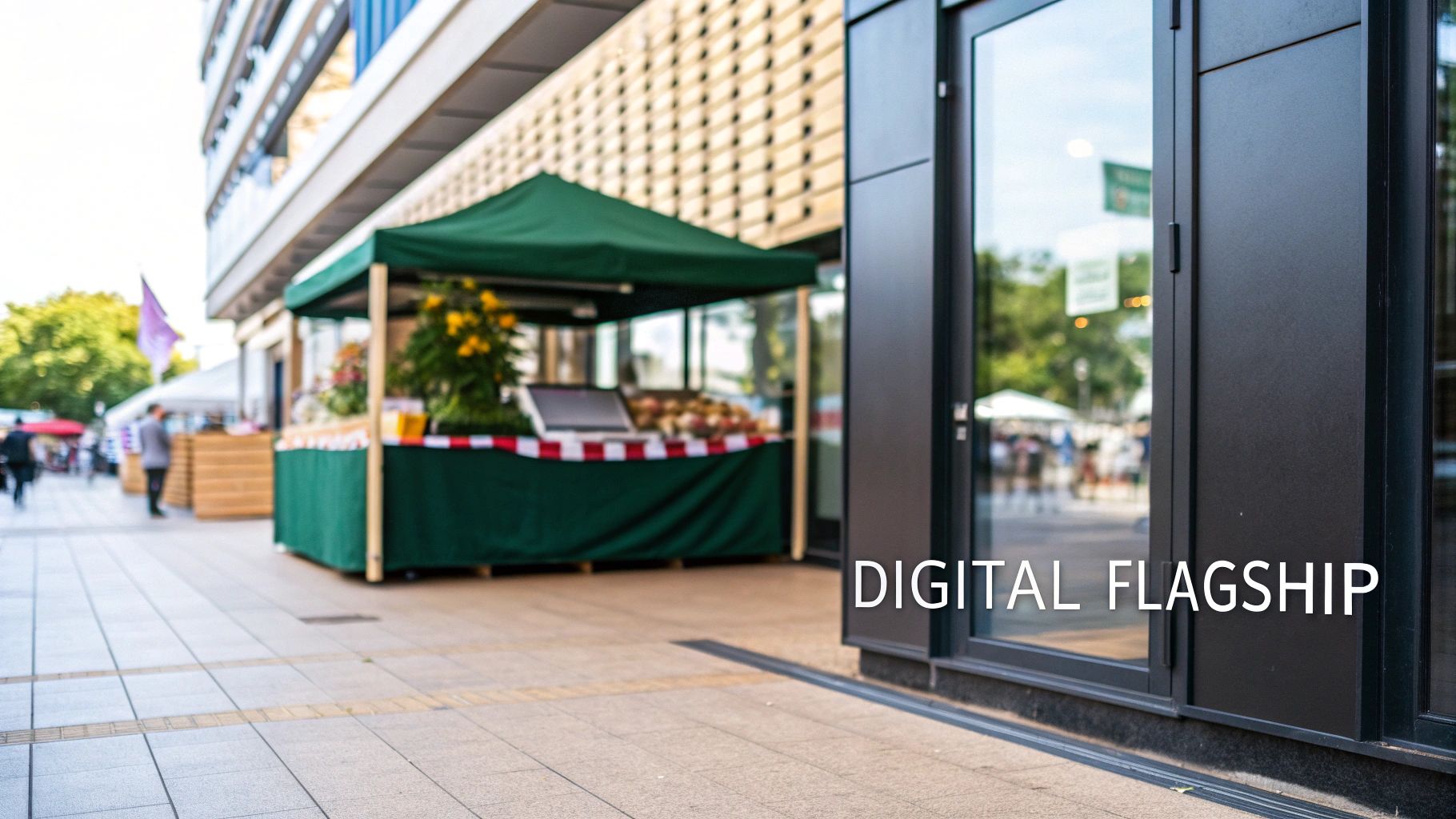
Let's use an analogy. A basic, DIY website is like setting up a temporary stall at a weekend market. Sure, it might work for a day, but it doesn't exactly scream confidence or permanence. It tells potential customers you’re just testing the waters.
A professionally designed website, on the other hand, is your flagship retail store. It’s well-lit, thoughtfully organised, and immediately communicates quality and trustworthiness. Every single detail, from the page layout to the font choice, is intentionally crafted to guide visitors, answer their questions, and make them feel secure about doing business with you.
Beyond Just Looking Good
Investing in professional small business website design isn't a cosmetic upgrade; it's a hard-nosed business decision. A well-built site becomes a powerful asset that works for you 24/7. It's your most dedicated salesperson, your most consistent brand advocate, and your most efficient customer service rep, all rolled into one.
Here’s how it multiplies your efforts:
- Builds Instant Credibility: A polished, modern design sends a clear signal that you're a legitimate and serious business. This makes customers far more likely to trust you with their time and money.
- Captures More Leads: Through smart calls-to-action, intuitive navigation, and search engine optimisation (SEO), a professional site is built to turn passive visitors into active leads.
- Improves User Experience (UX): Expert designers create a seamless journey for your visitors, cutting down on frustration and lowering bounce rates. When people enjoy being on your site, they stick around longer and are much more likely to take action.
A professional online presence is vital for building trust with your audience. When customers perceive your website as credible, they are more likely to engage with your brand and make purchases. This trust is essential for small businesses looking to establish a solid reputation.
At the end of the day, a professionally designed website isn't an expense—it's an engine for growth. It all starts with taking a holistic view of your digital footprint. You can learn more about strategies for building a strong online presence that gets results and see exactly how your website fits into that bigger picture. This powerful first impression is what sets the stage for real, sustainable growth in a very crowded marketplace.
What to Expect from a Web Design Service Package
When you hire a professional for your small business website, you’re not just buying a pretty design. You're investing in a complete digital toolkit built to grow your business. Knowing what should be in that toolkit is the key to making a confident decision and getting exactly what you need to succeed online.
Think of it like building a custom home. You wouldn't just pay for the exterior paint; you expect a solid foundation, smart wiring, and a floor plan that actually works for your family. A professional web design package is the same—it’s made up of several critical layers that all work together to create an effective digital storefront.
Let's break down the essential components you should expect to see in any decent proposal.
Custom and Brand-Aligned Design
First things first: a professional service will ditch the generic, cookie-cutter templates. The agency’s job is to create a custom design that is a true visual extension of your brand. This means carefully weaving in your logo, colour scheme, and fonts to create a consistent and memorable experience for every single visitor.
The whole process should be a partnership, starting with a deep dive into your business goals and who your ideal customer is. The final look shouldn’t just be easy on the eyes; it has to be strategically designed to connect with your audience and build trust from the moment they land on your site.
Fully Responsive Development
In a world where most of us live on our phones, a website that only looks good on a desktop is basically a dinosaur. A core part of any package is responsive development. This just means your site will automatically adjust its layout to look and work perfectly on any screen—from a smartphone or tablet to a massive desktop monitor.
This isn’t just a nice little extra; it’s non-negotiable. A huge chunk of your customers will find you on mobile, and if your site is a pinch-and-zoom nightmare, they’ll be gone in a heartbeat.
A professional web design service ensures your digital storefront is accessible and engaging for everyone, regardless of how they find you. This commitment to accessibility is a direct reflection of your commitment to your customers.
Intuitive User Experience Strategy
Behind every great-looking website is an invisible layer of strategy called User Experience (UX). It's the science of making your website dead simple and even enjoyable to use. A skilled agency will map out a clear site structure, making sure visitors can find what they need without having to think too hard.
This involves things like:
- Simple Navigation: Building menus and links that feel natural and predictable.
- Clear Calls-to-Action (CTAs): Designing obvious buttons and prompts that guide people to buy, book, or get in touch.
- Fast Load Times: Optimising everything so your pages load in a snap, keeping frustration low.
When you're chatting with an agency, ask them about integrating dynamic features like chat widgets for websites, which are fantastic for boosting engagement and support. This focus on UX is what keeps people on your site longer and turns them into actual customers. For anyone selling online, a smooth user journey is the bedrock of a successful https://digitalroos.com/ecommerce-websites/.
Key Services in a Professional Web Design Package
Understanding what's "under the hood" of a web design package helps you see the true value. It's not just about the final look, but the foundational elements that make it work for your business long-term.
Here’s a breakdown of the typical services you should expect and why each one is so important for a small business.
| Service Component | What It Delivers | Why Your Business Needs It |
|---|---|---|
| Custom Design | A unique visual identity using your brand's colours, logo, and fonts. | It builds brand recognition, establishes credibility, and sets you apart from competitors using generic templates. |
| Responsive Development | A website that looks and functions perfectly on all devices (mobile, desktop). | It ensures you don't lose the 50%+ of customers who browse on their phones and improves your Google ranking. |
| User Experience (UX) | An intuitive, easy-to-navigate site structure with clear calls-to-action. | It keeps visitors engaged, reduces frustration, and directly guides them towards becoming a paying customer. |
| On-Page SEO | Foundational search engine optimisation built into the site's code and content. | It gives you a head start in getting found on Google, attracting organic traffic without paying for every click. |
| CMS Integration | A user-friendly backend (like WordPress) for making your own content updates. | It puts you in control of your site for simple changes, saving you time and money on future developer fees. |
These components work together to create a powerful business asset, not just a digital brochure. Each piece plays a crucial role in turning your website into an engine for growth.
Foundational On-Page SEO
A stunning website that nobody can find is just an expensive secret. That’s why foundational on-page Search Engine Optimisation (SEO) is an absolute must-have in any quality design package. It simply means the agency will build your site from the ground up with search engines like Google in mind.
This includes optimising things like page titles, meta descriptions, and image text, and creating a logical URL structure. While it’s not a full-blown SEO campaign, this setup gives your site a fighting chance to start ranking for your key services and attract free, organic traffic.
The need for businesses to be visible online is booming. In fact, the Australian web design services market grew by a huge 6.9% in 2022, hitting a total value of $1.3 billion AUD, driven by this exact demand.
Seamless CMS Integration
Finally, your package should always include integration with a Content Management System (CMS), most commonly WordPress. A CMS is what gives you the power to make simple updates to your own website—like adding a blog post or changing some text—without needing to know a single line of code.
This gives you control over your own content and stops you from having to call (and pay) a developer for every tiny tweak, saving you a heap of time and money down the track.
The Real-World ROI of Strategic Web Design
Thinking of a professional website as just another business expense is an easy mistake to make. The truth is, it’s one of the highest-return investments you can make in your small business. A great website isn’t just a pretty online brochure; it's a hard-working engine that drives real, measurable growth and powers your entire digital marketing strategy, 24/7.
Think of your website as your star employee. A cheap, poorly designed site is like that unmotivated salesperson who ignores customers at the door. But a strategically designed website? That’s your top performer—always on, actively engaging visitors, answering their questions, and smoothly guiding them towards making a purchase. It doesn't just sit there looking nice; it gets results.
Once you see it that way, its true value becomes crystal clear. Let’s connect the dots between smart design choices and the direct financial impact they have on your bottom line.
From First Impressions to Lasting Credibility
Your website is often the very first handshake a potential customer has with your brand. And you don’t get a second chance to make a first impression. Research shows it takes a visitor a mere 50 milliseconds to form an opinion. A dated, confusing, or clunky design instantly kills trust and screams that you might not be a credible business.
On the flip side, a clean, modern, and professional website builds immediate confidence. This credibility is the foundation of any customer relationship. When someone trusts your website, they are far more likely to trust your products or services, which is the crucial first step toward winning their business.
"A strong online presence is vital for building trust with your audience. When customers perceive your website as credible, they are more likely to engage with your brand and make purchases. This trust is essential for small businesses looking to establish a solid reputation."
This is especially critical for local businesses here in Australia. It's shocking, but only 41% of Australian small businesses currently have a website, even though a massive 75% of consumers prefer to buy from businesses that are online. This gap isn't a problem; it's a huge opportunity for anyone willing to invest in a professional digital presence. You can dig into more insights on the Australian digital divide and its impact on small businesses from recent industry reports.
Reducing Bounce Rates and Boosting Engagement
Have you ever clicked on a website and left immediately because it was painfully slow, a nightmare to navigate, or just plain broken on your phone? That’s called a "bounce," and it's a lead killer. A high bounce rate is a flashing red light, signalling that your website's design is failing your visitors.
Strategic web design tackles this head-on by focusing on the User Experience (UX). A design built around great UX ensures your site is:
- Fast and Responsive: Pages load in a snap, and the site works perfectly on any device—especially mobile phones, where most local searches happen.
- Easy to Navigate: A logical menu structure and a clear, intuitive layout help people find what they need without getting frustrated.
- Visually Engaging: High-quality images and a clean, appealing design encourage users to stick around and explore what you have to offer.
By improving the user experience, you keep visitors on your site longer. And the more time they spend with your content, the more likely they are to remember your brand and take that next step.
Driving Conversions and Increasing Revenue
When it comes down to it, your website has one main job: to turn visitors into customers. In the web world, we call this a "conversion"—any action you want a user to take, whether it's buying a product, filling out a contact form, or signing up for your newsletter. Professional web design uses proven techniques to maximise these actions.
A streamlined checkout process is a perfect example. We've all abandoned a shopping cart because the checkout was too long and complicated. By simplifying this process, an expert designer can slash the number of lost sales. In the same way, clear and compelling Calls-to-Action (CTAs)—like "Get a Free Quote" or "Buy Now" buttons—are strategically placed to guide users exactly where you want them to go.
Every single element, from the colour of a button to the headline on a page, is carefully chosen to increase the odds of a visitor taking action. This is how a website stops being a passive online flyer and starts being a powerful, revenue-generating machine that delivers a clear and impressive return on your investment.
Your Step-by-Step Guide to the Web Design Process
Kicking off a new website project can feel like a huge deal, but a professional web design process isn't some chaotic mystery. Think of it as a clear, logical roadmap that takes your ideas and turns them into a powerful digital asset that works for your business. When you understand the path, the uncertainty vanishes, and you become an active partner in building your new online home.
The whole thing is a collaboration. A good agency will walk you through every stage, making it clear what they need from you and explaining why each step is essential for getting the result you want. Let’s break down the seven key phases you'll go through with a small business website design services provider.
Phase 1: Discovery and Strategy
This is the foundation, and honestly, it’s the most important part of the entire project. Before a single pixel gets designed, the agency needs to get inside your head and really understand your business. It’s like an architect drawing up detailed blueprints before anyone even thinks about pouring the concrete.
They’ll ask about your goals, who your dream customers are, what your competitors are up to, and what you need this website to do. This isn’t just a casual chat; it's a strategic deep-dive that shapes every single decision from here on out. Your input is critical—the more you share, the closer the final product will be to your vision.
Phase 2: Wireframing and Prototyping
With a solid strategy locked in, it’s time to build the website's skeleton. A wireframe is a simple, black-and-white layout that maps out the basic structure of each page. It’s all about function and user flow, answering one simple question: "Where does everything go?"
This stripped-back approach lets everyone agree on the core structure without getting side-tracked by colours, fonts, or images. Once the wireframes get the green light, they might be turned into a clickable prototype. This gives you a proper feel for how the site will navigate before any real coding starts.
Phase 3: Visual Design
Now for the fun part—this is where the website’s personality truly comes to life. The design team takes the approved wireframes and starts applying your brand’s visual identity. Your logo, colour scheme, fonts, and imagery all come together to turn a functional blueprint into a beautiful and engaging digital experience.
The visual design phase is where brand strategy meets user interface. It's about creating a look that not only reflects your business's values but also builds an emotional connection with your visitors, making them feel confident and welcome.
This stage is a real team effort. You’ll review design mock-ups and give feedback to make sure the final look and feel is a perfect match for your business online.
Phase 4: Development and Coding
Once the visual design is finalised, the developers step in. This is the most technical phase, where the static designs are meticulously translated into a fully functional website. The dev team writes the code that makes everything work, from the navigation menu right down to the contact forms.
They’ll build the site on a Content Management System (CMS) like WordPress, which is what will let you update your own content later. This is also where they ensure the site is fully responsive, meaning it looks and works perfectly on every device, whether it's a desktop, tablet, or smartphone.
Phase 5: Content Integration
A stunning website is just an empty shell without great content. In this phase, all the text, images, videos, and other bits and pieces are loaded into the newly built site. You might be providing the written copy yourself, but many agencies also offer professional copywriting to make sure your messaging is spot-on for both your customers and for search engines.
This infographic shows how all these elements really work together to generate a return on your investment, guiding a user from building initial trust to making a final conversion.
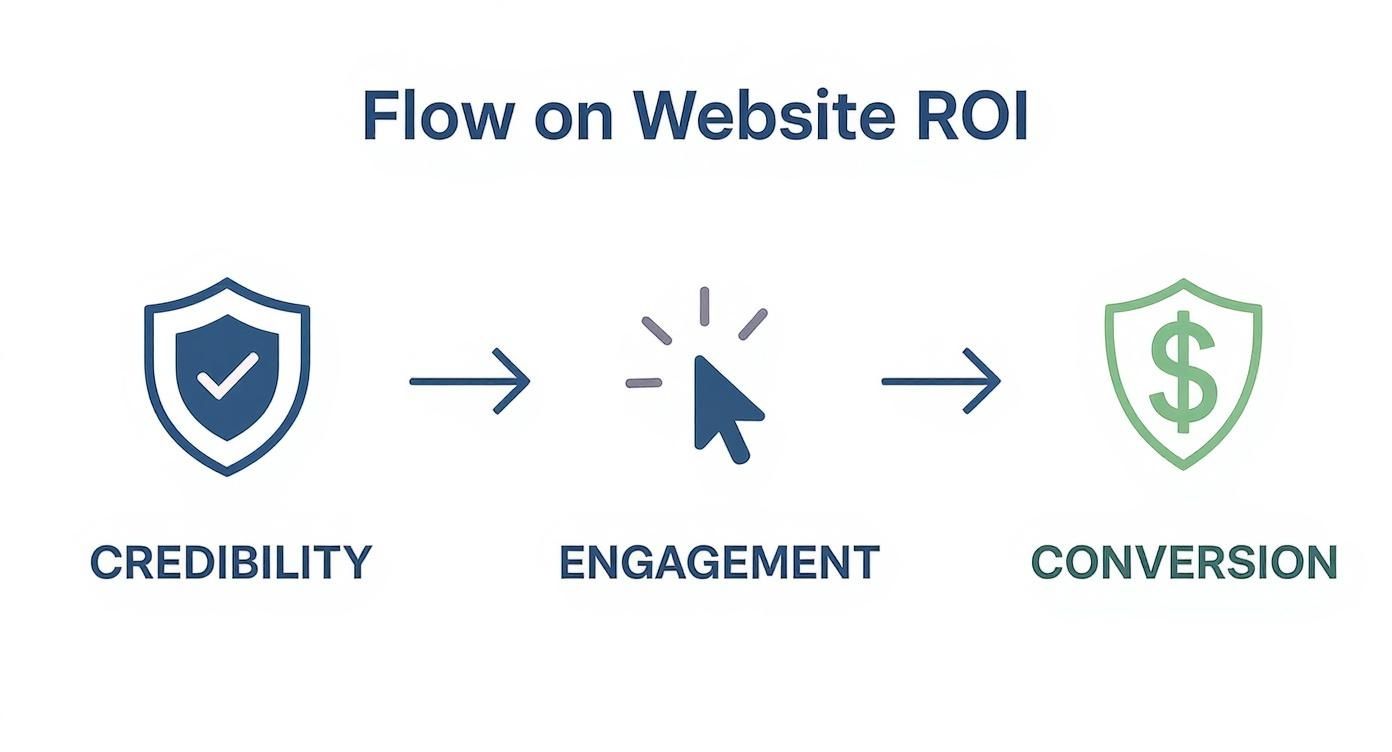
As you can see, every part of the design and content has to pull its weight to guide a visitor toward taking action.
Phase 6: Testing and Quality Assurance
Before your website is unveiled to the world, it goes through some serious testing. The Quality Assurance (QA) team meticulously clicks every link, tests every button, and checks every feature on multiple browsers and devices to hunt down any bugs or glitches. They’re checking for functionality, performance, and usability to guarantee a smooth, error-free experience for your future visitors.
Phase 7: Launch and Handover
This is the big moment everyone’s been working towards. After passing all its tests with flying colours, the website is deployed to a live server and made public. But the job isn't quite done. A good agency will give you training on how to use your new CMS and might offer ongoing support plans to keep things running smoothly.
Getting the technical foundation right from the start is also key. Understanding your options for things like reliable WordPress hosting ensures your new site stays fast and secure long after the launch party. This final step marks the end of the project and the beginning of your new, powerful digital presence.
How to Budget for Your Small Business Website
Figuring out a budget for a new website can feel a bit like trying to hit a moving target. The costs often seem mysterious, making it hard to know if you're getting a fair price. But getting a handle on what drives the cost of professional small business website design services is the first step to making a smart, confident decision for your business.
Think of it like getting a custom piece of furniture made. A simple, functional coffee table is going to have a very different price tag than an ornate, hand-carved dining set. The same logic applies to websites. The complexity of the design, the number of special features, and the level of customisation are what really determine the final cost.
A basic five-page informational website, for example, will be far more affordable than a sprawling e-commerce store with hundreds of products, payment systems, and inventory management. It all comes down to the scope of the project.
Key Factors That Influence Website Costs
Before you can nail down a realistic budget, you need to understand the main ingredients that go into the final price. These are the things that separate a simple online brochure from a powerful business tool. You should be ready to talk about these with any web design agency you’re considering.
Here are the key cost drivers:
- Design Complexity: A unique, custom design built from scratch for your brand will cost more than a site based on a pre-made template. The more bespoke the look and feel, the more design hours it takes.
- Specialised Functionality: Do you need an online booking system for appointments? Or maybe a secure portal for your clients to log in? Features like these require specialised development work and will add to the overall cost.
- E-commerce Integration: Building an online store is a big job. It involves setting up product catalogues, shopping cart functions, secure payment processing, and shipping calculators, making it one of the biggest potential cost factors.
- Content Creation: Are you planning to write all the text and supply all the images yourself? If you need professional copywriting or photography, you'll need to factor this into your budget.
Comparing Website Design Pricing Models
Web design agencies generally use one of three main pricing models. Each has its pros and cons, and the best one for you really depends on the specifics of your project. Understanding how they work will help you make sense of quotes and avoid any surprise bills down the road.
Choosing the right pricing model is all about aligning the financial structure with your project's goals and your comfort level with risk. A fixed price offers certainty, while an hourly rate provides flexibility—neither is inherently better, but one will be a better fit for your specific situation.
To help you get your head around the options, we’ve put together a quick comparison table. This breaks down the common pricing structures so you can figure out which one makes the most sense for your business and budget.
Comparing Website Design Pricing Models
| Pricing Model | Best Suited For | Key Advantages | Potential Downsides |
|---|---|---|---|
| Fixed-Price Project | Projects with a clearly defined scope and deliverables, like a standard business site. | Predictable Budget: You know the total cost upfront, with no surprises. | Less Flexible: Changes to the scope mid-project can be difficult and costly. |
| Hourly Rate | Ongoing work, complex projects with evolving needs, or projects with an unclear scope. | High Flexibility: You only pay for the time spent, making it easy to adapt. | Uncertain Final Cost: The total expense can be hard to predict and can escalate. |
| Monthly Retainer | Businesses needing continuous support for maintenance, SEO, and content updates. | Ongoing Partnership: Ensures consistent support and proactive improvements. | Can Be Costly: It's a recurring expense, even during months with fewer needs. |
By breaking down the cost factors and understanding these common pricing models, you're no longer in the dark. You’re now equipped to have an informed conversation, create a realistic budget, and choose a path that aligns perfectly with both your business goals and your bottom line.
Finding the Right Web Design Partner for Your Business
Choosing someone to build your website is a huge decision. It’s less like hiring a tradie for a one-off job and more like bringing on a long-term business partner. The right agency slots right into your team, genuinely caring about your success. But the wrong one? That’s a fast track to blown budgets, missed deadlines, and a website that just doesn't perform.
So, how do you get it right? You need to approach this like you're hiring for a critical role in your company. It means looking past the slick sales pitch and digging into their actual work, their process, and how they treat their clients. This bit of homework upfront is what separates a great project from a frustrating one.
Evaluate Their Portfolio with a Critical Eye
First things first, you’ve got to check out their past work. But don't just flick through the pretty pictures. A portfolio should tell a story of partnership and tangible results. As you browse, ask yourself: are these websites just nice to look at, or are they actually easy to use and logically laid out?
Look for variety, but also relevance. Do they have experience in your industry or with businesses of a similar size? A stunning portfolio packed with huge corporate sites doesn't necessarily mean they get the specific needs and budget of a small business. You can see how an agency tackles different challenges by looking at the range of projects in their portfolio, like our own showcase of small business website designs.
Read Between the Lines of Testimonials
Client testimonials are gold, but you need to know what you’re looking for. Vague praise like “they were great to work with” is nice, but it doesn’t tell you much. You want to hunt for specific feedback that shines a light on what the agency really nails.
Do their clients talk about things like:
- Excellent Communication: Were they kept in the loop every step of the way?
- Problem-Solving Skills: How did the agency handle any curveballs during the project?
- Measurable Results: Did the new site actually lead to more enquiries or sales?
Specific, results-focused testimonials are a massive indicator that you’re dealing with a professional and effective team.
Assess Their Communication and Processes
A brilliant website is built on clear communication, simple as that. Pay close attention to how they talk to you in those first conversations. Are they actually listening to your goals, or do they jump straight into a sales pitch? A true partner asks smart questions to really understand what makes your business tick.
A web design agency's proposal is more than just a quote; it's a reflection of their professionalism and process. A detailed, transparent proposal that outlines every deliverable, timeline, and cost is a sign of a well-organised team that respects your investment.
Finally, you need to ask about ownership. This is a big one. You must get it in writing that you will have 100% ownership of all the final website files and your domain name once the project is finished and paid for. It’s a non-negotiable point that protects your business asset for the long haul. Armed with these insights, you can confidently pick a partner who will help build a stronger digital presence for your business.
Your Web Design Questions Answered
Deciding to invest in a professional website is a big step, and of course, you’re going to have questions. Getting clear, straight-up answers is the key to moving forward with confidence and making sure you find the right team for the job.
Let’s tackle some of the most common questions we hear from business owners just like you.
How Long Does It Take to Build a Small Business Website?
For a typical small business website, you should plan for a timeline of 4 to 8 weeks from our first chat to the day we go live. A simpler, informational site will naturally fall on the shorter end of that window.
However, if you need more complex features like a full e-commerce shop or a custom booking system, the project can extend to 10-12 weeks or even a bit more. Any decent agency will give you a detailed project timeline right after the initial strategy phase, so you know exactly what to expect.
Do I Need to Supply All the Website Content?
That’s a great question to ask early on, as it can vary. Most web design agencies will expect you to provide the core text (the "copy") and specific images like team photos or product shots. After all, nobody knows your business and your story better than you do.
That said, many agencies, including us, offer professional copywriting and stock photo sourcing as an add-on. This can be a smart move to make sure every word on your site is working hard for your SEO and is written to connect with your customers.
Think of it this way: You provide the core story and personality of your business. A professional copywriter and designer then act as expert editors and stylists, polishing that story to make the biggest possible impact on your audience.
What’s Involved in Website Maintenance After Launch?
This is crucial. Your website isn't a "set and forget" brochure; it's a living business asset that needs looking after to stay secure, fast, and effective. Most agencies offer monthly maintenance plans to handle the essential tasks needed to protect your investment.
These plans almost always include:
- Regular Updates: Keeping your Content Management System (CMS) and all its plugins updated is the number one way to patch security holes.
- Security Scans: Actively monitoring your site for any malware or suspicious activity to stop hacks before they happen.
- Site Backups: Taking regular, full backups of your site so it can be restored in a flash if anything ever goes wrong.
While you could try to manage this yourself, a professional maintenance plan frees you up to focus on your business, knowing your website is in safe hands.
Ready to build a website that not only looks incredible but actually drives real growth for your business? The team at Digital Roo's combines strategic design with technical expertise to create powerful digital experiences. Start your project with us today and see how a professional website can transform your online presence.