
So, you're wondering how much a website costs in Australia? The short answer is a basic site will likely set you back between $3,000 and $8,000, while a more complex, feature-rich build can climb anywhere from $10,000 to over $70,000.
The final number really comes down to the complexity of your project, the features you need, and the team you choose to build it.
Why Is There No Single Price Tag for a Website?
Trying to get a fixed price for a website is a bit like asking for the cost of a car. Are we talking about a reliable daily runabout or a custom-built, off-road beast kitted out for a trip around the country? They’re both vehicles, but they’re worlds apart in terms of engineering, features, and price.
The same logic applies to your digital presence. A simple online brochure that tells people who you are and what you do serves a completely different purpose—and has a different budget—than a sophisticated eCommerce store managing hundreds of products and secure payments.
Your investment will scale directly with the complexity and functionality you need. This is why you'll see such a wide range of quotes. A freelance designer might quote for a straightforward setup, while a full-service agency will factor in market research, content strategy, and ongoing support.
Understanding the Different Tiers of Website Investment
To figure out a realistic budget, it helps to understand where different types of websites sit on the pricing spectrum. Each level represents a pretty significant jump in features, development time, and strategic thinking.
- The Digital Business Card (Basic Informational Website): This is your essential online footprint. It's perfect for showcasing your services, giving customers your contact details, and just looking professional and credible online.
- The Lead Generation Engine (Advanced Business Website): These sites do more of the heavy lifting. They often include features like online booking systems, detailed service pages with case studies, client login portals, or extensive project portfolios. They're built to actively generate leads and keep users engaged.
- The Online Retail Machine (Full-Featured eCommerce Store): This is a complete online business. It requires secure payment gateways, inventory management systems, customer accounts, and a flawless checkout process, making it the most complex and costly option by a long shot.
The reality is, you're not just buying a 'website'; you're investing in a business tool. The right investment aligns with your specific commercial goals, whether that's generating local leads or selling products nationwide.
Australian Website Design Cost at a Glance
To give you a clearer picture, here’s a quick summary of what you can expect to pay for different types of websites in Australia. This table breaks down the typical cost ranges based on the scope and purpose of the site.
| Website Type | Typical Cost Range (AUD) | Best For |
|---|---|---|
| Basic "Brochure" Site | $3,000 – $8,000 | Startups, sole traders, or businesses needing a simple online presence. |
| Advanced Business Site | $10,000 – $35,000 | Established businesses focused on lead generation, with features like booking systems or client portals. |
| eCommerce Store | $22,000 – $70,000+ | Businesses selling products online, requiring payment gateways, inventory management, and customer accounts. |
These figures should give you a solid starting point for your budget. Remember, the goal is to match your investment to your business objectives to ensure you get a real return.
The chart below gives you a visual breakdown of how these costs stack up.
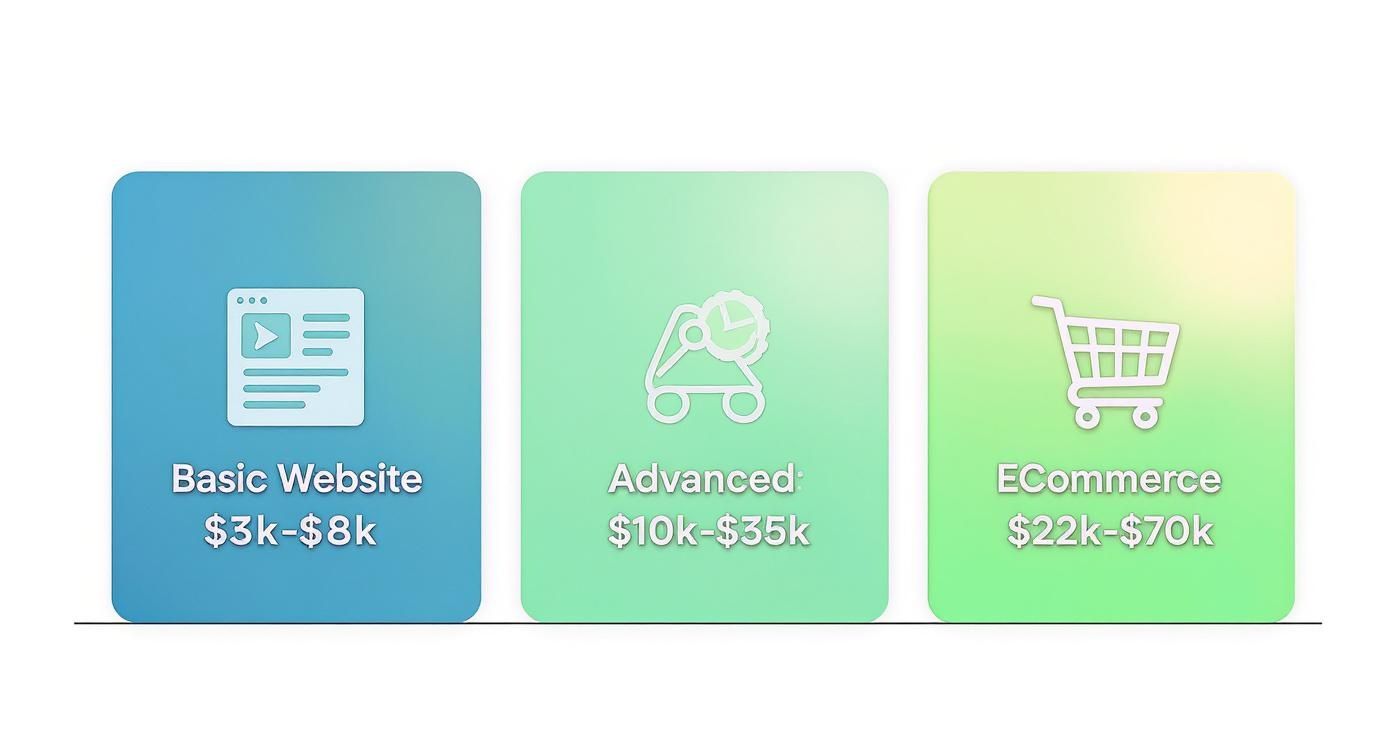
As the data shows, there are clear budget tiers based on what you need your website to do. For any small business trying to make its mark, understanding the financial commitment is the first critical step. To plan your investment wisely, it's worth getting a detailed overview of the typical small business website cost.
Freelancer vs Agency: Which Is Right for You?
Choosing who builds your website is one of the biggest decisions you'll make, and it has a massive impact on your total investment. It's a bit like deciding between hiring a highly skilled solo tradesperson for a specific job or bringing in a full construction company to manage a project from the ground up.
Both have their place, but they offer completely different experiences and outcomes.
A freelance web designer is that specialist tradesperson. They're often more agile, personable, and affordable, which makes them a fantastic choice for businesses with clear, well-defined needs and a smaller budget. You get to work one-on-one with the person doing the actual work, leading to quick communication and a more personal touch.
On the other hand, a full-service digital agency is the construction company. They bring an entire team of specialists to the table—designers, developers, SEO experts, copywriters, and project managers. This all-in-one approach is perfect for more complex projects that need a strategic, end-to-end solution.
Comparing the Cost Structures
The most obvious difference you’ll notice right away is the price tag. A huge factor driving the total website design cost in Australia is the hourly rate you’re paying for professional time, and freelancers almost always have lower overheads.
This gap becomes pretty clear when you look at the numbers. Freelance designers in Australia typically charge somewhere between AUD $75 and $150 per hour. In contrast, local web design agencies usually have higher rates, often landing between AUD $150 and $250 per hour. Their fees cover a much broader team and more involved services like custom UI/UX design, professional content creation, and ongoing SEO. If you want a deeper look at how these rates stack up, you can explore a complete guide to web design costs in Australia.
This price difference doesn't mean one is a "rip-off" and the other is a "bargain." It simply reflects two different service models.
A freelancer’s price reflects their individual expertise and time. An agency's price reflects the combined brainpower, processes, and strategic oversight of an entire team dedicated to your project's success.
Scope and Specialisation Differences
Your project's scope should be your main guide here. Freelancers often specialise in a particular niche, like WordPress development, UI design, or building sites on Webflow. If what you need fits neatly into their area of expertise, you can get exceptional results for a great price.
But if your project needs a bit of everything—logo design, SEO strategy, content writing, custom backend development, and a social media launch plan—an agency is almost always the smarter choice. Their integrated team ensures all these moving parts work together seamlessly, saving you the headache of hiring and managing multiple freelancers yourself.
Think of it this way:
- Choose a Freelancer if: You have a clear, limited scope, a smaller budget, and you're comfortable managing the project relationship directly.
- Choose an Agency if: You need a wide range of services, you're looking for a long-term strategic partner, and you want a single point of contact to manage the whole process.
Communication and Project Management
Working with a freelancer usually means direct communication. You'll be talking to the person who is actively designing and coding your site, which can be incredibly efficient for quick feedback and minor tweaks. The potential downside is that they're often juggling multiple clients, so their availability might be limited at times.
Agencies, on the other hand, offer a structured project management experience. You’ll almost always have a dedicated account or project manager as your main point of contact. This person coordinates the internal team, keeps timelines on track, and makes sure the project stays on course, providing a more formal and predictable process. This structure is especially valuable for larger businesses or stakeholders who need consistent reporting and organised communication.
What Actually Goes Into Your Website Quote?
Getting a web design quote can feel a bit like looking at the bill after a big dinner out—you see the final number, but what did each part of the meal actually cost? The key to understanding where your money is going is to break down the individual "ingredients" that make up the total. The final website design cost in Australia isn't just a number pulled out of thin air; it’s a direct reflection of the time, skill, and resources needed to build a site that actually hits your goals.
Just like ordering a simple main course is a lot cheaper than a five-course degustation, a basic website is always going to be more affordable than a complex digital platform. Every feature, page, and custom touch adds to the development time and, as a result, the price. Let's pull back the curtain on the core components that have the biggest impact on your quote so you can make smart decisions about your investment.
The Scale of Your Digital Footprint
One of the most straightforward factors is the sheer size of your website. A bigger site with more pages simply requires more design work, more content to be created, and more time in development. It’s a simple matter of volume—building a five-room house is fundamentally less work than constructing a fifty-room hotel.
A small local business might only need a handful of essential pages to create a professional online presence:
- Home Page: Your digital front door, making that all-important first impression.
- About Us: The page that shares your story and builds trust with potential customers.
- Services/Products: A clear breakdown of what you offer and why it matters.
- Contact Us: The crucial page that turns a curious visitor into a genuine lead.
This kind of compact "brochure" website gets the job done and is very cost-effective. On the other hand, a larger company or an established brand might need a much bigger site map, with individual service pages, detailed case studies, team profiles, a blog with dozens of articles, and resource libraries. A 5-page website is a much smaller project than a 50-page corporate portal, and the quote will reflect that difference directly.
Custom Design vs Template-Based Approaches
Your website's look, feel, and user experience (UI/UX) are non-negotiable, and the path you take to get there has a massive impact on the cost. In fact, one study found that 75% of consumers judge a business's credibility based on its website design alone. This is where you face a big decision: use a pre-made template or invest in a completely custom design.
A template-based design is like buying a suit off the rack. It’s faster, more affordable, and can look fantastic with a few tweaks. The catch? It wasn't made specifically for you, so you're locked into the original design's structure and limitations.
A custom UI/UX design is the equivalent of a bespoke, tailored suit. It’s crafted from the ground up to perfectly fit your brand, your target audience, and your business goals. This involves deep research, wireframing, prototyping, and user testing to create a unique digital experience that gets results. While it’s a bigger investment upfront, a custom design almost always delivers a higher return by converting more visitors into paying customers.
Investing in custom design isn't just about looking good; it's about building a strategic tool engineered to solve your specific business problems and connect with your ideal audience on a deeper level.
Content Creation and Asset Sourcing
A beautiful website is just an empty shell without high-quality content. Your quote can swing quite a bit depending on who’s responsible for providing the words, images, and other media for the site.
There are usually three ways this plays out:
- You Provide Everything: If you come to the table with all the finalised copywriting and professional photos, you'll save on costs. The responsibility, however, is on you to deliver top-notch, web-ready content on time.
- The Agency Creates Everything: Many agencies offer professional copywriting and photography services. This adds to the budget but guarantees your content is persuasive, on-brand, and optimised for search engines right from the start.
- A Hybrid Approach: You might provide the basic text, and the agency’s copywriter polishes it for the web. Or, you might have some of your own photos but need the agency to source extra stock imagery to fill the gaps.
Professional copywriting and imagery aren't just filler; they are essential for communicating your value and building trust. Skimping on content can completely undermine an otherwise brilliant design.
Core Functionality and Management Systems
Finally, the technology running under the hood plays a huge role in the final price. Even a simple website needs a few essential functions, like a secure contact form to capture leads. Beyond that, a Content Management System (CMS) is pretty much standard for any modern business.
A CMS like WordPress is what allows you to easily update your own website—like adding a new blog post or changing your business hours—without ever needing to write a line of code. Integrating and setting up a CMS is a standard part of most professional web design quotes. The complexity of this setup, along with any other features you need like a blog or basic SEO tools, will all be factored into your final price.
Pricing for Advanced and eCommerce Websites
When your business needs more than a simple online brochure, you step into the world of advanced websites and eCommerce. Think of it like this: a basic website is the house itself, but now you need to add the high-tech home theatre, the automated security system, or the fully-kitted-out workshop in the garage. Each of those additions requires specialised skills and a bigger investment.
It's the same with your website. Adding powerful features like online payments, booking systems, or customer logins adds a layer of complexity that pushes up the website design cost in Australia. These aren't just cosmetic tweaks; they are sophisticated systems designed to handle real business operations, from taking money to managing your client relationships.
What Drives the Cost of Advanced Features?
Features like a secure payment gateway or a custom booking engine aren't just simple "plug-ins." They need serious development time to build, integrate with other software, and test until they're bulletproof.
Developers need to make sure these systems are not just working, but are completely secure—especially when you’re handling sensitive information like credit card details. This means writing complex code, connecting to other platforms through APIs, and building robust security to fend off any potential threats.
The higher price tag for advanced websites directly reflects the increased development hours, heightened security protocols, and specialised expertise required to build tools that automate business processes and drive revenue.
Cost Comparison of Common Advanced Features
So, let's break down some of the most popular advanced features and what they might add to your project's bottom line. These are the kinds of tools that turn a simple website into a powerful business engine.
| Advanced Feature | Estimated Additional Cost (AUD) | Primary Use Case |
|---|---|---|
| Payment Gateway Integration | $1,500 – $4,000+ | Connecting your site to platforms like Stripe or PayPal to securely accept online payments. |
| Inventory Management System | $3,000 – $8,000+ | For businesses with stock, this syncs your website inventory with your physical stock levels automatically. |
| Custom Customer Portals | $4,000 – $12,000+ | Creating a secure login area for customers to view order history, manage subscriptions, or access private content. |
| Online Booking & Scheduling | $2,500 – $7,000+ | Perfect for service businesses, allowing clients to book appointments that sync with calendars like Google Calendar. |
The cost of these features really depends on your industry. For example, a medical practice might need a sophisticated online booking system, which could sit in the $5,000 to $15,000 range. Meanwhile, a full-blown eCommerce site needing a secure checkout and inventory management could range from $6,000 to over $20,000. The complexity of your specific needs is what really shapes the final price.
eCommerce: The Ultimate Advanced Website
Building an online store is one of the biggest reasons businesses upgrade to an advanced website. When you go down this path, you hit a fork in the road that will have a huge impact on your budget: do you use an all-in-one platform like Shopify, or build a more flexible store with a tool like WooCommerce on WordPress?
Shopify: The Managed Platform
Think of Shopify as leasing a premium retail space in a busy shopping centre. You get a fantastic, secure spot with all the basics included for a monthly fee. It's faster and easier to get started, but you have less control over the fundamental structure and you'll be paying ongoing subscription and transaction fees.
WooCommerce: The Custom Build
Building with WooCommerce is like constructing your own custom-designed shop from the ground up. You have total freedom over the design, the features, and the entire customer journey. That flexibility comes with a higher upfront cost for development, but you own the asset outright and dodge most of those recurring platform fees.
Choosing the right platform comes down to your budget, your technical confidence, and your long-term vision for the business. For a much deeper dive into this decision, check out our comprehensive guide on building powerful eCommerce websites. It’ll help you weigh up the pros and cons to make the smartest choice for your online store.
Budgeting For Hidden And Ongoing Website Costs
The initial quote you get for a new website is a big part of the investment, but it's a classic mistake to think it's the only part. That's a bit like buying a brand-new car and forgetting you'll need to budget for petrol, insurance, and regular servicing.
Your website is a living, breathing asset for your business. It needs ongoing care to keep it performing at its best. These recurring expenses aren't just optional extras; they're fundamental to keeping your site secure, working properly, and actually visible online. If you overlook them when calculating your website design cost in Australia, you're setting yourself up for a budget blowout down the track.
Essential Ongoing Website Expenses
To keep your website online and running smoothly, there are a few non-negotiable costs you need to account for. Think of these as the basic utilities for your digital storefront.
Here are the core expenses you’ll need to budget for each year:
- Web Hosting: This is the 'rent' you pay for your website's home on the internet. It’s the plot of land where all your files, images, and data are stored. Quality hosting is what makes your site fast and reliable for visitors. For a deep dive, you can explore our guide to the best WordPress hosting options out there.
- Domain Name Renewal: This is your website's address (like yourbusiness.com.au). You need to renew it every year to keep ownership, which typically costs between $10 and $50.
- SSL Certificate: An SSL certificate encrypts the data flowing between your site and your visitors. It’s what gives you that little padlock icon in the browser bar and is absolutely essential for security and trust. While some hosting plans include one, standalone certificates can run anywhere from $50 to $300 per year.
The Critical Cost Of Website Maintenance
Beyond the technical basics, the single most important ongoing investment is a solid website maintenance plan. This is your insurance policy against things going sideways. You get your car serviced to prevent a major breakdown on the highway, and you maintain your website to prevent costly hacks, crashes, or performance meltdowns.
A good maintenance plan will typically cover:
- Regular Backups: Creating frequent copies of your entire site so it can be restored in a flash if something goes wrong.
- Software Updates: Keeping your core system (like WordPress) and all its plugins updated to patch security holes as they're discovered.
- Security Scans: Proactively hunting for and removing any malware or hacking attempts.
- Performance Checks: Making sure your site continues to load quickly for your users.
Neglecting maintenance is a false economy. The cost of an emergency fix after your site gets hacked or crashes is almost always far, far greater than the modest monthly fee for a professional maintenance plan.
On top of this, you also need to think about ongoing legal accessibility standards. It’s crucial to understand the legal and financial risks of ADA non-compliance to avoid hefty penalties and ensure your site is usable for everyone. This is another one of those 'hidden' costs that a bit of proactive budgeting can easily cover.
Putting aside between $500 and $5,000 per year for a comprehensive maintenance plan is a seriously wise investment. It protects your valuable asset and gives you priceless peace of mind.
How to Get an Accurate Web Design Quote
Knowing the average website design cost in Australia is one thing, but getting a quote that actually matches your vision and budget is another game entirely.
Walking up to a web designer and saying, "I'd like a website, please," is a bit like going to a builder and asking for "a house." Without a blueprint, they can't possibly give you a meaningful price. It’s just guesswork.
Your best tool for getting sharp, comparable quotes is a detailed project brief. Think of it as the ultimate shopping list for your website. It cuts through the ambiguity, gets you and the web pro on the same page from day one, and helps them price your project correctly.
Even better, crafting a brief forces you to get crystal clear on your own goals before you even start the conversation. It’s the foundation for the entire project.
Creating Your Website Project Brief
Your brief doesn't need to be some super-technical document. It just needs to answer the key questions any good designer would ask you anyway. A clear brief helps them give you a quote that lines up with what you’re expecting, which is the best way to avoid scope creep and surprise costs down the track.
Here’s a simple checklist of what to include:
- About Your Business: A quick rundown—who are you, what do you do, and what’s your secret sauce?
- Project Goals: What’s the number one thing this website needs to achieve? Is it all about generating leads, selling products online, or positioning you as an industry expert?
- Target Audience: Paint a picture of your ideal customer. What are their biggest frustrations, what do they need, and where do they hang out online?
- Must-Have Features: List the absolute essentials. This could be anything from a simple contact form and a blog to a full-blown online booking system or eCommerce shop.
- Example Websites: Share links to 2-3 websites you love. Be specific about what you like—is it the clean layout, the colours, or how easy it is to use? It’s just as helpful to include a site or two you dislike and explain why.
A detailed brief is so much more than a request for a price; it’s the start of a strategic conversation. It shows you’ve done your homework and are serious about investing in a powerful digital asset for your business.
Evaluating the Proposals You Receive
Once the quotes start rolling in, resist the urge to immediately jump on the cheapest one. A low price can sometimes be a red flag for an inexperienced provider or a cookie-cutter template that won’t serve your long-term goals.
Instead, look at each proposal through the lens of overall value.
Go beyond the bottom line. Check out their portfolio, read what their past clients have to say, and see how clearly they’ve laid out their proposal. A great agency will break down the costs and walk you through their process. They should feel like a strategic partner, not just a supplier you’ve hired.
By looking at the whole picture, you’ll find the right fit for your project and get a much better sense of what goes into professional websites that are built to get results.
Your Questions Answered
Diving into a new website project always brings up a few questions. It’s a big investment, after all. So, let’s clear the air on some of the most common things business owners ask when figuring out the real website design cost in Australia.
How Long Does It Take to Build a Website in Australia?
The honest answer? It varies as much as the price does. Think of it like building a house – a simple project home might be ready in a few weeks, while a custom architectural build will take months of detailed work.
A straightforward 5-page "brochure" website can often be designed, built, and launched in a brisk 4 to 6 weeks. But once you start adding more complexity, like a full-blown eCommerce store or a custom client portal, the timeline naturally stretches. For these more involved projects, you should realistically budget for 8 to 16 weeks or even more. That extra time is crucial for nailing the strategy, crafting a unique design, handling complex development, and thoroughly testing everything to make sure it’s perfect.
Can I Save Money by Providing My Own Content?
Absolutely. In fact, it's one of the best ways to bring down your upfront costs. When an agency doesn’t need to hire a copywriter or a photographer for your project, those savings are passed right on to you.
But here’s the crucial part: you have to be ready for the commitment. Your content—all the text, images, and videos—needs to be completely finalised and delivered on schedule. If your content is late, it creates a bottleneck that can push back your entire launch date. So, before you commit, make sure you have the time and resources to produce quality assets without holding up the project.
The Bottom Line: Supplying your own content is a fantastic way to save money, but only if you can deliver high-quality, finalised materials on time. Remember, even the most stunning design can be let down by poor-quality content.
What Is the Difference Between Web Design and Web Development?
Great question. People often use these terms interchangeably, but they are two very different jobs that need to work hand-in-hand to create a great website.
-
Web Design (The Architect): This is all about the look, feel, and user experience (UI/UX) of the site. The designer is like the architect, creating the visual blueprint. They decide on the layout, the colours, and how a visitor will interact with every part of the site to make it intuitive and engaging.
-
Web Development (The Builder): This is the hands-on, technical construction. The developer takes the designer’s blueprint and uses code (like HTML, CSS, and JavaScript) to bring it to life. They build all the functional, interactive parts of the website, making sure everything actually works.
Put simply, the designer plans how it looks and feels, while the developer is the one who actually builds it.
Does the Website Cost Include Ongoing SEO Services?
Typically, no. The initial quote for designing and building your website covers just that—the one-off cost of the build. Now, any reputable agency will build your site with SEO best practices baked in from the start. We're talking about things like clean code, mobile-friendly design, and fast load times. This is foundational SEO.
But this is very different from an ongoing SEO campaign. That’s a separate marketing service focused on consistently improving your Google rankings over time through things like content creation, link building, and regular technical tweaks. Most agencies offer this as a distinct monthly service after your new website goes live.
Ready to build a website that actually delivers results for your business? The team at Digital Roo's combines strategic thinking with creative design to help Australian brands grow. Get your free, no-obligation quote today!