Asking "how much does a website cost in Australia?" is a bit like asking how much a car costs. A simple runaround has a very different price tag to a high-performance sports car, and the answer is always, "well, it depends."
But that's not a very helpful place to start, is it? For a professionally designed and built website, Australian businesses should be prepared to invest anywhere from $5,000 to over $25,000. Simpler sites will sit at the lower end of that scale, while more complex projects will climb higher.
Your Quick Guide to Australian Website Costs
Think of building a website like building a house. A simple brochure site for a local Noosa cafe is like a one-bedroom granny flat—functional and effective. An advanced eCommerce platform for a growing Brisbane retailer is more like a multi-level custom home with all the trimmings. The investment directly reflects the complexity, features, and strategic thinking required.
Your website isn't just an online placeholder. It’s your hardest-working employee, operating 24/7 to find, attract, and convert customers for you. As an award-winning web design agency with deep roots in both design and SEO marketing, we've seen time and again how a smart upfront investment creates a powerful digital asset that drives real, measurable growth for years to come.
To give you a clearer picture, here's a quick breakdown of what you can generally expect to invest for different types of websites here in Australia.
| Typical Website Investment Ranges in Australia | |||
|---|---|---|---|
| Website Type | Primary Goal | Typical Page Count | Estimated Cost Range (AUD) |
| Brochure / Informational | Establish a professional online presence and provide key business information. | 3-5 pages | $3,500 – $8,000 |
| Lead Generation | Actively capture leads through forms, calls-to-action, and targeted content. | 5-10 pages | $8,000 – $15,000 |
| eCommerce (Basic) | Sell a small catalogue of products with standard payment and shipping options. | 10-20+ pages | $10,000 – $25,000 |
| Custom / Enterprise | Highly tailored functionality, complex integrations, and bespoke user experiences. | 20+ pages | $30,000+ |
These are, of course, ballpark figures. The final cost will always come down to the specific features and level of customisation your project needs.
Why a Design-First Approach Matters
We don’t just build websites; we engineer customer experiences. As a web design first agency, our approach means we start by getting inside the heads of your audience, whether they're on the Sunshine Coast, in Noosa, or across Brisbane. It’s all about creating an intuitive, seamless journey that guides them from being a casual visitor to becoming a loyal customer.
Investing in strategic design isn't just an expense; it's a direct investment in your brand's credibility, the trust you build with users, and, ultimately, your conversion rates. A well-designed site built with SEO in mind from day one is the foundation for any kind of sustainable online success.
This means we focus relentlessly on the things that actually move the needle:
- User Experience (UX): Making sure your site is dead simple to navigate and genuinely enjoyable to use.
- Conversion Rate Optimisation (CRO): Designing clear, compelling pathways that encourage users to take the action you want them to take.
- A Solid SEO Foundation: Building the site on a technically sound framework that search engines like Google absolutely love.
Understanding the Investment Brackets
The cost of website design in Australia is driven entirely by the scope of the project. For simpler brochure-style websites with around 3-5 pages, you're typically looking at a range between $3,500 and $8,000.
Once you move into more premium sites with custom features and up to 10 pages, the investment can range from $8,000 to $30,000 or more, depending on just how complex the required functionality is.
For businesses looking to sell online, the eCommerce platform you choose also plays a big role. If you're weighing up your options, understanding the real how much Shopify costs per month is a crucial part of budgeting for those ongoing platform expenses. Getting a handle on these different brackets helps you align your budget with your business goals from the very start.
Understanding Different Website Types and Prices
Not all websites are built to do the same job. Just like a small retail shop in Noosa has different needs than a large logistics company in Brisbane, your website has to be shaped around your specific business goals. The complexity and purpose of a site are the biggest factors driving the website design cost in Australia.
To get your head around the investment, it helps to think of your website like a property. You could build a stylish studio apartment, a family home designed to welcome visitors, a bustling retail storefront, or a completely custom architectural masterpiece. Each serves a different function and demands a different level of planning, materials, and craftsmanship.
Brochure or Informational Websites
This is the digital version of a glossy brochure or a high-quality business card. Its main job is to plant a flag online, build credibility, and give people the essential info: who you are, what you do, and how to get in touch.
These sites are generally quite small, often just three to five pages (think Home, About, Services, Contact). They’re perfect for businesses that find most of their clients through word-of-mouth or offline marketing but need a polished, professional hub to back up their reputation. While they look great, they don't usually have any complex bells and whistles.
Lead Generation Websites
Taking things up a notch, a lead generation website is an active marketing machine. Its entire reason for being is to turn casual visitors into potential customers. It does everything a brochure site does but adds strategic elements specifically designed to capture people’s details.
This usually includes things like:
- Prominent Calls-to-Action (CTAs): Unmissable buttons and links prompting users to "Request a Quote," "Book a Consultation," or "Download Our Guide."
- Optimised Contact Forms: Simple, easy-to-use forms that gather essential lead info without feeling like a chore to fill out.
- Landing Pages: Specialised pages built for specific marketing campaigns, laser-focused on a single offer to maximise conversions.
For many of our clients on the Sunshine Coast, a strong lead generation site is the absolute engine room of their business, working 24/7 to fill their sales pipeline.
E-commerce Websites
An e-commerce website is your online shopfront, open around the clock. This is where the complexity—and therefore the cost—takes a significant leap. An e-commerce site needs to do more than just look good; it needs a rock-solid and secure backend to handle products, inventory, customer accounts, payments, and shipping.
Key features always include product catalogues, a secure shopping cart, and integration with payment gateways like Stripe or PayPal. While a basic small business site in Australia might land between AUD 3,000 and AUD 8,000, e-commerce is a different beast altogether. These projects often start around the AUD 8,000 mark and can easily push past AUD 20,000, driven by the complex backend work and custom functionality required. For a deeper dive, check out our guide on building powerful e-commerce websites that actually drive sales.
Custom Web Applications
This is the top tier of web development, like getting a bespoke architectural home designed from the ground up. A custom web application is built from scratch to perform specific, complex functions that no off-the-shelf software can handle. Think of custom-built online booking systems, client portals, or unique software-as-a-service (SaaS) products.
These projects involve a huge amount of planning, user experience (UX) research, custom coding, and deep integrations with other systems. They deliver unmatched performance and can scale with your business, but they also represent the largest investment. When you're looking at different options, a transparent breakdown is key to understanding a company's pricing structure and seeing what you're really getting for your money.
Key Factors That Influence Your Final Website Cost
So, you've got two quotes in front of you for what looks like the same website. One is for $5,000, and the other is for $25,000. It’s a super common situation for businesses from Noosa to Brisbane, and that huge price gap almost always comes down to what’s happening beneath the surface.
The final website design cost in Australia is shaped by a handful of strategic decisions that turn a simple online brochure into a genuine, high-performance business asset.
Getting your head around these cost drivers is essential. It lets you look past the final number on a quote and properly evaluate the value you’re getting. Think of it like buying a car: one has a standard engine, the other has a high-performance, custom-tuned motor. They might look similar, but their capabilities are worlds apart.
Let's break down the key factors that determine your final investment.
Custom Design vs Template-Based Approach
The single biggest factor driving your website's cost is the design approach. Are you getting a unique, custom-built experience, or just a pre-made template with your logo and colours dropped in?
A template-based design is like buying a suit off the rack. It’s faster and cheaper because the basic structure is already there. While it can be a decent starting point for businesses on a tight budget, it often comes with creative handcuffs and bloated code that can hurt your performance and SEO down the track.
On the other hand, a custom design is a tailored suit, crafted specifically for your brand and your customers. As an award-winning web design first agency, we start with a blank canvas, digging deep into your Sunshine Coast audience to build a user journey from the ground up. This approach means every single element serves a purpose, leading to a unique, high-performing website that stands out and actually converts. The initial investment is higher, but the return is significantly greater.
The Depth of User Experience (UX) Strategy
A pretty website is one thing; a website that’s intuitive and dead simple to use is another beast entirely. A huge chunk of a professional agency's quote is dedicated to User Experience (UX) and User Interface (UI) design. This isn't just about picking nice fonts and colours.
It’s a strategic process that involves:
- Audience Research: Understanding who your customers are and what they need to get done on your site.
- Wireframing: Creating a blueprint of the site’s structure and layout before any visual design even begins.
- Prototyping: Building interactive mockups to test the user flow and find any potential friction points.
- Usability Testing: Making sure the final design is simple, logical, and frustration-free for your visitors.
A study by Stanford University found that 75% of users judge a company's credibility based purely on its website design. Skimping on UX is like building a beautiful shop with a door that's hard to open—it undermines trust and costs you customers.
E-commerce and Third-Party Integrations
If you're planning to sell products online, the complexity jumps up immediately. E-commerce functionality is so much more than just a "buy now" button. You’ve got to set up secure payment gateways (like Stripe or PayPal), figure out complex shipping logic for different Australian states, and manage inventory—all of which requires specialised development.
This complexity also applies to third-party integrations. Getting your website to talk seamlessly with your other business tools is crucial for efficiency. This could be anything from hooking into a CRM like HubSpot, a booking system like Calendly, or email marketing software like Mailchimp. Each integration needs careful planning and development to make sure data flows correctly and securely, which naturally adds to the project's bottom line.
SEO Foundation and Technical Excellence
Finally, a critical but often overlooked cost factor is the website’s technical foundation, especially its readiness for SEO. For our agency, SEO isn't an optional add-on; it's baked into the development process from day one. This means building a site with clean code, lightning-fast loading speeds, a logical site structure, and mobile-first responsiveness.
This foundational work ensures that search engines like Google can easily crawl and understand your content, giving you a powerful head start in ranking for valuable keywords. It’s an investment in your site’s future visibility and a key reason why a professional build from an expert agency costs more than a quick template job. It makes sure your new digital asset doesn't just launch—it performs.
Comparing a Professional Agency to DIY Builders
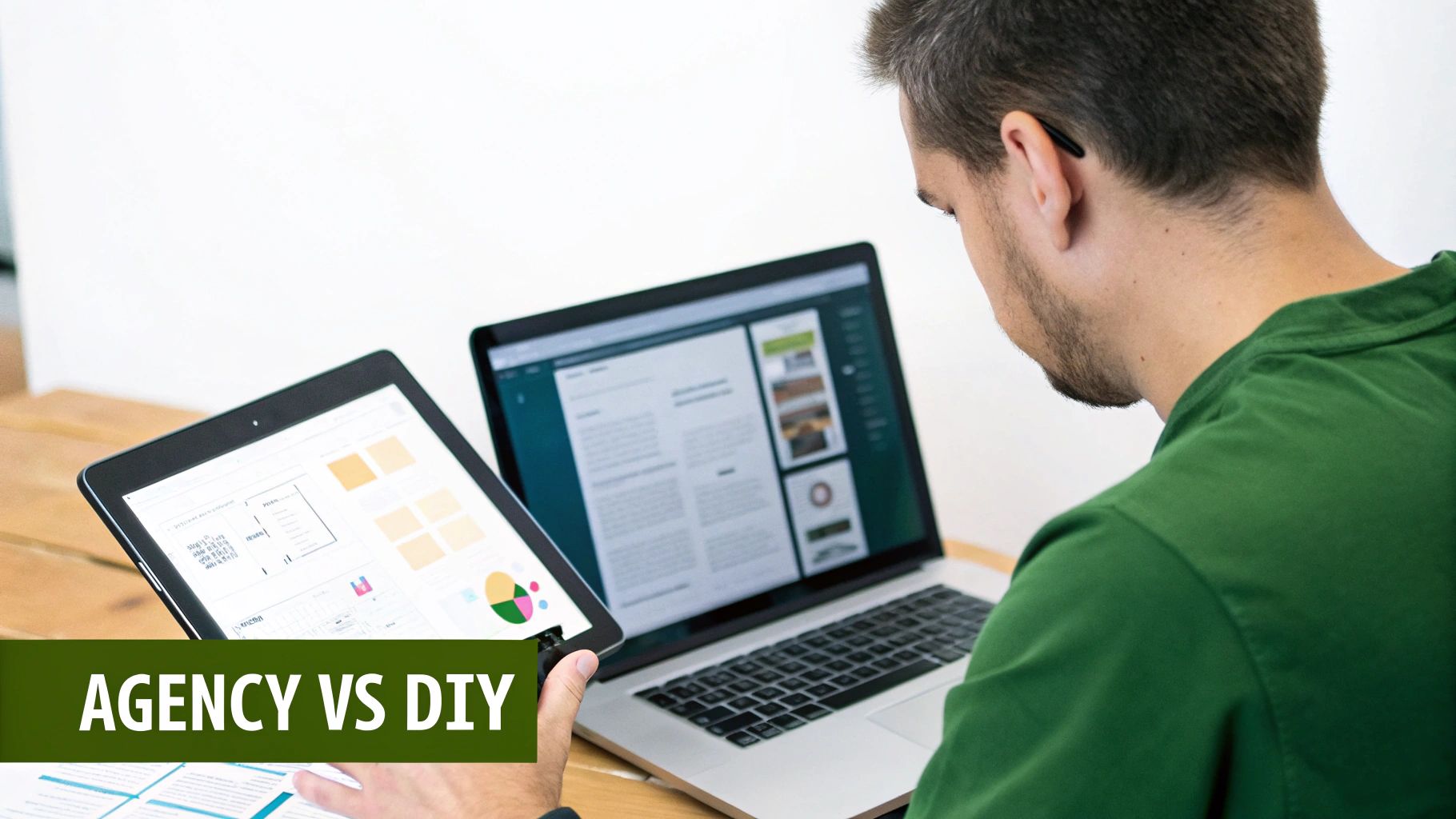
The pull of a "free" or super-low-cost DIY website builder is strong, especially when you're just starting out. But what's the real cost to your business when you choose the DIY route over bringing in a professional?
Think of it like getting a suit. A DIY website is the off-the-rack option. It might look okay from a distance and do the job for one night, but it rarely fits perfectly. It’s probably tight in the shoulders (limited features) or too long in the sleeves (clunky user experience), and it definitely wasn't made to last.
A professionally built website, on the other hand, is a tailored suit. It’s measured and crafted to fit your brand, your audience, and your business goals flawlessly. It’s built to perform under pressure, look impeccable, and adapt as your business grows. This is the difference between simply having a presence and owning a powerful digital asset.
The Hidden Costs of a DIY Website
While the upfront sticker price of a DIY builder seems unbeatable, the hidden expenses stack up fast. These aren't just financial costs; they're costs to your time, your brand's reputation, and your potential for growth.
The biggest hidden cost is your own time. Building a functional, attractive website takes dozens, if not hundreds, of hours. That's time you could be spending running your Brisbane business, serving clients in Noosa, or perfecting your craft on the Sunshine Coast. Every hour you spend wrestling with a drag-and-drop editor is an hour you’re not generating revenue.
Beyond your time, DIY platforms come with serious limitations:
- Poor SEO Performance: Most DIY builders create websites with bloated code and rigid structures that search engines struggle with. Without a deep understanding of technical SEO, you’re building a beautiful shop on a dead-end street that no one can find.
- Limited Functionality: Need to integrate a specific booking system or a custom shipping calculator? DIY platforms often can't handle complex integrations, forcing you into clunky workarounds or preventing you from offering the features your customers need.
- Scalability Roadblocks: Your business is built to grow, but your DIY website might not be. As your needs become more complex, you'll eventually hit a wall, forcing a costly and disruptive move to a professional platform down the line.
The Long-Term Value of a Professional Agency
Partnering with an expert agency isn't an expense; it's an investment in a long-term return. It's a strategic decision that pays dividends in leads, sales, and brand equity.
While DIY builders offer a starting point, they are a notable counterpoint to what professional development provides. The rise of these platforms in Australia enables businesses to create simple sites for approximately AUD 0 to AUD 1,000 upfront. However, this approach comes with trade-offs in design flexibility, SEO power, and the ability to scale. It’s why ambitious businesses ultimately partner with experts for sustainable growth. Explore more about these website development cost comparisons.
An investment in a professional agency isn't just for a website; it's for a strategic partnership. You gain access to a team of experts—designers, developers, and SEO marketing specialists—all focused on one thing: turning your website into your most valuable business-generating asset.
This partnership delivers value that DIY builders simply can't match:
- Strategic Planning: We start by understanding your business and your customers, creating a digital strategy designed to achieve specific, measurable goals.
- Conversion-Focused Design: We use proven user experience (UX) principles to design a website that doesn't just attract visitors but guides them toward becoming customers.
- Technical SEO Excellence: We build your website on a rock-solid technical foundation, ensuring it’s fast, secure, and perfectly optimised for search engines from day one.
- Ongoing Support and Growth: Our relationship doesn't end at launch. We provide ongoing support, maintenance, and SEO marketing services to ensure your website continues to perform and evolve with your business.
Choosing an agency means investing in a robust, high-performance engine for your business, not just a shiny exterior.
Budgeting for Long-Term Website Success
Launching your new website is a huge milestone, but it's the start of the journey, not the finish line. A high-performing website for your Brisbane or Noosa business is a living, breathing asset. It needs ongoing care to keep delivering value long after the initial build is done.
Too often, businesses pour everything into the upfront website design cost in Australia and forget to budget for what comes next. Think of it like buying a high-performance car; the sticker price is just the beginning. You still have fuel, insurance, and regular servicing to keep it running smoothly and safely on the road.
Your website is exactly the same. Let’s break down the essential ongoing costs that make sure your initial investment grows into a powerful, revenue-generating machine.
Core Ongoing Website Costs
Beyond the one-time design fee, a couple of non-negotiable costs are required just to keep your website live and functional. These are the absolute basics every website owner in Australia needs to factor in.
-
Domain Name Registration: This is your website's address on the internet (like yourbusiness.com.au). It’s a small but vital annual fee, usually costing between $15 and $50 per year.
-
Website Hosting: This is the digital plot of land where your website's files live. You’ll see cheap hosting for under $10 a month, but it’s a false economy. Poor hosting means slow load times, frequent crashes, and security holes—all things that kill your SEO and user trust. Quality, secure hosting in Australia typically ranges from $30 to $100+ per month.
Website Maintenance Plans
A professional website is built with complex software like WordPress and various plugins that need constant updates to patch security flaws and ensure they all play nicely together. Neglecting this is like leaving your front door wide open.
A maintenance plan is your digital insurance policy. As an award-winning web design first agency, we provide plans that cover the essentials:
- Regular software and plugin updates
- Daily or weekly backups of your entire site
- Security monitoring to block threats
- Performance checks to keep it running fast
These plans give you peace of mind and stop small issues from turning into catastrophic, expensive disasters.
A website is not a "set and forget" project. Ongoing maintenance is the single most important factor in protecting your digital asset from security threats and ensuring it performs optimally for both users and search engines.
Investing in Growth: SEO and Content
Finally, we get to the most critical ongoing investment: your website's visibility. A stunning website is useless if no one can find it. This is where ongoing Search Engine Optimisation (SEO) and content marketing come into play. These aren't just costs; they are direct investments in attracting qualified customers from the Sunshine Coast and beyond.
Ongoing SEO makes sure your website continuously climbs the ranks on Google, capturing valuable traffic from people actively looking for what you offer. It involves creating helpful blog posts, building your site's authority, and adapting to Google's algorithm changes. This is how you transform your website from a static online brochure into your hardest-working lead generation tool, ensuring a powerful and consistent return on your investment for years to come.
To give you a clearer picture of how these ongoing costs break down, here is a sample budget for a business serious about maintaining its site and growing its presence.
Sample Ongoing Website Maintenance & Growth Budget
| Service | Typical Monthly Cost (AUD) | Purpose |
|---|---|---|
| Secure Hosting & Domain | $50 – $150 | The foundational cost to keep your site live, fast, and secure on a quality server. |
| Technical Maintenance Plan | $100 – $300 | Your insurance policy: covers updates, backups, and security monitoring to prevent issues. |
| Content & SEO Retainer | $1,000 – $3,000+ | The growth engine: drives new, qualified traffic to your site through content and optimisation. |
| Software/Plugin Licences | $20 – $100 | Annual fees for premium tools (e.g., forms, SEO plugins) that power key site functions. |
This table illustrates that keeping a professional website running and growing is an active investment, not just a one-off expense. Budgeting for these items ensures your digital asset continues to appreciate in value and drive real business results.
When you start getting quotes for your new website, it can feel a bit like you’re comparing apples and oranges. With website design prices in Australia swinging so wildly, how do you sort through the proposals to find a partner who will deliver genuine value, not just a cheap price tag?
The trick is to look past the final number and focus on the thinking behind it. A quality proposal should feel less like a bill and more like a blueprint for your business's success. It needs to lay out a comprehensive scope of work, clearly defining what’s included—and just as importantly, what’s not.
Look Beyond the Price Tag
Let’s be honest: the cheapest quote is almost never the best investment. An unusually low price is often a red flag, signalling a cookie-cutter template, a total lack of strategic thinking, or—and this is the big one—a complete disregard for SEO from the get-go.
A true web design partner will be excited to show you what they’ve done and prove their expertise. When you’re vetting potential agencies, keep an eye out for these clear signs of quality:
- A Strong Portfolio: Have they built high-performing websites for businesses like yours? The best way to gauge an agency's design chops and technical skill is to see the results they've already delivered. Check out some examples of our work to see what we mean.
- A Focus on SEO: A stunning website is completely useless if nobody can find it. A top-tier partner builds search engine optimisation into the website from day one, creating a technically sound foundation that’s designed to rank on Google.
- Clear Post-Launch Support: What’s the plan after your site goes live? A reliable partner will have clear, straightforward options for ongoing maintenance, security updates, and support to protect your new asset.
Critical Questions to Ask Any Agency
To help you choose with confidence, we encourage every Sunshine Coast, Noosa, and Brisbane business owner to ask these essential questions. The way an agency answers will tell you everything you need to know about their process and their commitment to your success.
Choosing a web design partner is about building a relationship that drives results. You're not just buying a product; you're investing in a team that should be as committed to your business growth as you are.
Get straight to the point and ask them:
- How do you integrate SEO into the website build process?
- Can you walk me through your design and development phases?
- What does your post-launch support and maintenance look like?
- Who will be my main point of contact throughout the project?
- How will we measure the success of the new website?
By asking these direct questions and taking a good look at their past work, you can find a partner who won’t just build you a website, but will build you a powerful, long-term asset for your business.
Common Questions About Website Costs
As you start to map out your budget, it's natural for questions to pop up. We get asked these all the time by business owners across the Sunshine Coast, Noosa, and Brisbane, so let's clear the air on what goes into the website design cost in Australia.
How Long Does It Take to Build a Website in Australia?
The honest answer? It's completely tied to how complex the site is.
A simple, sharp-looking brochure website can often be designed, built, and launched within 4-6 weeks. This gives us enough breathing room to nail the strategy and creative without rushing things.
But if you're looking at a more involved lead generation or eCommerce website with custom features, you should plan for a timeline closer to 8-12 weeks. For the big, fully custom projects, that can easily stretch to 3-6 months. The biggest variable here is often how quickly you, the client, can give us the feedback and content we need to keep the wheels turning.
Do I Need to Pay for My Website All at Once?
Not at all. Any reputable agency knows a professional website is a serious investment. Most of us, including our award-winning team, break the cost down into a milestone-based payment structure. It just makes things easier on your cash flow.
Typically, it looks something like this:
- An initial deposit (usually 30-50%) to get the project off the ground and dive into the strategy and design work.
- One or two payments in the middle of the project, tied to key approvals like signing off on the final design or a major development stage.
- The final payment is settled up just before we push the button to take your new website live.
Can I Provide My Own Content to Lower the Cost?
Absolutely! In fact, supplying your own professionally written copy and high-quality images is one of the best ways to keep your budget in check. When you handle the content, you’re cutting down the hours the agency needs to bill for copywriting or hunting for stock photos, which directly shaves dollars off your final bill.
Just a heads-up, though: the content needs to be top-notch. The text should be written with SEO in mind to give you a fighting chance to rank, and the images must be high-resolution and properly formatted for the web. The last thing you want is for poorly optimised images to slow your brand-new site to a crawl.
Why Shouldn't I Just Pick the Cheapest Quote?
An extremely low quote is almost always a red flag. It’s a sign that corners are being cut somewhere—whether that's by using a generic, cookie-cutter template, completely ignoring how the site looks on a phone, or skipping SEO altogether. That initial "saving" can end up costing you a fortune down the track in lost business or, worse, needing a complete rebuild a year later.
Investing in a quality build from a web design first agency means you're not just buying a website; you're acquiring a powerful, strategic asset built for growth. It's an investment that should deliver a real, tangible return for years to come.
Ready to build a website that delivers real results for your business? As an award-winning agency serving the Sunshine Coast, Noosa, and Brisbane, Digital Roo's combines stunning design with powerful SEO marketing to create digital experiences that drive growth. Get in touch with us today for a personalised quote.