
Think of the best website designers for small business not as order-takers, but as genuine strategic partners. They’re the ones who dig deep to understand what you actually want to achieve—whether that’s getting more local leads or selling products online—and then build a site that works tirelessly to make that happen, 24/7.
Your Website Is Your Hardest-Working Employee
Let’s be blunt: your website isn’t a digital business card. It’s a powerful asset that never clocks off. While you’re busy with customers or managing the day-to-day, your site is in the background building trust, reeling in new clients, and even streamlining your processes.
But a surprising number of small businesses are still missing out on this advantage.
The Digital Divide in Australian Business
It’s genuinely shocking how many operators are still sitting on the digital sidelines. In Australia, a massive 59% of small businesses don't have a website. That figure jumps to an even bigger 65% in regional areas.
This is a huge missed opportunity, especially when you learn that 75% of Australian consumers would rather buy from a business that has an online presence. You can get the full picture on the impact of websites for Aussie SMBs from RockingWeb's 2024-2025 data.
A professional website isn't a 'nice-to-have' anymore. It's a fundamental tool for survival and growth.
Real-World Scenarios Tell the Whole Story
Picture two local cafes on the same street. One relies entirely on foot traffic and word-of-mouth. The other has a simple, professional website showcasing its menu and an online booking system.
That second cafe isn't just selling coffee during the day. It's taking dinner reservations while the owner is asleep and attracting customers who plan their weekend brunch online.
Your website is often the very first interaction a potential customer has with your brand. A professional, user-friendly site builds instant credibility before they’ve even thought about walking through your door.
This holds true for any industry. Think about a local electrician. One hands out business cards, hoping for a call. The other has a website with a slick portfolio of finished jobs, complete with glowing testimonials from happy clients. The electrician with the great online presence isn't just a tradie; they’re a trusted, proven expert.
That digital proof is what turns a casual Google searcher into a paying customer.
Ultimately, putting money into the right website designers for small business isn't an expense. It's an investment in an asset that generates leads, builds your reputation, and drives real growth around the clock.
Turning Your Business Goals Into Website Features
Before you even think about talking to a designer, you need a rock-solid vision. It’s not enough to just say, "I need a new website." You have to get specific about what that website needs to do for your business.
Is your main goal to get more qualified leads pouring in? Or are you looking to sell products directly, show off a portfolio of your work, or simply be a reliable source of information for customers? These big-picture business goals are the starting point, and they need to be translated into actual, tangible website features.
For instance, if your goal is to "boost client bookings by 30%," that immediately tells a designer you’ll need an intuitive, seamless booking system built right into the site. Once your goals are clear, a good designer can turn them into practical elements, like building high-converting lead capture forms designed to turn casual visitors into genuine prospects.
Defining Your Core Website Needs
Put yourself in your ideal customer's shoes. What path do you want them to take when they land on your site? The answers you come up with will form the backbone of your website's feature list.
- Goal: Generate Leads. This means your site needs prominent contact forms, crystal-clear calls-to-action (CTAs) on every single page, and maybe even a dedicated landing page for a special offer.
- Goal: Sell Products. You’re looking at a full e-commerce setup. That includes secure payment gateways, well-designed product pages, and a checkout process so smooth that customers don't even think twice.
- Goal: Build Authority. Features like a blog, in-depth case studies, and glowing client testimonials become non-negotiable for proving you're the expert in your field.
Getting this planning done upfront is absolutely crucial because it has a direct impact on your budget.
A website is a tool built for a specific job. Knowing the job you need it to do is the first step toward getting an accurate quote and a successful outcome.
The infographic below really drives home how a well-thought-out website can help a small business cut through the noise, build trust, and ultimately, grow.
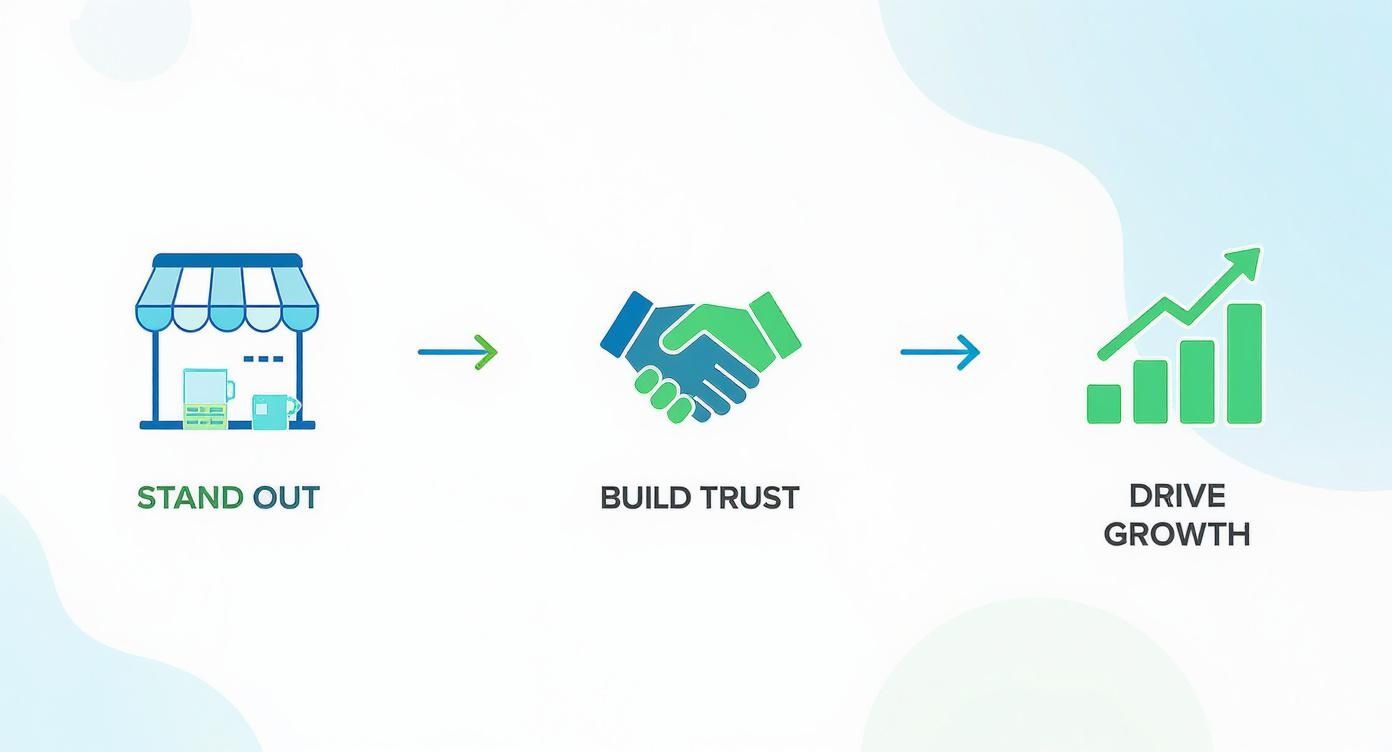
This process proves that a strategic website is so much more than an online brochure; it's an active, hard-working part of your business development strategy.
Setting a Realistic Budget
Once you have a handle on your feature list, you can start to think realistically about your budget. Web design costs in Australia can vary wildly depending on the complexity of the job.
Recent 2025 pricing data, for example, shows that websites for medical services can range anywhere from AUD 5,000 to 15,000. E-commerce platforms often kick off at around AUD 6,000 and can easily climb past AUD 20,000. On the simpler end of the scale, a site for a local cafe might sit somewhere between AUD 3,000 and 8,000.
To help you get a clearer picture, here’s a quick breakdown of typical budget ranges for different types of small businesses in Australia.
Sample Website Budget Ranges for Australian Small Businesses
This table gives a general idea of what you can expect to invest based on common business types and the features they typically need.
| Business Type | Common Features | Typical Budget Range (AUD) |
|---|---|---|
| Local Service (Plumber, Electrician) | Contact Forms, Service Pages, Photo Gallery, Testimonials | $4,000 – $9,000 |
| Professional Services (Accountant, Lawyer) | Booking System, Blog, Detailed Service Pages, Lead Magnets | $5,000 – $12,000 |
| Restaurant or Cafe | Online Menu, Booking Integration, Image Gallery, Google Maps | $3,000 – $8,000 |
| Basic E-commerce (Small Retailer) | Product Pages, Secure Checkout, Payment Gateways, Inventory | $6,000 – $20,000+ |
| Medical or Health Clinic | Patient Forms, Appointment Booking, Service Details, Blog | $5,000 – $15,000 |
These figures are a guide, but they show how your feature list directly shapes the final cost.
Having a clear list of must-haves ensures you’re not paying for bells and whistles you don’t need, or worse, skimping on critical functions that actually drive results. The right designer will help you prioritise these features to get the most out of every dollar you spend.
This is exactly why a solid SEO strategy for the Sunshine Coast and Noosa needs to be part of the conversation from day one. After all, what’s the point of a brilliant new website if nobody can find it?
Where to Find Your Ideal Web Design Partner
Knowing what you need is one thing; finding the right person to actually build it is another challenge entirely. A simple Google search can feel pretty overwhelming, serving up endless pages of agencies and freelancers all claiming to be the best.
The secret isn't in endless searching. It's knowing where to look for genuine talent that actually understands the small business world. Forget wading through generic results. Let's focus on the talent pools where the best website designers for small business really spend their time. This isn't about finding just anyone, but about finding a true partner for your business.
Tapping Into Curated Marketplaces and Networks
First up are the platforms specifically built to connect businesses with properly vetted creative professionals. These aren't your typical gig sites; they are curated environments that filter for quality and experience, which saves you a huge amount of time.
- Upwork Pro & Toptal: These platforms are a massive step up from the standard freelance sites. They have a tough screening process, meaning you're getting access to a pre-vetted pool of top-tier talent. They're excellent for finding designers with proven track records and specific industry expertise.
- Local Business Networks: Never underestimate the power of your local community. Ask for recommendations in your local Chamber of Commerce or a business networking group. A referral from a trusted local business owner is often more valuable than any online review you'll ever read.
This initial search helps you move beyond a random list of names and start building a shortlist based on proven ability. It’s also important to remember that a good designer does more than just design. As you explore, you'll see how expert agencies build comprehensive websites that generate real results.
Exploring Design-Centric Communities
If you want a more direct look at a designer’s creative skills, head to the platforms where they actually show off their work. These communities are like the virtual studios of the design world, offering a raw, unfiltered view of a designer’s style and capabilities.
Portfolios on platforms like Dribbble or Behance show you what a designer can do. Your job is to filter that down to find someone who can do what your small business needs them to do.
When you're browsing these sites, use their search filters strategically. Look for terms like "small business," "e-commerce," or your specific industry (e.g., "cafe website"). This helps you cut through the noise of designers who mainly work with huge corporate clients and focus on those with a portfolio full of projects similar in scale to your own.
Pay close attention to how they present their work. Do they just show pretty pictures, or do they give you case studies explaining the business problem they solved? The best website designers for small business are problem-solvers first and artists second. They connect their design choices back to real business outcomes, like more bookings or higher sales. That’s the kind of partner you want.
How to Vet Designers and Evaluate Their Portfolios
A slick-looking portfolio is table stakes these days, but it doesn't tell you the whole story. Far from it. A gallery of pretty pictures won't guarantee a smooth project or a designer who genuinely gets what your business needs to grow.
Truly vetting potential website designers for small business means digging deeper. You need to look past the polished visuals to understand their process, how they communicate, and whether they can deliver a website that actually produces results. After all, a website is a business tool, not just a piece of art.
The most beautiful design in the world is useless if it takes forever to load, breaks on a mobile phone, or leaves customers confused about what to do next. This is where you need to put on your detective hat.
Digging Deeper Than Design
When you’re looking at a designer's portfolio, don't just scroll and admire. Your first move should be to open their featured websites in a new tab.
Get your hands dirty. Click around. Pull it up on your phone and see how it feels. Can you find what you’re looking for easily, or is it a confusing mess? This simple, hands-on test gives you a gut feeling for their real-world user experience (UX) skills. You can even check out our own Digital Roo's portfolio to see how finished projects should look and feel out in the wild.
Pay close attention to these non-negotiables:
- Mobile Performance: Is the site properly adapted for a small screen, or is it just a shrunken, hard-to-use version of the desktop site?
- Site Speed: Does it load in a snap, or are you left tapping your fingers? A slow website is a conversion killer. Full stop.
- Clear Calls-to-Action (CTAs): Is it dead obvious what the business wants you to do? "Book Now," "Get a Quote," "Shop the Collection"—these should be impossible to miss.
A great portfolio doesn't just show you what a website looks like. It proves the designer understands how a website needs to work to hit specific business goals for their client.
This practical check is what separates the purely visual designers from the ones who build high-performing business assets.
Asking Questions That Reveal True Value
The initial chat or consultation is your chance to get past the portfolio and understand the "how" and "why" behind their work. This is how you find a strategic partner, not just an order-taker.
Prepare a few questions that force them to talk about business outcomes, not just fonts and colours. It’s a fact that well-designed websites in Australia can see conversion rates jump by as much as 200%. You need to know if your potential designer even thinks in these terms. For a deeper dive, you can explore more about how design choices impact business outcomes.
Here are a few killer questions to have up your sleeve:
- "Can you walk me through the business results this website achieved for your client?" Listen for answers that mention tangible results—more leads, higher sales, better booking rates—not just compliments on how pretty it looks.
- "What’s your process for project communication and handling feedback?" You’re looking for a clear, structured system. The last thing you want is a messy process with endless, costly revisions because no one is on the same page.
- "What was the biggest challenge on that project, and how did you solve it?" This question is brilliant for revealing their problem-solving skills and honesty. Every single project hits a snag; a good partner won't be afraid to tell you about it.
And one final thing: always ask for references you can actually speak to. A quick chat with a past client is the most honest review you'll ever get. It’s a non-negotiable step to finding the right long-term partner for your business.
Right, you’ve done the legwork, had the chats, and now a few proposals have landed in your inbox. This is the moment of truth, but honestly, it can also be the most confusing part of the whole process.
A good proposal from a professional website designer for small business should feel like a clear, comprehensive roadmap. No guesswork, no doubts. A bad one, however, can be a minefield of vague promises and hidden costs down the track. Your job is to look past the final price tag and really dig into the details to understand what you're actually getting. The cheapest option rarely ends up being the best investment for your business.
Deconstructing the Key Components
A solid proposal should lay out the entire project from start to finish. If any of these core bits are missing or feel wishy-washy, it's a massive red flag. Don't be shy about asking for more detail before you even think about signing anything.
Here’s what you should be looking for:
- A Detailed Scope of Work: This is the absolute heart of the proposal. It needs to list every single deliverable—from the exact number of pages to specific features like a blog, a booking system, or e-commerce functions. Vague phrases like "standard website features" just won't cut it.
- Project Timeline: Look for a clear breakdown of the project phases. Think discovery, design, development, and launch. An experienced designer will give you estimated timelines for each stage, so you know exactly what to expect and when.
- Cost Breakdown: The proposal must spell out exactly what you're paying for. This includes design, development, content integration, and any third-party software licences. It should also specify the payment terms, like the initial deposit and any milestone payments.
- Post-Launch Support: What happens after your new site goes live? A good partner will include a period of support to iron out any bugs. Many also offer ongoing maintenance plans for things like security updates and backups, which should be outlined as a separate option.
A proposal isn't just a quote; it's a direct reflection of the designer's professionalism and how they communicate. If it’s confusing and messy, you’re getting a preview of what the project management experience will be like.
This single document sets the expectations for the entire project, so it needs to be right.
Comparing Proposals for Long-Term Value
Once you’ve got your head around each individual proposal, it’s time to line them up side-by-side. The temptation is to just scan for the lowest number at the bottom, but that's a mistake. Instead, focus on the overall value and the potential for a genuine partnership.
For instance, Designer A might be cheaper, but they only offer one round of design revisions. Designer B costs a bit more but includes three revision rounds, a basic SEO setup, and even training on how to update the site yourself. Suddenly, Designer B is offering significantly more long-term value.
To make this easier, you can use a simple framework to evaluate your options fairly.
Comparing Web Designer Proposals
The table below provides a simple way to compare the critical elements of each proposal you receive, helping you see past the price and focus on the true value.
| Evaluation Criteria | Designer A | Designer B | Designer C |
|---|---|---|---|
| Scope of Work | Vague on features | Clearly lists all pages and functions | Lists features but misses some |
| Project Timeline | No detailed phases | Clear milestones provided | A single "end date" is given |
| Cost Breakdown | One lump sum | Itemised costs for each phase | Mostly itemised, some unclear fees |
| Revisions Included | 1 round | 3 rounds | 2 rounds |
| Post-Launch Support | 14 days of bug fixes | 30 days plus training session | Not specified |
By breaking it down like this, the best choice often becomes much clearer.
Choosing the right website designer for small business is really about finding a partner who gets your goals, communicates clearly, and offers a transparent process right from the get-go. A thorough, well-thought-out proposal is the first and best indicator that you've found one.
Common Questions About Hiring a Web Designer
Navigating the world of web design for your small business can throw up a lot of questions. Getting straight answers is the key to making a good decision and ending up with a website that actually helps you grow.
Let's tackle some of the most common queries we hear from business owners, breaking them down with some practical advice to help you move forward with confidence.
Freelancer or Agency: Who Should I Choose?
This is usually the first big fork in the road, and the right answer really boils down to your budget, how complex your project is, and the way you like to work.
A freelancer is often the more affordable route and gives you a single, direct person to deal with. This can be perfect for more straightforward projects where you have a clear idea of what you need and you value that one-on-one connection. Often, they’re specialists in a particular style or platform.
An agency, on the other hand, brings a whole team to the table—designers, developers, maybe even marketers. This full-service approach is a much better fit for more complex websites, like a custom e-commerce store or a site that needs to be deeply integrated with your other business systems. If you're after a complete solution with structured project management and ongoing support, an agency is a solid bet.
The right choice isn’t about which is "better," but which model is the best fit for your specific project's needs and your comfort level with managing the process.
Think of it this way: are you building a custom home extension (freelancer) or a brand-new commercial building (agency)? Both require serious skill, but the scale and team structure are worlds apart.
What Is the Difference Between a Designer and a Developer?
It's really easy to mix these two roles up, but they handle completely different parts of bringing a website to life.
Think of a web designer as the architect and interior designer of your digital space. They’re focused on the user experience (UX) and user interface (UI)—how your website looks, feels, and guides people through it. Their job is to create the visual mockups and make sure the site is intuitive and easy for your customers to navigate.
A web developer is the builder who takes those blueprints and turns them into a real, working website with code. They’re the ones who actually construct the functional site, ensuring every button, form, and feature works exactly as it should. For many small business websites, you can find a professional skilled in both areas, but it's vital to confirm their expertise covers both the visual design and the technical build.
What Ongoing Costs Can I Expect After Launch?
Your investment doesn't stop the moment your website goes live. To keep it secure, online, and performing well, you’ll need to budget for a few recurring costs.
- Domain Name: This is your website's address on the internet, which you'll renew every year (usually around $20-$40 AUD).
- Web Hosting: This is the service that keeps your site online and accessible to visitors. While your designer handles the look and feel, a great site needs a solid foundation to perform well. It's smart to look into web hosting solutions tailored for small businesses to ensure your site stays fast and reliable. This can range from $15-$100+ AUD per month.
- Maintenance Plan: This is crucial. Often offered by your designer for $50-$300 AUD per month, this service covers security updates, software patches, and regular backups to protect your site from threats and keep it running smoothly.
How Much Should I Be Involved in the Process?
You should be very involved, especially at the start. Any good designer will kick things off with a "discovery" phase to get a deep understanding of your business, your customers, and what you’re trying to achieve.
From there, they should present wireframes (basic structural layouts) and then full visual mockups for your feedback and formal approval before a single line of code gets written. Make sure you clarify how many rounds of revisions are included in the proposal. This ensures it's a collaborative process where your vision stays front and centre from start to finish.
Ready to partner with an award-winning Australian team that understands what it takes to build a website that delivers real growth? The team at Digital Roo's combines strategic design, technical skill, and a results-driven approach to help small businesses succeed online. Get in touch today and let's build something great together.